

The best Instapage alternative depends on where your revenue leaks. If it leaks on the page, a specialist builder like Unbounce or Leadpages fits. If it leaks after the click, at the checkout, the payment decline, the missed upsell or the failed subscription, you need a platform where the page, the checkout and the payments sit in one account. For a business selling a $1,000 to $10,000 offer, that is Commas, and the rest of this article shows why, with the other options laid out fairly.
TL;DR
- Instapage is a landing page tool built for ad campaigns, with 500+ layouts, heatmaps, A/B testing and team collaboration. It stops at the page.
- Unbounce suits performance marketers who run many variants. Leadpages suits small teams on a tighter budget. Webflow and Framer suit design-led teams.
- High-ticket sellers lose money between the click and the payment. A page-only tool leaves that gap to other apps.
- Commas puts funnels, checkout, courses, paid communities, webinars and affiliates in one account, with payments built in.
- Pick by your bottleneck: traffic, page design, testing volume or post-click revenue.
Table of Contents
- What Instapage does, and what it does not
- What to compare before you switch
- Instapage alternatives compared
- Why the page is rarely the problem at $1,000 and up
- How to test and optimize without a testing team
- Perspective
- How to choose: a short decision guide
- Moving off Instapage without losing momentum
- Commas for sellers past the landing page
- What makes a page convert, whichever tool you choose
- FAQ
- Sources
What Instapage does, and what it does not
Instapage creates and hosts conversion-focused landing pages. Its own comparison page lists a visual builder, forms, analytics, experimentation, personalization and collaboration, plus 500+ layouts, heatmaps, A/B testing, AdMaps and dynamic text replacement. That is a strong set for an in-house team running paid traffic to many ad-specific pages.
The pricing model is where many teams start looking elsewhere. Instapage is positioned as a premium platform and is reported to start at roughly $79 to $99 a month, with higher tiers needed for advanced features like A/B testing and heatmaps. Check Instapage's own pricing page for the current plans before you decide, since tiers and limits change.
The bigger issue for a seller of a four- or five-figure offer is scope. A landing page captures a lead or sends a visitor to a checkout somewhere else. Everything that happens next, the order form, the payment plan, the upsell, the recovery of a declined card, the delivery of the course or the access to the community, lives in other software. Each handoff is a place where a buyer who was ready to pay drops out.

What to compare before you switch
A useful comparison has five criteria. Score every option on them before you look at a feature list.
- Where the buyer ends up. Does the tool take the payment, or does it hand the buyer to another app?
- Pricing model. Some plans scale with visitors. A page that suddenly performs can push you into a higher tier. Others offer unlimited traffic on every plan.
- Testing and optimization. Is A/B testing included on your plan, and does the tool optimize automatically or only report results?
- Number of tools you will still need. Page builder, checkout, email, course platform, community, affiliate tracking. Count the logins.
- Migration effort. How many pages, forms and integrations have to be rebuilt?
On the first and fourth criteria, page-only builders all score the same: they need partners. That is the dividing line in the comparison below.
Instapage alternatives compared
| Option | Best for | Pricing model | What it covers |
|---|---|---|---|
| Commas | Sellers of $1,000 to $10,000 offers who want pages, checkout and payments together | Subscription after a free trial or demo | AI funnel builder, integrated payments, upsells, courses, paid groups, webinars, affiliates, analytics |
| Unbounce | Performance marketers running many variants | Visitor-based plans | Landing pages, AI copywriting, AI traffic optimization on its top self-serve plan |
| Leadpages | Small businesses on a budget | Reported from about $37 to $49 a month, unlimited traffic | Landing pages, Lead Meter conversion prediction |
| Webflow | Design-led teams | Per-site and workspace plans | Visual design control, CMS-driven content |
| Framer | Teams that want fast AI-assisted layouts | Per-site plans | AI-assisted layout generation |
| Landingi | Teams that want a builder with AI assistance | Tiered plans | Landing pages, Lunar AI |
The next sections take each in turn, with the client first because it is the only one built around what happens after the click.
Commas: pages, checkout and payments in one account
Commas is one platform where online businesses sell and get paid. Its AI funnel builder, Vibe Funnels, creates sales funnels with drag-and-drop editing, and the same account handles checkout, one-click payments, buy now pay later (BNPL), subscriptions and upsells. Commas runs payments through regulated payment partners, so the buyer pays inside the funnel rather than being sent to a separate checkout app.
For a high-ticket seller, that changes the math. When an offer costs $3,000, a split-pay option, a one-click upsell and a recovery flow for a failed subscription payment each protect real revenue. Commas offers automated tools to recover failed subscriptions and maximize approvals, which a landing page tool cannot touch because it never sees the payment.
The rest of the business sits in the same dashboard: online courses, paid groups, webinars and the Commas Affiliate Center. Funnel import and automation are part of the platform, which matters when you are leaving another builder and do not want to rebuild every page by hand. Commas also uses AI to optimize funnels based on proven patterns, so improvement does not depend on someone configuring every test.
Who it fits: coaches, course creators, agencies, paid communities and service businesses that already make sales and want fewer moving parts. Who it does not need to fit: anyone looking for a hobby page. This is built for sellers.

Unbounce: variant testing for performance marketers
Unbounce is the most direct competitor in the page-builder category. It is used heavily for variant testing, and it offers AI copywriting from its Build tier and AI traffic optimization on its top self-serve plan, which routes each visitor to the variant they are more likely to convert on. Its plans are visitor-based, so cost rises as traffic grows.
It is a good answer when your team's job is running dozens of paid-traffic experiments and the sale is closed somewhere else. Like Instapage, the checkout and the payment live outside it.
Leadpages: a lower-priced builder for small teams
Leadpages is positioned as an affordable choice for small businesses, reported at roughly $37 to $49 a month with unlimited traffic on all plans. Its Lead Meter feature predicts a page's conversion potential, per one 2026 roundup of landing page builders.
If you are weighing it seriously, our guide to Leadpages alternatives for sellers past the landing page covers what changes once the offer price climbs.
Webflow and Framer: design freedom
These two win when brand and design control come first. Webflow offers visual design control and CMS-driven content, and Framer uses AI-assisted layout generation, as described in a comparison of fast and design-led builders. They are website builders first, so checkout, payment plans and course delivery come from other tools you connect.
Landingi: a builder with AI assistance
Landingi offers Lunar AI for page creation and optimization, according to the same 2026 landing page builder roundup. It stays in the page-builder lane, so the post-click questions remain.
Why the page is rarely the problem at $1,000 and up
A landing page does one job: get a qualified visitor to take the next step. At a $29 price, that step is often the purchase. At $1,000 to $10,000, the step is usually a booked call, a webinar registration, an application or a payment plan. The buyer needs several touches, and the money moves in installments or through financing.
That is why teams selling high-ticket offers often find that a prettier page does little. The loss shows up elsewhere:
- A buyer agrees on the call, then hits a separate checkout with a different look and a clumsy payment-plan form.
- A card is declined on the second installment and nobody follows up for a week.
- The upsell requires a second checkout, so most buyers skip it.
- The course or community login arrives from a different system than the receipt.
If this describes your funnel, the useful comparison is not page builder against page builder. It is a stack of five apps against one account. Our breakdown of how landing pages differ from sales pages shows how traffic temperature and price decide which page you need, and our guide to choosing a landing page builder goes through the page-level criteria in more detail.
How to test and optimize without a testing team
Instapage ties A/B testing and heatmaps to its higher tiers, and Unbounce's smart routing sits on its top self-serve plan. A visitor-based plan also means more traffic can push you up a tier: one comparison notes that going from 10,000 to 20,000 visitors can mean moving from Create to Optimize on Instapage. Plan for that in your budget.
Testing only pays off with enough traffic to read the result. Smart routing tools skip the wait for statistical significance by sending each visitor to the variant most likely to convert, as described in the Smart Traffic overview. If you want to understand the method before you trust any tool, this overview of landing page optimization strategies covers the fundamentals, and our own guide on how AI A/B testing works for funnels and when to trust it applies them to full funnels.
Perspective
We built Commas around one observation: sellers of high-ticket offers rarely lose the sale on the page. They lose it in the handoffs.
A buyer clicks, reads, decides and then meets a different tool, a different design and a different form. Every one of those seams costs conversions, and every extra app adds another subscription, another login and another integration to keep working.
That is why we put payments, funnels, courses, communities, webinars and affiliates in one account, with payments built in. Our funnel builder uses AI to apply proven patterns, so you are not hand-tuning every step. For a $5,000 offer, a payment plan, a one-click upsell and a recovery flow for failed subscriptions belong in the same place as the page.
If your page already converts and your problem is what happens next, switching page builders will not fix it. Consolidating the stack can.
Commas
How to choose: a short decision guide
Match your situation to the option.
- You run a large volume of paid-traffic variants and close the sale elsewhere. Unbounce or Instapage fit, and you accept that checkout and payment stay in other tools.
- You need a cheap, simple page for a lead magnet. Leadpages fits. Our lead magnet ideas by funnel stage can help you decide what the page should offer.
- Your brand team wants full design control. Webflow or Framer fit.
- You sell a $1,000 to $10,000 offer and want the page, checkout, payment plan and delivery together. Commas fits.
- You are comparing whole funnel platforms, not just pages. Read our comparison of 8 sales funnel platforms.
A useful way to decide is to write down every tool in your current path from ad to delivered product. If the list has more than three entries, consolidating is worth pricing out.
Moving off Instapage without losing momentum
Migration is where good intentions stall, so plan it in order.
- Inventory your pages. List every live page, its traffic source and its conversion rate. Move the best earners first.
- Map every integration. Note which forms feed which email lists, CRMs and webhooks. This is the part that breaks quietly.
- Decide what the new page must do. If the old page only passed visitors to a separate checkout, this is the moment to bring the checkout inside the funnel.
- Import or rebuild. Commas offers funnel import and automation, so existing funnels do not have to be recreated from nothing.
- Run old and new side by side. Split traffic for a short period, then retire the old pages once the numbers hold.
- Redirect the old URLs. Ad campaigns and backlinks still point to them.
Keep in mind that no migration guarantees a result. Compare your own numbers before and after.
Commas for sellers past the landing page
If your offer is priced at $1,000 or more, the page is only the first step. Commas gives you Vibe Funnels for the pages and funnels, Commas Payments for checkout, split pay and subscriptions, and courses, paid groups, webinars and affiliates in the same account. The platform is a paid subscription after a free trial or demo.
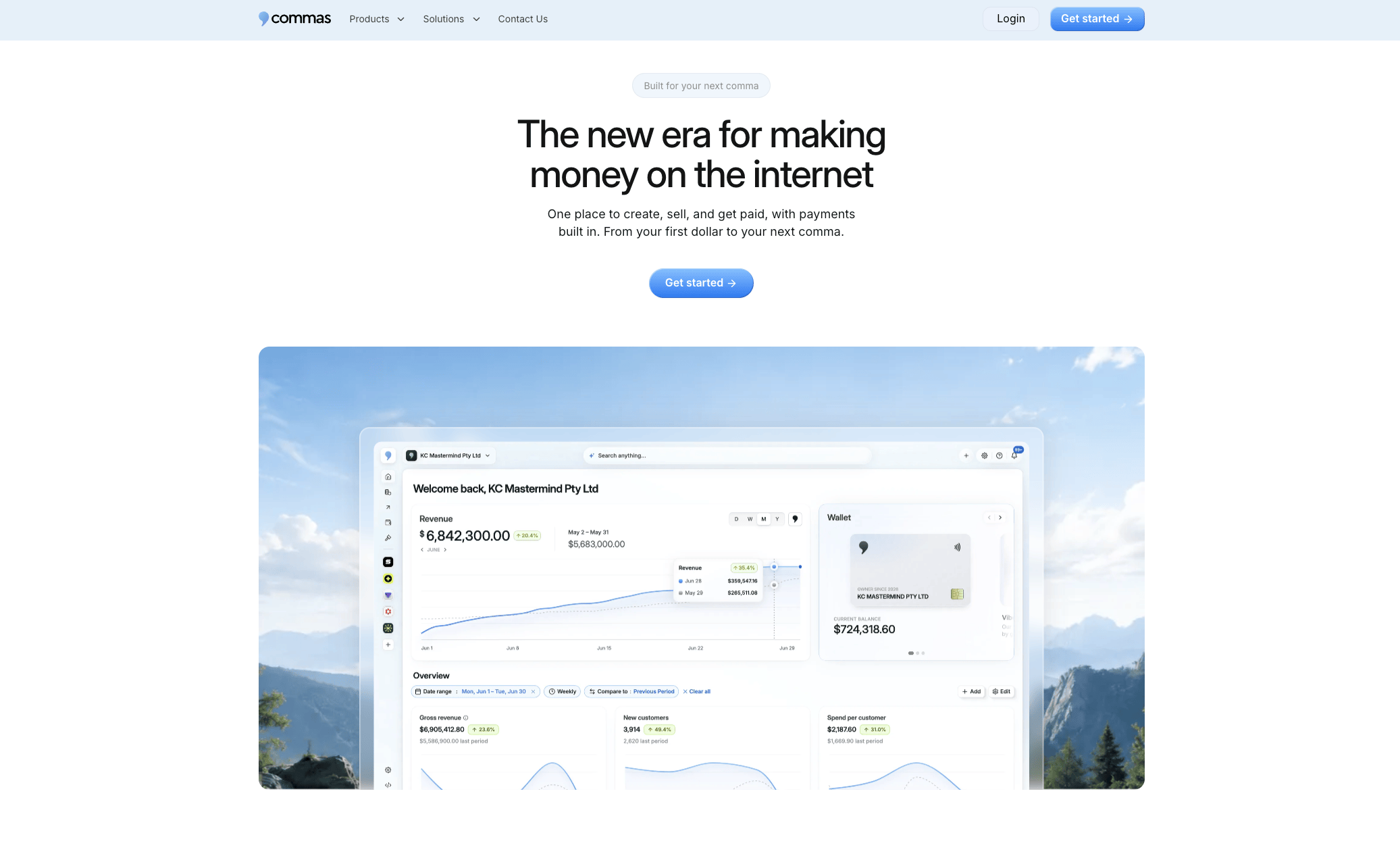
If you coach, run an agency or sell a course or membership, see how the pieces fit on the Commas site. If you are leaving another course platform at the same time, our alternatives guide for sellers of $1,000 to $10,000 offers shows how that move looks.
What makes a page convert, whichever tool you choose
Tool choice matters less than the basics. A landing page has one goal, one call to action and a message that matches the ad or email that sent the visitor. Different page types serve different jobs, and this overview of common landing page types is a good refresher.
For a high-ticket offer, add three habits:
- Show the price path early. If there are payment plans or BNPL, say so on the page, so the buyer does not discover them at checkout.
- Match the page to the buyer's temperature. Cold traffic needs a lead page. Warm traffic can go to a sales page.
- Keep the checkout inside the same look and domain as the page, so the handoff does not feel like a different company.
FAQ
What is the best Instapage alternative?
It depends on your bottleneck. For landing page testing at volume, Unbounce is the closest match. For a lower monthly cost, Leadpages. For a seller of $1,000 to $10,000 offers who wants pages, checkout, payments and delivery in one account, Commas.
Is Instapage worth the price?
It can be, if your team runs many ad-specific pages and uses collaboration, heatmaps and A/B testing, which sit on higher tiers. If your revenue problem starts after the click, a page-only tool will not solve it, and the money may work harder in a platform that includes checkout and payments.
Do I need a landing page or a full website?
A landing page has one goal and one action, which makes it right for a specific campaign. A website serves many visitors and many goals. High-ticket sellers often send campaign traffic to a funnel page and keep a website for credibility.
Can I move my existing funnels to Commas?
Yes. Commas offers funnel import and automation, which is designed to reduce rebuilding. Start by listing your live pages and integrations so you know what has to move first.
Does Commas process payments itself?
Commas runs payments through regulated payment partners. Checkout, one-click payments, BNPL and subscriptions work inside the same account as your funnels.
Sources
- Best Landing Page Builders for Marketers (10 Picks for 2026)
- Instapage vs Unbounce vs Leadpages: 2026 Comparison
- Unbounce vs Instapage 2026: Pricing, Testing, Verdict
- Choose the right tool for your pages
- Instapage vs. Competitors: Fast, Scalable Landing Pages
- Optimizing Landing Pages: Proven Strategies for 2025
- What Is a Landing Page? Definition, Types, and Best Practices
- Instapage Alternatives: Compare With Nutshell Landing Pages