

The best landing page builder depends on what happens after the click. If you only need to capture leads, a design-first tool with A/B testing is enough. If you sell a $1,000 to $10,000 offer, the page is one step in a chain that includes checkout, payment plans, upsells and delivery, and you will want a platform that handles the whole chain. This guide compares the main options by use case, explains the features worth paying for and shows where each type of tool runs out.
TL;DR
- Pick a page-first builder (Unbounce, Instapage, Leadpages) when your job is driving ad traffic to lead-capture pages and testing variants.
- Pick a lightweight tool (Carrd) for a simple one-page site, and an ecommerce builder (Shogun) if you run a store.
- Pick a funnel platform (ClickFunnels, Commas) when the page has to lead into checkout, upsells, payment plans and delivery.
- Compare on integrations, analytics, mobile editing, testing and what the tool does after the form submit, not on template count.
- Prices rise with pages, visitors and features, so confirm current plans on each vendor's own pricing page before you commit.
Table of Contents
- What a landing page builder does
- How to choose: the criteria that matter
- The main options at a glance
- Page-first builders for lead generation and ads
- Lightweight and ecommerce options
- Funnel platforms: when the page has to sell
- Our perspective: a landing page is one step in a sale
- Landing page builders for specific needs
- How to test a builder before you commit
- Where Commas fits
- FAQ
- Sources
What a landing page builder does
A landing page builder lets you create and track standalone marketing pages without writing code. Software Advice's category overview lists the core features as mobile compatibility, templates, analytics and A/B testing. Most tools also add forms, popups, custom domains and integrations with email and CRM systems.
The category is broader than the name suggests. Some products are design tools with a page editor. Others are conversion tools built around testing and traffic routing. A third group sits closer to sales software and includes checkout, subscriptions and member areas. Choosing well starts with knowing which of these three jobs you need done.

How to choose: the criteria that matter
Templates look good in a demo, but they rarely decide the outcome. These criteria do.
Integrations and data flow
Captured leads should move into your email platform or CRM without manual exports. Analytics professionals who review these tools treat CRM and email connections as critical, because they trigger nurture sequences and keep attribution intact. If you run a call-based sales process, check that the form data lands where your setters or closers work.
Testing and measurement
Tracking basics are GA4 and Google Tag Manager installation, ad pixels and UTM parameter passing, which the same analytics review names as standard requirements for measuring campaign spend. Beyond that, look for A/B testing, personalization and heatmaps. Test one variable at a time, and only when you have enough traffic to read the result.
Mobile editing
A large share of visits comes from phones, so you should be able to edit and preview the mobile layout separately instead of trusting an automatic one. Check this in a trial with your real headline and form, not the demo template.
What happens after the click
This is the criterion most comparison lists skip. A page that collects an email is finished. A page that sells a high-ticket offer still needs a checkout, a payment plan or financing option, an upsell, a receipt, access to the product and recovery when a card fails. Every tool you stitch in is another login, another bill and another place for data to break. Our own guide on how landing pages differ from sales pages covers when each page type fits the traffic and the price point.

Price drivers
Landing page software pricing is driven by the number of pages, visitors, integrations and features, according to Software Advice. Visitor caps matter most for paid traffic: a plan that looks cheap can become expensive once a campaign scales.
The main options at a glance
| Tool | Best for | Strength | Where it stops |
|---|---|---|---|
| Unbounce | Marketers and agencies running paid traffic | Testing, AI copy, traffic routing | Not a checkout or delivery platform |
| Instapage | Larger ad budgets with many ad groups | Ad-to-page personalization, heatmaps | Focused on pages, not selling |
| Leadpages | Small teams that want low cost | Affordable, simple setup | Light on funnels and payments |
| Carrd | One-page sites and simple signups | Very lightweight | Few conversion tools |
| Shogun | Ecommerce stores | Store-specific modules and integrations | Built around store catalogs |
| ClickFunnels | Sales funnels with checkout and upsells | Pages, email, checkout, memberships | Priced as a full funnel suite |
| Commas | Sellers of high-ticket offers, courses and paid communities | Pages, funnels, payments and delivery in one account | Built for selling, not for pure lead-gen design |
Page-first builders for lead generation and ads
Unbounce
Unbounce is aimed at marketers and agencies. It combines a hybrid builder with A/B testing, AI copywriting, traffic routing and lead forms. KlientBoost ranks it the best all-around choice in its 2025 review. Its plans scale by visitor volume, so look at the cap that matches your monthly ad traffic before you pick a tier.
Instapage
Instapage is built for teams that run many ad groups and want a page tailored to each one. Reviewers describe it as suited to larger ad budgets that need personalized pages, with A/B testing, heatmaps and ad-to-page personalization. Expect a pixel-precise editor, a large template library and a range of integrations. It is a strong fit when the page is the product you optimize, and a weaker one when you also need payments and delivery under the same roof.
Leadpages
Leadpages is the budget pick in KlientBoost's review, which lists it as the most affordable of its group. It suits solo operators and small teams collecting leads. If you are weighing it against tools that go further, we wrote a separate piece on Leadpages alternatives for sellers past the landing page.
Swipe Pages
Swipe Pages is AMP-first and tuned for mobile speed, according to a 2026 comparison, which makes it interesting for affiliate and paid-social traffic. G2's comparison lists its Starter plan at $39 per month with funnels, AMP pages, A/B testing and 20,000 unique visits. Check the current price before you buy, since plans change.
Lightweight and ecommerce options
Carrd
Carrd builds simple one-page sites. The free tier allows up to three one-page sites on a carrd.co subdomain, and features such as forms, custom code and custom domains need the paid Pro plan. It is a good fit for a personal page, a waitlist or a link-in-bio style page. It is not designed for testing programs or multi-step sales.
Shogun
Shogun is a visual page builder for online stores. KlientBoost's assessment places it as the strongest pick for ecommerce because it adds commerce modules and store integrations. If your business is a catalog of physical products, this category fits. If you sell coaching, courses or memberships, it is the wrong shape.
Funnel platforms: when the page has to sell
Funnel platforms put the landing page inside a longer sequence. KlientBoost describes ClickFunnels as an all-in-one sales funnel platform rather than a design-first tool. It combines drag-and-drop funnels with email autoresponders, checkout and order forms, one-click upsells, membership sites and analytics. That review reports pricing between $97 and $297 per month, or $81 to $248 per month when billed annually. It is not an official price list, so check ClickFunnels' own page for current numbers.
This is the category where Commas sits, and the next section explains how we approach it.
Our perspective: a landing page is one step in a sale
We talk to sellers every week who have a good landing page and a messy business behind it. The page is in one tool, the checkout in another, the community in a third, the webinar in a fourth and the affiliate tracking in a spreadsheet. Each handoff loses data, and each login is a place where a buyer drops out.
That is why we built Commas as one platform. You build funnels with Vibe Funnels, our AI funnel builder that applies proven funnel patterns, and the same account runs checkout, courses, paid groups, webinars and an affiliate center. Commas runs payments through regulated payment partners, and the checkout supports one-click payment, subscriptions and buy-now-pay-later options, which matter when your offer costs thousands of dollars.
Our advice is simple. If your job is to collect leads for someone else's sales team, buy a page-first builder and enjoy the testing tools. If you sell the offer yourself, choose the platform that owns the whole path from first click to delivered product, so you can see where revenue leaks in one dashboard.
Commas
Landing page builders for specific needs
Affiliate campaigns
Affiliate marketers should look for a single conversion goal per page, consistency between the ad and the page, concise copy, social proof, analytics and custom-domain support. Adsterra's guidance for affiliate landing pages stresses the same points. Speed matters too, which is why AMP-first tools appear on affiliate shortlists. If you run your own affiliate program instead of promoting someone else's, you need tracking and payouts connected to the checkout, which is what the Commas Affiliate Center is for.
Coaches and course sellers
A high-ticket coach usually needs an application or qualification step before the call, a payment plan after it and a place to deliver the program. A page-only tool covers the first third of that. A funnel platform covers the rest. Our Qualifier helps you know who can buy before the call, and Online Courses and Paid Groups handle delivery and community.
Agencies
Agencies building pages for clients prize collaboration, reusable blocks and white-label output, which is where page-first builders are strongest. If you also bill clients and collect payments, look at how agency billing and payments work on one account.
How to test a builder before you commit
Most vendors offer a free trial, so use it on a real campaign. Follow these steps.
- Rebuild your best-performing existing page, with real copy and your real form.
- Edit the mobile layout separately and check load time on a phone.
- Connect your CRM or email tool and confirm that a test lead arrives with its UTM parameters.
- Install your analytics and ad pixels, then verify events fire.
- Run one A/B test with a single variable, such as the headline.
- Push a test purchase through the whole flow if you sell directly: payment, receipt, access.
If step 6 needs three other tools, count their cost and their failure points when you compare the price of the builder.
AI features are worth testing too. AI-powered tools can reduce the effort in creating pages, writing content, testing and analyzing performance, but a generated draft still needs a human who knows your buyer. For ideas on improving a page once it is live, see this guide on optimizing landing pages.
Where Commas fits
Commas is one platform for online businesses that sell and get paid. It covers funnels, checkout, courses, paid communities, webinars and affiliates, with payments built in. It is designed for established sellers with offers from $1,000 to $10,000, not for people testing a side project.
A funnel built with Vibe Funnels starts from AI-assisted patterns and connects directly to checkout, so the page is not a separate project from the sale. Our guides on the 30-day AI sales funnel plan and on order bumps show how sellers structure what comes after the page.
If you want to see your own page inside a connected sales flow, start with Vibe Funnels.
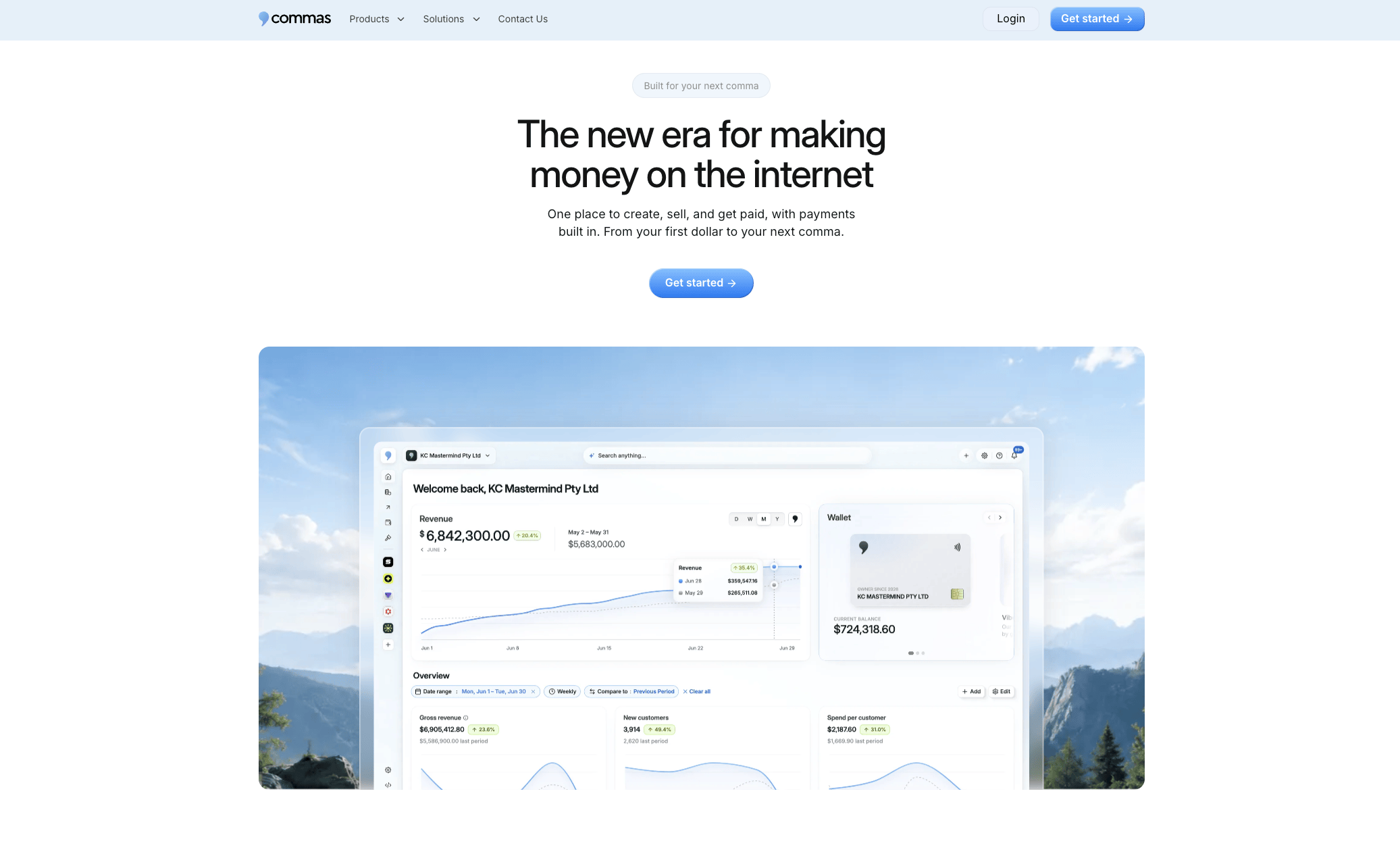
Pricing is not listed publicly for the individual products, so request a demo or start a trial from the product page to see what fits your volume.
FAQ
Which landing page builder is the best?
There is no single winner. Unbounce and Instapage lead for paid-traffic testing, Leadpages for budget, Carrd for simple pages and Shogun for ecommerce. For sellers who need pages, checkout and delivery in one account, a funnel platform such as ClickFunnels or Commas fits better.
How much does a landing page builder cost?
Prices depend on the number of pages, visitors, integrations and features, so they range widely. Reviews list entry plans from roughly $39 per month, such as Swipe Pages Starter on G2, up to funnel suites reported at $97 to $297 per month. Always confirm on the vendor's own page, and check visitor caps.
Which is the best free landing page builder?
Carrd is a common free choice, with up to three one-page sites on a carrd.co subdomain. Forms, custom code and custom domains need a paid plan, so a free tool suits a simple test more than a serious campaign.
What is the best affiliate landing page builder?
Choose a fast, mobile-first tool with analytics, custom domains and easy testing. Keep one conversion goal per page and match the page to the ad. If you run your own affiliate program, pick a platform that connects tracking to checkout.
Sources
- Best Landing Page Software, Software Advice
- The Best Landing Page Builders in 2025, KlientBoost
- Best landing page builders with A/B testing and analytics, Analytics1
- Swipe Pages vs Zoho LandingPage, G2
- Landing Page Builders 2026 comparison, Net Partners
- Build free websites and landing pages with Carrd
- Landing page builders for affiliate marketing, Adsterra
- Choosing a landing page builder, Zoho
- Optimizing landing pages, Baby Love Growth