
A lead magnet is a single, tightly scoped resource you trade for contact details, and the one rule that separates the winners from the ignored downloads is simple: pick one specific problem and solve it in under five minutes. Everything else, format, length, design, is secondary. Build your next offer around that rule before you build anything else.
TL;DR:
- Effective lead magnets focus on a single, narrow problem and offer a quick win that can be achieved within five minutes.
- The most successful formats are short videos and written content, with checklists, cheat sheets, and templates performing especially well for top-of-funnel engagement.
- Matching the magnet to the visitor’s stage in the funnel—top, middle, or bottom—ensures relevance and improves conversion rates, with specific tools for each stage.
- Building follow-up sequences that are tailored to specific actions or results from the magnet significantly increases lead quality and downstream revenue.
- Using integrated platforms that streamline hosting, delivery, and follow-up reduces friction and enhances lead conversion efforts.
Table of Contents
- Lead Magnet Ideas: Quick Rules For Higher Conversion
- What Is A Lead Magnet, And Where Does It Sit In Your Funnel?
- What Separates A Great Lead Magnet From A Forgettable One
- Lead Magnet Ideas Organized By Funnel Stage And Format
- How To Pick The Right Format For Your Audience
- How To Host, Deliver, And Follow Up Without Losing Momentum
- Copy These Mini-Templates To Launch This Week
- What We're Seeing In The Field, And One Tactic Worth Stealing
- Build, Host, And Convert Lead Magnets Without Duct-Taping Five Tools Together
- Sources
Lead Magnet Ideas: Quick Rules For Higher Conversion
Three factors decide whether a magnet converts: specificity, speed to value, and alignment with what you eventually sell. Miss any one of them and you'll collect emails nobody opens for.
- Specificity beats breadth. "5 Instagram Hooks for Local Bakeries" outperforms "The Ultimate Social Media Guide" almost every time.
- Speed to value matters more than production quality. If the reader can't get a win in five minutes, the checklist rule from AWeber's lead magnet guide says you've already lost them.
- Alignment with your paid offer keeps the leads you generate relevant to what you're actually selling.
On format, short wins. A GetResponse study found that 47% of surveyed marketers ranked short video and short written content as their top-performing lead magnet types, ahead of long-form guides and ebooks.
Pro Tip: Before you launch anything, run it through a 60-second gut check: could a stranger consume this and get one usable result before they'd normally close the tab? If not, cut it down.
Your pre-launch QA checklist should cover three things: Does it solve one narrow problem? Can it be consumed in under five minutes? Does it point naturally toward your paid product?
What Is A Lead Magnet, And Where Does It Sit In Your Funnel?
A lead magnet is a free resource, tool, or experience offered in exchange for a visitor's contact information, usually an email address. That's the transaction: value for access. But not every magnet belongs in the same place in your funnel, and treating them as interchangeable is where most lists of "lead magnet ideas" fall apart.
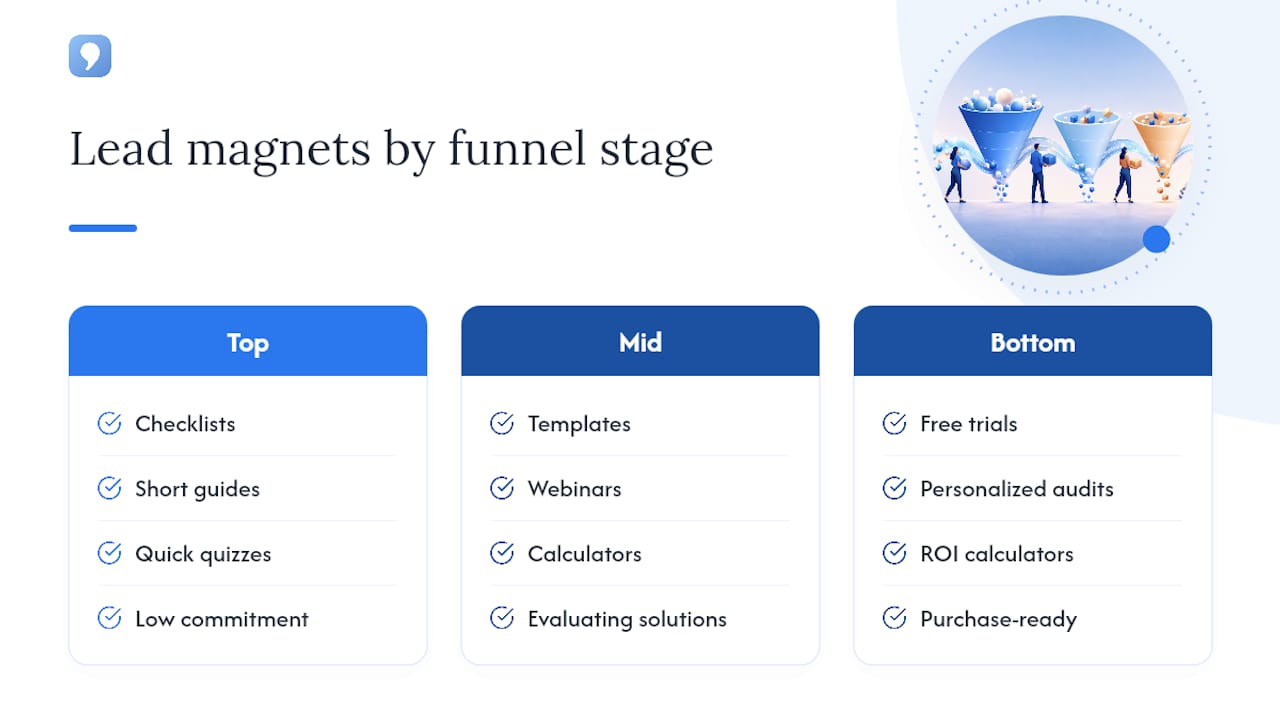
Top-of-funnel magnets target people who don't know you yet. Think checklists, short guides, or a quick quiz, low commitment, high curiosity. Mid-funnel magnets serve people already evaluating solutions: templates, webinars, calculators. These readers know they have a problem and are comparing approaches. Bottom-funnel magnets target people close to buying: free trials, personalized audits, ROI calculators tied directly to your product.
The mismatch to avoid is offering a bottom-funnel magnet (like a product demo) to a cold visitor who's never heard of you, or offering a generic checklist to someone who's already compared five competitors and just wants pricing. Match the magnet to where the visitor actually stands.
What Separates A Great Lead Magnet From A Forgettable One
Most lead magnets fail for one of three reasons: they're too broad, too slow to deliver value, or disconnected from what the business actually sells. Fix those three issues and conversion rates climb without touching your traffic or your design budget.
1. Narrow the problem until it hurts. "How to Grow Your Business" is not a lead magnet, it's a book proposal. "The 7-Question Discovery Script for Landscaping Sales Calls" is a lead magnet. The narrower the promise, the easier it is to keep, and the easier it is for the reader to judge whether it's for them.
2. Deliver the win in under five minutes. This isn't a style preference, it's the mechanism that makes lead magnets work at all. According to AWeber's guidance on building lead magnets, a resource built around one problem, solved completely, in a short amount of time, converts better than a comprehensive guide that asks for a bigger time investment upfront. A design principle from AWeber's own research treats the magnet as a minimal viable asset, closer to a one-page checklist or a three-email mini-course than a 40-page ebook, because it builds the same trust faster and gets measured more easily.
3. Align the magnet with the paid offer. If you sell bookkeeping software, a magnet about general small business motivation misses the point. A "Month-End Close Checklist" pulls in people already living the exact pain your product solves.
Three tests before you publish anything:
- The specificity test: could you rename this magnet to include a number, a role, or a narrow outcome? If not, narrow it further.
- The speed test: time yourself consuming it. If it takes longer than five minutes to get value, cut it down or split it into parts.
- The alignment test: does completing this magnet naturally raise the question your paid product answers? If someone finishes it and has no reason to think about buying from you, rework the topic.
Lead Magnet Ideas Organized By Funnel Stage And Format
Here's where most lists get lazy: they dump forty ideas with no context on when each one actually works. Below, ideas are grouped by where the visitor sits in your funnel and what it costs you to build.
Top-of-funnel magnets (for strangers who don't know you yet):
- Checklists — a single-page rundown of steps for a narrow task, cheap to build, fast to consume, and one of the highest-converting formats according to the same GetResponse survey data that ranks short content above long-form guides.
- Cheat sheets — condensed reference material (formulas, shortcuts, swipe copy) that readers keep open while they work.
- Short video walkthroughs — a three-to-five-minute screen recording solving one visible problem; video performed on par with short written content in marketer rankings.
- Blog content upgrades — a downloadable version of a popular post, expanded with a template or extra step, delivered right where the reader is already engaged.
- Infographics — visual summaries of a process or comparison, especially strong for topics that are naturally sequential or hierarchical.
Mid-funnel magnets (for people actively comparing solutions):
- Webinars — live or recorded sessions that let you demonstrate expertise while collecting registrations; pairing a webinar with a built-in checkout page turns the same session into a direct sales moment.
- Templates — fill-in-the-blank documents (a budget spreadsheet, a contract, a content calendar) that save the reader hours of setup work.
- Calculators — tools that produce a personalized number (savings estimate, pricing breakdown, timeline projection). Interactive magnets that generate a custom output create stronger intent signals than static content, according to Tajo's framework research on B2B lead magnets.
- Email mini-courses — a three-to-five-day sequence teaching one skill in digestible pieces, which doubles as your welcome sequence and your magnet at once.
- Case studies — a documented result from a real client, especially effective when the reader can see their own situation reflected in it.
Bottom-of-funnel magnets (for people close to a buying decision):
- Free audits — a personalized review of the visitor's current setup (their website, their ad account, their sales process) that surfaces gaps your product happens to fix.
- ROI calculators — tools tied directly to your pricing that show the visitor a projected return, useful for service businesses and software vendors alike.
- Free trials or demos — hands-on access to the actual product, which works best when the trial period is short enough to create urgency but long enough to show real value.
- Sample plans or blueprints — a scaled-down version of a deliverable you'd normally charge for, like a marketing plan outline or a project timeline.
Interactive tools and generators:
Quizzes, self-assessments, and generators deserve their own category because they do something static PDFs can't: they produce a result specific to the person taking them. A "Which Pricing Model Fits Your Business?" quiz or a "Is Your Funnel Leaking Leads?" assessment gives a personalized score, and personalized outputs consistently signal higher purchase intent in B2B contexts. That's a meaningful edge if you're trying to prioritize which leads your sales team calls first.
Relationship-building magnets:
Not every magnet needs to close a sale on day one. Insider newsletters, member-only content libraries, and early-access lists build a different kind of asset, ongoing trust, rather than an immediate transaction. These work especially well for community-driven brands where the long-term relationship matters more than the first conversion. If you run any kind of paid community, an early-access list to a paid group or membership can double as both a lead magnet and a pre-sell for your core offer.
One category worth calling out separately: ecommerce. If cart abandonment is your bottleneck rather than list growth, a discount code or free-shipping threshold functions well as a lead magnet in its own right, since Statista's research on cart abandonment shows pricing friction is a leading reason shoppers walk away before completing a purchase.
How To Pick The Right Format For Your Audience
Stop guessing which idea to build first. Map the visitor's intent to a format, and the choice gets a lot easier.
- The doer wants to act immediately. Give them a checklist or template they can use inside the hour.
- The comparer is evaluating options against each other. Give them a calculator, an assessment, or a comparison chart that shows where they stand.
- The bargain hunter wants a deal, not a lesson. A discount, free shipping threshold, or a bundled offer speaks their language.
- The long-term learner wants to build a skill, not just fix one problem today. An email mini-course or a webinar series fits better than a single-page download.
This mapping approach mirrors the selection framework outlined by Tajo, which ties visitor intent directly to recommended magnet type and improves relevance from the first click.
When you're choosing your first magnet, prioritize speed over ambition. Rank your candidate ideas by three factors: how fast you can build it, how fast the visitor can consume it, and how tightly it aligns with your paid product. A checklist you can finish this afternoon beats a calculator that takes three weeks to code, even if the calculator would theoretically convert better once it's live. Ship the fast one first, learn from real data, then invest in the bigger build.
Once a magnet is live, three metrics tell you whether it's working: conversion rate on the landing page, lead quality (does this audience actually match your buyer profile?), and downstream revenue (do these leads eventually purchase?). A magnet that pulls a 40% opt-in rate but produces no buyers is worse than one converting at 15% that consistently turns into paying customers.
Pro Tip: Track lead quality separately from opt-in rate for at least 90 days before killing a magnet that "isn't converting." Some of the best bottom-funnel magnets look mediocre on volume but crush it on revenue per lead.
Before launch, run this checklist: Is the promise specific enough to fit in a headline? Can it be delivered automatically without manual work on your end? Does the thank-you page point toward a next step, not a dead end?
How To Host, Deliver, And Follow Up Without Losing Momentum
Delivery mechanics matter more than most marketers assume. A brilliant checklist buried in a clunky download flow loses leads at the exact moment they were most willing to engage.
- Choose your hosting method deliberately. A plain email attachment is fast to set up but offers zero tracking. A shared Google Doc is free and easy to update but looks unpolished and can't gate access cleanly. A dedicated landing page gives you analytics and branding control but takes longer to build. An integrated platform that combines the opt-in form, delivery, and payment in one flow removes the handoff friction entirely, which matters most when your magnet leads directly into a paid offer.
- Send the welcome email within minutes, not hours. Deliver the resource immediately, restate the one problem it solves, and include a single next step, not five.
- Build a short follow-up sequence, three to four emails, spaced over five to seven days. Each email should deliver one more piece of value tied to the magnet's topic, then introduce the paid product naturally by email three or four.
- Tag leads by behavior, not just by magnet. Someone who opened every email and clicked the checkout link is a different lead than someone who downloaded and vanished. According to Sender's lead generation playbook, connecting the magnet, the capture form, lead scoring, and behavior-triggered sends is what actually moves leads through the funnel, rather than treating the download as the finish line.
For measurement, run one A/B test at a time: test the opt-in placement (inline versus popup versus dedicated page) before you test headline copy. VWO's research on lead magnet optimization found that contextual, in-content offers tend to outperform generic popups, but the only way to know for your specific audience is to test it directly rather than assume the general pattern holds.
Copy These Mini-Templates To Launch This Week
You don't need a design team to get a solid lead magnet live. Here are structures you can fill in today.
One-page checklist skeleton:
- Headline stating the specific outcome ("The 12-Point Pre-Launch Checklist for Shopify Stores")
- Three to five grouped sections (Setup, Content, Testing)
- Checkboxes under each section, five to eight per group
- One closing line pointing to your paid offer
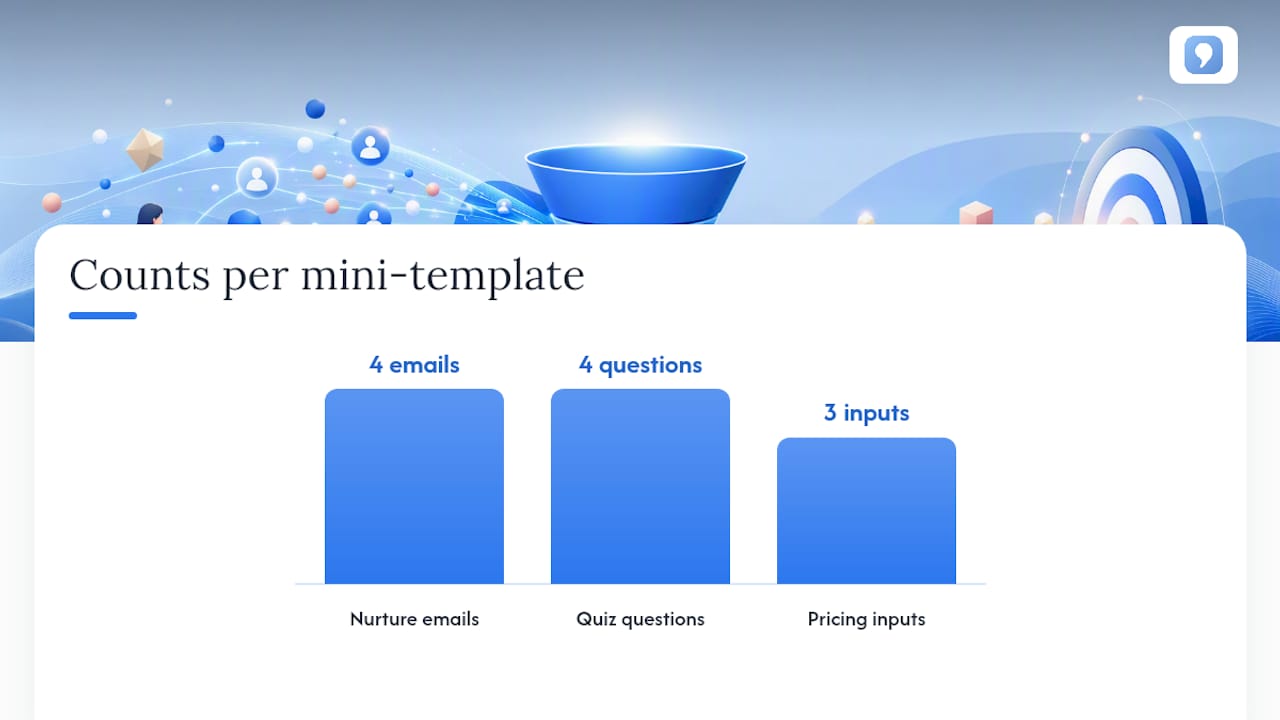
Four-email nurture sequence skeleton:
- Email 1 (immediate): deliver the magnet, set expectations
- Email 2 (day 2): share one additional tip not included in the magnet
- Email 3 (day 4): case study or result related to the magnet's topic
- Email 4 (day 6): direct offer with a clear reason to act now
Mini-template ideas worth building:
- A campaign brief template for agencies pitching new clients
- A pricing calculator outline that asks three inputs and returns a custom range
- Quiz result formats that assign the reader to one of three or four profiles, each with a tailored recommendation
Here's how this plays out in practice. A B2B software company built a "Which Automation Tool Fits Your Team Size?" quiz as a mid-funnel magnet. Visitors answered four questions, got a personalized recommendation, and were tagged by result. Leads tagged "enterprise" received a demo-request email within the hour; leads tagged "small team" received a self-serve trial link instead.
The result mattered less than the mechanism: matching the follow-up to the quiz outcome meant every lead received a next step that actually fit their situation, instead of the same generic pitch sent to everyone on the list.
What We're Seeing In The Field, And One Tactic Worth Stealing
Short video and interactive tools are eating into the dominance of the classic PDF checklist, especially in B2B, where buyers now expect a personalized output before they'll hand over an email address. A static guide still works, but the bar has moved.
The mistake we see most often isn't a bad idea, it's a magnet built too broad and then abandoned after one generic follow-up email. A "Complete Guide to Marketing" pulls the wrong leads, and a single autoresponder email afterward wastes whatever intent the download signaled.
The tactic worth stealing: build your follow-up path around the specific action the lead took, not just the fact that they downloaded something. Someone who used a calculator and got a high number should get a different next email than someone who got a low one. That single branch, built once, keeps paying off on every new lead who runs through it.
— FanBasis
Build, Host, And Convert Lead Magnets Without Duct-Taping Five Tools Together
Most of the friction in a lead magnet funnel happens in the handoffs, one tool captures the email, another hosts the download, a third handles the follow-up, and a fourth processes payment when the lead is finally ready to buy. Commas puts all four in one dashboard.

Vibe Funnels builds your opt-in and delivery flow using AI patterns pulled from proven funnel structures, so you're not starting from a blank page. If your magnet is a webinar, Commas lets you run the session with checkout built into the same room, so a viewer who's ready to buy doesn't have to leave to find a payment page. And because Commas handles tagging leads by behavior before they ever reach a sales call, your bottom-funnel magnets, audits, calculators, trials, can automatically route high-intent leads to the right follow-up without manual sorting.
If you're tired of your checklist living in one app, your email sequence in another, and your checkout in a third, take a look at the Commas platform and see what a single connected funnel looks like end to end.
Sources
- Best Lead Magnets for Lead Generation Study Report
- How to create a lead magnet
- Lead Magnet Ideas: 30 Examples, Selection Framework, Delivery Workflow, and QA Checklist (2026)
- Lead Generation Guide: The Complete Playbook 2026