

AI A/B testing uses machine learning to run the experiment for you: it drafts variations, shifts traffic toward the version that is winning while the test runs, and reports the outcome. A classic split test keeps a fixed split and waits for a verdict. For a seller of a $1,000 to $10,000 offer, the practical question is not which method is newer. It is which one gives you a result you can act on with the traffic you actually have.
This guide covers how AI testing differs from the traditional kind, which parts of a funnel it can improve, how a small team can run a test without an analyst, and the safeguards that keep a "winner" from being noise.
TL;DR
- AI A/B testing automates hypotheses, traffic allocation and reporting. Traditional testing splits traffic evenly and decides at the end.
- Shifting traffic toward a leader earns more during the test, but it gives you a less reliable read on how big the difference really is.
- Checking a dashboard daily and stopping at the first good-looking number can inflate false positives. Set the stopping rule before you launch.
- AI is an accelerator, not an autopilot. You own the offer, the price and the positioning.
- On a high-ticket funnel, test the page and the checkout, and let AI handle drafts and setup, not strategy.
Table of Contents
- What AI A/B testing is
- How it differs from a traditional split test
- Where AI helps in a sales funnel
- AI funnel templates and how to adapt them
- Running an AI-assisted test without a technical team
- Making sure the result is reliable
- A short checklist before you trust a winner
- Build and test funnels in one place
- FAQ
- Sources
What AI A/B testing is
An A/B test compares two versions of something, a page, an email, a checkout step, to see which one produces more of the action you care about. The AI version keeps that logic and automates the labor around it. One overview of the method describes AI testing as using algorithms to generate data-backed hypotheses, allocate traffic dynamically and produce automated reports, in contrast to the manual, linear way traditional tests run.
In practice, three jobs move from you to the software:
- Idea generation. Instead of staring at a blank page, you get draft headlines, calls to action and layouts.
- Traffic allocation. The system watches results as they arrive and sends more visitors to what is working.
- Reporting. Results are summarized and sometimes interpreted, so you do not need to build a spreadsheet.
The thing that does not move is the decision about what is worth testing. That still depends on knowing your buyer.
How it differs from a traditional split test
The core difference is what happens to traffic while the test runs. Salesforce's explainer puts it this way: AI-driven testing allocates traffic dynamically and optimizes continuously, while traditional testing generally uses fixed splits and analyzes results to reach a final decision.
Instapage's help documentation describes the same pattern in a landing page tool. A traditional A/B/n test splits traffic evenly and runs until enough visitors show a clear winner. Its AI experiments begin with an even split, then send more traffic to higher-converting variations over time.
| Traditional A/B test | AI-assisted test | |
|---|---|---|
| Traffic split | Fixed, usually even | Shifts toward the leader as data arrives |
| Decision point | At the end, once there is enough data | Continuous |
| Setup effort | You write variations and hypotheses | AI drafts variations and suggests hypotheses |
| Best for | Learning why something won | Capturing conversions while you learn |
| Main risk | Slow, and visitors keep seeing the loser | Weaker evidence on the size of the gap |
That last row matters. A write-up on bandit-style testing notes that moving traffic toward the better version during the test earns more than a fixed split, but gives you less reliable evidence about how large the difference is. If you want to know that a new headline lifts conversion by a certain amount before you roll it across five funnels, a fixed split is the cleaner instrument. If you just want the better page to take more of the traffic, adaptive allocation is fine.
Where AI helps in a sales funnel
AI is not equally useful at every stage. Monday.com's overview lists lead scoring, email nurturing and personalized recommendations as tasks AI can automate, spanning awareness through post-purchase loyalty. An academic review in the Journal of Business-to-Business Marketing found AI is most effectively used today in lead qualification and account service, with untapped room in opening relationships and presenting sales messages.
For a seller of a high-ticket offer, that translates into a rough map:
- Landing or opt-in page. Good territory for testing headlines, proof placement and the form. Our notes on optimizing landing pages cover the basics worth fixing before you test anything clever.
- Application or booking step. Qualification is where AI has the strongest track record, so this is where automated scoring and routing pay off.
- Checkout. Payment options, order bumps and the wording around the guarantee are all testable. A $5,000 offer converts or stalls here depending on whether the buyer can split the payment, so payment plan presentation is a worthwhile test.
- Post-purchase. Upsell and onboarding sequences are a second place to test, because the buyer has already said yes once. We go deeper on this in our piece on upsell versus cross-sell.
- Recovery. Failed subscription charges and abandoned checkouts quietly leak revenue, and sequences for recovering them are testable like any other step.
Before you test, make sure you are matching traffic and price to the right page. Our comparison of landing pages and sales pages covers that decision.
AI funnel templates and how to adapt them
A funnel template is a pre-built sequence of pages and steps for a common goal: a webinar registration, a course sale, an application funnel for coaching, a paid community join page. An AI funnel builder uses a template as a starting structure, then fills in copy and layout based on what you tell it about your offer and audience.
Treat the template as a first draft, and adapt three things before you publish:
- The price tier. A $197 course can sell from a short page with one-click checkout. A $5,000 coaching program usually needs more proof, a call or application, and a clear payment plan. Pick a template built for your price band, not the one with the best-looking preview.
- The buyer's awareness. Cold traffic needs education. Warm traffic from your list or a webinar needs less. Cut steps the buyer has already been through.
- Your proof. Replace every placeholder testimonial and number with your own real ones. Generic proof is the quickest way to make a funnel feel like a template.
Then test one element at a time against the template's default. The default is your control.
Running an AI-assisted test without a technical team
You do not need a developer or a statistician to start. Pipedrive's SMB guide notes that visual editors let you build page variations without code, and that generative tools can draft variations such as call-to-action copy in minutes from a prompt, then help with reports and interpretation.
A workable routine for a small team:
- Pick one page with real traffic. Testing a page that gets a handful of visitors a week teaches you nothing.
- Write a one-line hypothesis. For example: "Naming the payment plan above the fold will increase checkout starts because buyers see the monthly cost early."
- Ask AI for three to five variants, then edit them. Cut anything that makes a claim you cannot back up. Do not promise results you cannot guarantee.
- Change one thing. If the headline, image and button all differ, you will not know which mattered.
- Define the success metric and the stopping rule first. Purchases or booked calls beat clicks.
- Run it, then document it. Write down what you tested, what happened and what you will do next.
Making sure the result is reliable
This is where most teams get hurt. Software will happily declare a winner after 40 visitors.
Do not stop at the first good number
Researchers studying online experiments found that checking a standard A/B dashboard continuously, without correction, can inflate the rate of false positives, sometimes up to fivefold even with 10,000 observations. The same paper proposes methods that remain valid however often you peek. If your tool says it uses sequential or "always valid" statistics, that is the feature you want. If it does not, decide your sample size and end date up front and leave the test alone until then.
Measure what pays you
For a high-ticket offer, a variant that wins on email sign-ups can lose on revenue. Track the metric closest to money: completed purchases, booked and attended calls, revenue per visitor and refund or failed-payment rates. Low volume is the norm at these price points, so run tests longer and test bigger changes rather than button colors.

Keep humans in the loop on simulated results
Some tools use AI agents to simulate visitors. Researchers on that approach position it as a low-cost, faster complement to human testing, useful for prototyping and pre-launch checks. Another 2026 paper points out that AI-generated stand-ins can be biased because they cannot perfectly replicate how real people respond, so tests on real traffic remain the standard for conclusive proof. Use simulation to narrow ideas, then confirm on real buyers.
Start with simple rules when data is thin
On lead scoring, Rework's guide says a simple rules-based score is a better first step than a model when CRM data is thin or inconsistent. If you have a few hundred contacts, a rule like "booked a call and visited pricing" will serve you well.
Keep ownership of strategy
Omniconvert's framing is a useful one: AI is an accelerator, not an autopilot. It handles data-heavy work like hypotheses and traffic allocation, while people keep the strategic and brand decisions. Pipedrive's guide similarly advises checking AI results against expert judgment and your business goals.
A short checklist before you trust a winner
- The test ran for the planned duration, covering full weeks so weekday and weekend behavior both appear.
- Each variant had enough conversions, not just visits, to compare.
- The winner also holds on the metric closest to revenue.
- Nothing else changed on the page, in the ad or in the offer during the test.
- You can explain in one sentence why the winner won. If you cannot, treat it as a lead for the next test, not a law.
Perspective
We build Commas around one belief: most revenue leaks live in the gaps between tools. When the page builder, the checkout, the course, the community and the webinar room each sit in a different app, nobody can see the whole path a buyer takes, and nobody can test it end to end.
That is why we put funnels and payments in one account. Vibe Funnels is our AI funnel builder, designed to optimize funnels using proven patterns without manual input. Because checkout lives in the same place as the funnel, the step where a buyer chooses a one-click payment, a payment plan or buy now, pay later is part of what you can improve, not a separate system you have to reconcile later. Commas runs payments through regulated payment partners, and we also build automated tools to help recover failed subscriptions.
Our view on AI testing is simple. Let it do the drafting, the setup and the traffic shifting. Keep the offer, the price and the promise in your own hands. The sellers who get the most from it are the ones who test fewer, bigger ideas on pages with real traffic.
Commas
Build and test funnels in one place
If you sell a $1,000 to $10,000 offer, your test results are only as useful as your ability to act on them. Vibe Funnels gives you drag-and-drop funnel creation, funnel import, upsell management and analytics, with checkout and subscriptions in the same dashboard. You can see how funnel templates and AI-assisted building work with your own offer, rather than judging from screenshots.
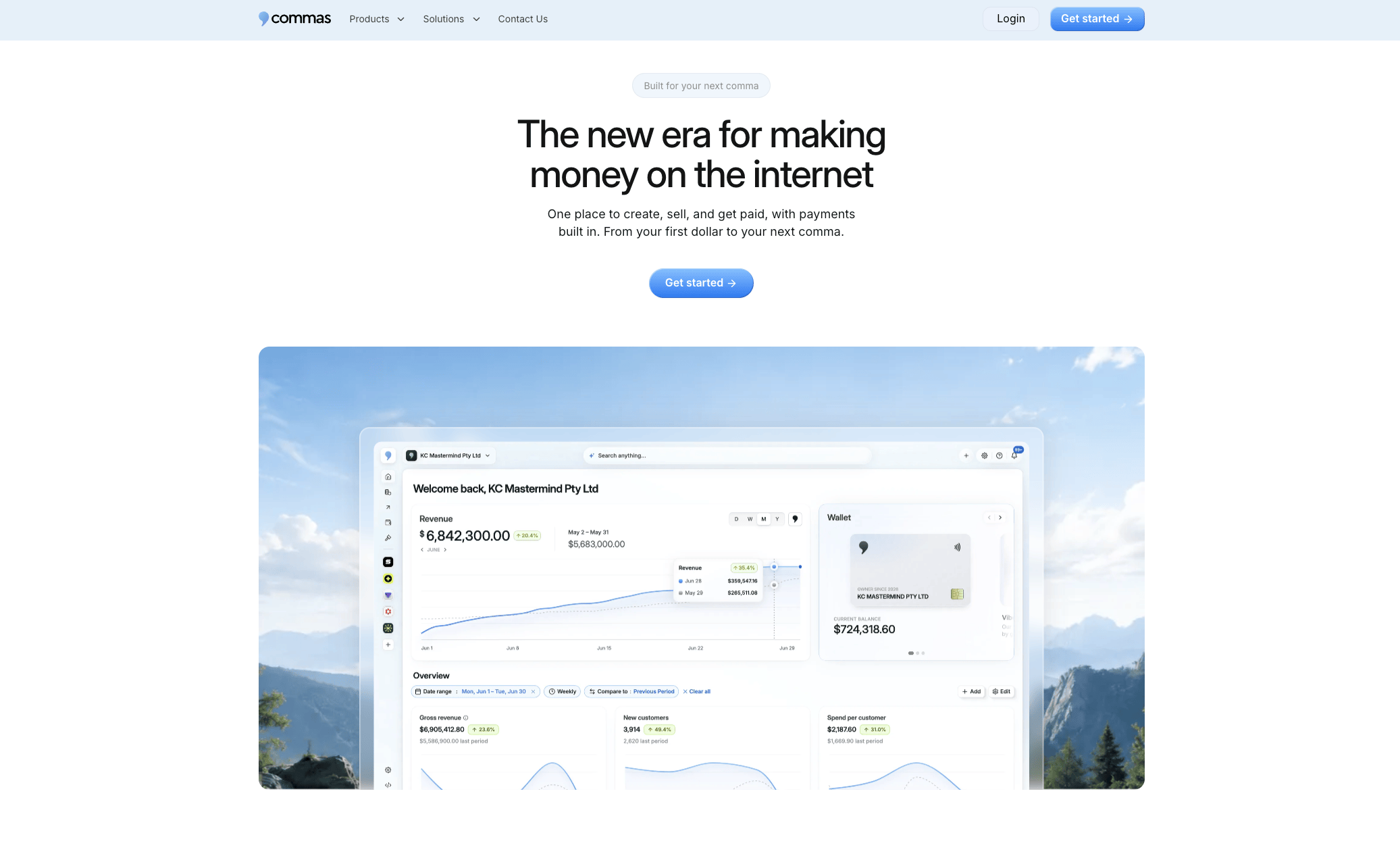
If checkout is where your funnel stalls, look at Commas Payments for one-click payments, subscriptions and buy now, pay later options. If your offer includes a program or community, online courses and paid groups live in the same account, so buyers move from purchase to delivery without leaving it. For a practical rollout, our 30-day AI sales funnel plan and the guide to funnel automation show how to sequence the work.
FAQ
What is the difference between AI A/B testing and regular A/B testing?
Regular A/B testing splits traffic evenly and waits for enough data to declare a winner. AI A/B testing automates hypotheses, variation drafting and reporting, and often shifts traffic toward the better performer while the test runs. The trade-off is that adaptive allocation gives you less reliable evidence about how big the gap between versions is.
Do I need a lot of traffic to use AI A/B testing?
Yes, enough that each version collects a meaningful number of conversions. If your offer is high-ticket and traffic is modest, test larger changes such as the offer framing, the payment plan presentation or the page structure, and let tests run longer. Small tweaks need far more data to detect.
Can AI write the variations for me?
Yes. Generative tools can draft headlines and calls to action from a prompt in minutes. Edit every draft for accuracy, remove claims you cannot support, and keep your own voice so the page still sounds like your business.
Is it safe to check results every day?
Only if your tool uses statistics built for continuous monitoring. Looking repeatedly at an ordinary test and stopping when it looks good can inflate false positives. Otherwise, set the sample size and end date first and hold to them.
Sources
- AI A/B Testing: What It Is and How It Works (2026 Guide), Omniconvert
- What is A/B Testing?, Salesforce
- AI Experiments, Instapage Help Center
- AI A/B Testing: What AI Can and Cannot Do for Your Tests, Convertica
- AI Sales Funnels: Boost Conversions and Automate Growth, Monday.com
- Artificial Intelligence Applications in the B2B Sales Process, Journal of Business-to-Business Marketing
- Always Valid Inference: Continuous Monitoring of A/B Tests, arXiv
- Agent A/B: Automated and Scalable Web A/B Testing, arXiv
- Statistical Foundations of LLM-based A/B Testing, arXiv
- AI Marketing Use Cases by Funnel Stage, Rework
- Optimizing Landing Pages: Proven Strategies for 2025