
An upsell asks a customer to buy a better version of what they already want. A cross-sell asks them to add something complementary that solves a different, related need. Upselling typically lifts average order value by 10 to 30%, while personalized offers of either type can convert at 15 to 30%. Use upsells when the customer is already committed and just needs a nudge upward; use cross-sells when they need something adjacent to what they just bought.
TL;DR:
- Upselling increases revenue per transaction by 10 to 30%, especially effective when customers are already committed to a purchase.
- Cross-selling supports the primary sale by introducing complementary products or services, with higher acceptance rates but smaller per-transaction gains.
- Proper timing and relevance are critical; upsell offers work best on product pages and at renewal, while cross-sells are more effective at checkout or post-purchase.
- Overly aggressive cross-sell tactics risk damaging customer trust and causing negative feedback, exemplified by the Wells Fargo scandal.
- Testing should focus on personalized, benefit-led framing, placement, and offer type, with metrics like acceptance rate and revenue lift guiding optimization.
Table of Contents
- Upsell vs Cross-Sell: Definitions and Examples
- Which One Should You Test First?
- When Should You Offer an Upsell vs a Cross-Sell?
- How to Frame the Offer and What to Test
- What Metrics Actually Prove These Tactics Are Working
- SaaS vs Ecommerce: The Execution Actually Differs
- The Risks Nobody Talks About Until It's Too Late
- How Commas Approaches Upsells and Cross-Sells
- Run Your Upsell and Cross-Sell Offers Without Duct-Taping Five Tools Together
- Sources
Upsell vs Cross-Sell: Definitions and Examples
An upsell offers a higher-value version of the exact thing the customer is already buying or using: more capacity, a better tier, an upgraded model. A cross-sell offers something different but complementary: an accessory, a related service, a second product that fills a gap the first one leaves open.
In ecommerce, the pattern shows up constantly. A shopper buying a 13-inch laptop gets shown the 16-inch model with more memory. That's an upsell. The same shopper then gets offered a laptop sleeve or a two-year warranty at checkout. That's a cross-sell.
SaaS follows the same logic with different mechanics:
- Upsell examples: A team on a 10-seat plan gets prompted to move to a 25-seat plan before they hit the cap. A user on a "Basic" analytics tier gets offered "Pro" with advanced reporting once they've run 50 reports in a month.
- Cross-sell examples: A project management customer gets offered a time-tracking add-on. A customer using a scheduling tool gets offered SMS reminders as a bolt-on service.
Service businesses cross-sell constantly too: a dentist recommending whitening after a cleaning, a consultant pitching a training workshop alongside a strategy engagement.
Bundles blur the line on purpose. A "starter kit" that packages a base product with two accessories is technically a cross-sell dressed up as a single offer. The test that matters isn't the label. It's whether the customer intent is "more of this" (upsell) or "also this" (cross-sell). Both tactics increase revenue per customer without raising acquisition costs, just through different mechanics: one deepens the transaction, the other widens it.
Which One Should You Test First?
The two tactics behave differently enough that running them interchangeably wastes budget and annoys customers. Here's the practical comparison:
- What you're offering. Upsell: more of the same category, priced higher. Cross-sell: a different category that supports the primary purchase.
- Customer intent at the moment of offer. Upsell fits a customer who's already decided to buy and is choosing between tiers. Cross-sell fits a customer who's finished deciding and is now open to "what else do I need?"
- Typical revenue effect. Upsells tend to drive a bigger jump per transaction because they replace a purchase with a pricier one. Cross-sells often see higher raw acceptance because add-ons carry lower friction, even though the per-transaction dollar amount is usually smaller.
- Recommended placement. Upsells work best on the product page or at renewal. Cross-sells work best at checkout or in a post-purchase follow-up.
- Risk to the primary sale. An upsell offered too early can make the customer second-guess the purchase entirely. A cross-sell offered too aggressively can feel like a bait-and-switch on price.
Before launching either, run this checklist:
- Confirm the offer is relevant to what the customer just viewed or bought, not just "what's expensive."
- Cap the number of offers shown at one per touchpoint, not a stack of five.
- Test the upsell against a no-offer control to isolate its actual lift.
- Set a clear opt-out or dismiss path so the offer never feels forced.
If you're short on testing time, start with post-purchase upsells in ecommerce and mid-lifecycle cross-sells in SaaS. Both have the clearest acceptance data to benchmark against, and both are low-risk to the original sale since it's already closed.
When Should You Offer an Upsell vs a Cross-Sell?
Timing decides whether either tactic works, and the signals aren't subtle once you know what to watch for.
Signals that point to an upsell:
- The customer is hitting a usage ceiling, like a seat limit, storage cap, or API rate limit.
- They've asked support or sales about a feature that only exists in a higher tier.
- A renewal date is approaching, which 37% of sales professionals identify as the optimal moment to present an upgrade, right after a project goal has been met.
Signals that point to a cross-sell:
- The customer asks how your product integrates with another tool they use.
- Support tickets reveal a workflow gap your core product doesn't cover.
- The customer just hit a first-success milestone, like completing onboarding or shipping their first campaign.
Placement follows naturally from these signals. Product pages are the right spot for upsells because the customer is still comparing options. Checkout and post-purchase screens work better for cross-sells because the primary decision is already made. Onboarding email sequences and renewal reminders are where SaaS teams should concentrate upsell energy, since 42% of sales professionals say understanding customer needs drives their upsell strategy more than any script or discount.
Pro Tip: Don't pitch an upgrade to a customer who's still waiting to see results from what they already bought. Wait for a documented win, then anchor the upsell to that milestone directly: "You hit X, here's what unlocks Y."
A common sequencing pattern that works well: trigger a one-click post-purchase upsell immediately after checkout, then follow with an educational cross-sell email 7 to 10 days later once the customer has had time to use the core product.
How to Frame the Offer and What to Test
Good upselling techniques start with framing, not discounting. The strongest offers sell the next step in the customer's success, not just a bigger number on a price tag. Practitioners consistently emphasize leading with benefits over features: instead of "upgrade to Pro for $49/mo," try "unlock the reporting your team already asked for."
Personalization signals worth collecting before you build the offer:
- Purchase or usage history (what they own, how much of it they use).
- Behavioral signals like pages viewed, features clicked, or support tickets filed.
- Lifecycle stage: new customer, mid-tenure, or approaching renewal.
You don't need a data warehouse to start. Even basic segmentation, like "customers who used feature X three times last week," beats a generic offer shown to everyone.
Pricing tactics differ by tactic type. Upsells generally work best framed as incremental cost for a proportionally bigger gain, like "$20 more for triple the storage." Cross-sells work well as small order bumps ("add this for $8") rather than a second full-price decision. Bundling both product and add-on into one checkout step tends to outperform sequential offers, since it removes a decision point rather than adding one.
Xero's guide notes that when offers are personalized to purchase behavior, conversion rates land between 15 and 30%, roughly double the rate of a generic, unsegmented offer.
Suggested A/B tests to run:
- Offer copy: feature-led vs benefit-led framing.
- Placement: product page upsell vs post-purchase upsell.
- Discounted upgrade vs full-price upgrade with added value framing.
- Single offer vs a two-option choice (good/better).
Pro Tip: Run one test at a time per placement. Stacking a new offer copy test on top of a new placement test at once makes it impossible to know which change moved the number.
Relevance beats frequency almost every time. A single, well-targeted offer consistently outperforms multiple low-relevance exposures, which is worth remembering before adding a third pop-up to your checkout flow.
What Metrics Actually Prove These Tactics Are Working
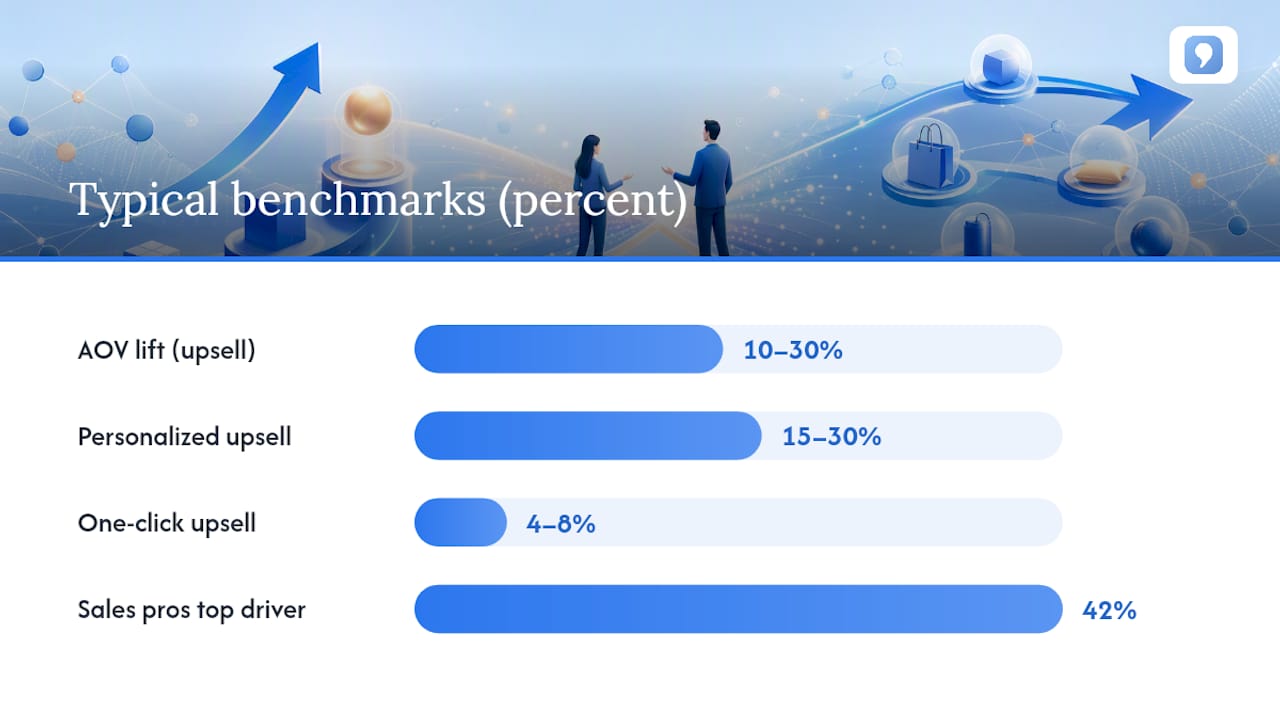
Track five numbers, not fifteen. Average order value (AOV), acceptance rate (the percentage of customers who take the offer), expansion MRR or net revenue retention for SaaS, conversion uplift against a no-offer control group, and customer lifetime value (CLV) over a 6 to 12 month window.
Benchmarks give you something to measure against instead of guessing:
| Metric | Typical Benchmark | Context |
|---|---|---|
| AOV lift from upselling | 10 to 30% | Xero |
| Personalized upsell conversion | 15 to 30% | Behavior-based targeting |
| One-click post-purchase upsell acceptance | 4 to 8% | Upsell |
| Sales pros citing "understand needs" as top upsell driver | 42% | HubSpot |
One happens seconds after checkout with a cold, one-click interaction; the other happens after weeks of behavioral data collection. Comparing them directly is like comparing a vending machine sale to a consultative pitch.
Attribution matters more than most teams realize. Separate acquisition revenue (new customers, first purchase) from expansion revenue (upsell and cross-sell dollars from existing customers) in your reporting from day one. Blending them hides whether your growth is coming from new demand or from squeezing more out of the customers you already have, and those require completely different fixes when they slow down.
SaaS vs Ecommerce: The Execution Actually Differs
The mechanics of upsell vs cross-sell strategy shift hard between subscription software and product sales.
- SaaS priorities: tier structure, seat-based pricing, renewal timing, and ROI-driven messaging. A SaaS upsell succeeds or fails based on whether the higher tier's ROI is obvious before the price is even mentioned.
- Ecommerce priorities: checkout order bumps, accessory attachment rates, extended warranties, and one-click post-purchase flows. Ecommerce cross-sells live or die on how frictionless the "add to cart" moment feels.
- Sales motion changes the timing. A sales-led SaaS deal has a human rep who can pitch an upsell mid-conversation, tied to a documented outcome. A product-led SaaS flow or a pure ecommerce store has to earn that same trust through in-app prompts or checkout copy, with no rep to read the room. That's why product-led upsell acceptance rates lean more heavily on timing and personalization data than on persuasion.
The Risks Nobody Talks About Until It's Too Late
The clearest cautionary tale in cross-selling history is the Wells Fargo scandal, where aggressive, unearned cross-sell quotas led employees to open accounts customers never asked for. The fallout was regulatory, financial, and reputational, and it still gets cited as the textbook example of what happens when cross-selling becomes a mandate instead of a genuine fit.
Guardrails that actually hold up in practice:
- Cap it at one high-value offer per touchpoint, never a wall of add-ons.
- Set a relevance threshold: if the offer doesn't map to a real signal from that customer, don't show it.
- Always give a visible, one-click way to decline or dismiss the offer.
- Watch for drops in checkout completion, spikes in support complaints, or rising unsubscribe rates after launching a new offer, and pull it fast if any of those move.
Poorly executed cross-selling erodes trust faster than almost any other growth tactic, precisely because it happens at the moment customers are already deciding whether to trust you with their money.
How Commas Approaches Upsells and Cross-Sells
Commas treats upsells and cross-sells as funnel design decisions, not afterthoughts bolted onto a checkout page. Because payments and funnel logic sit in the same account, a creator can set a post-purchase upsell to fire the instant a payment clears, no separate integration, no lag between the primary sale and the offer.
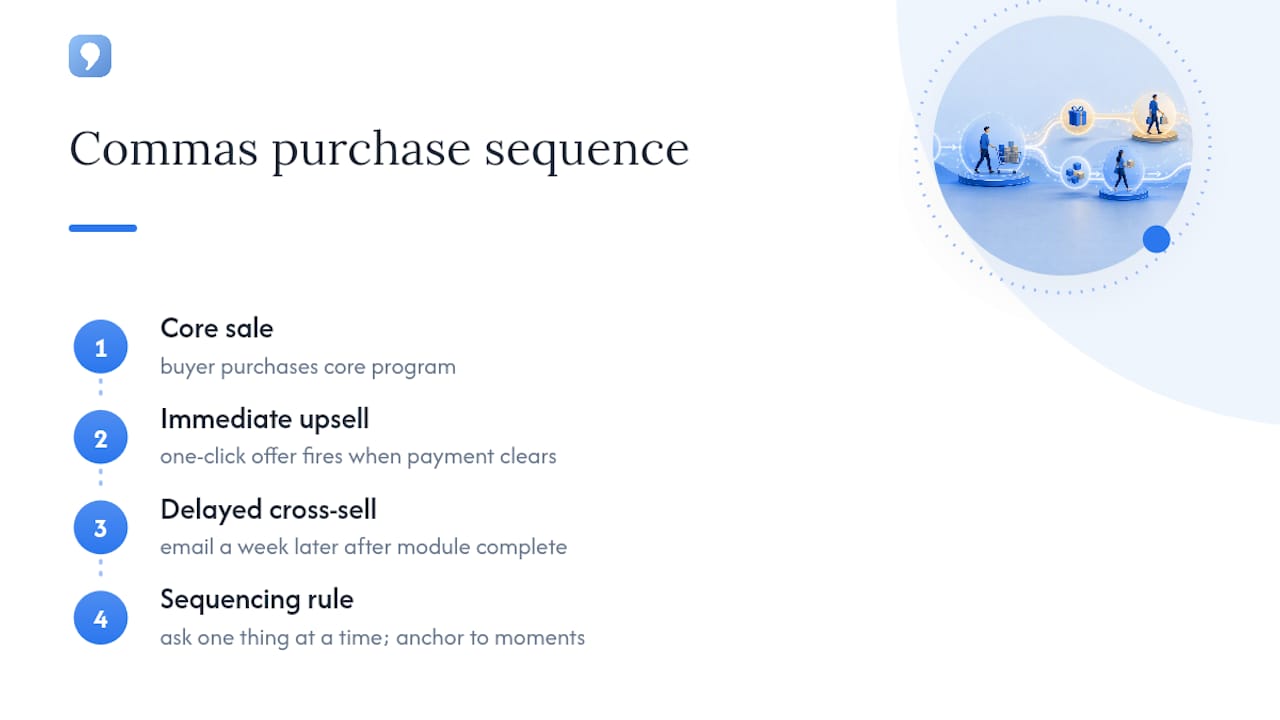
A typical sequence: a course creator sells the core program, triggers a one-click upsell for a coaching add-on immediately after checkout, then follows with a cross-sell email for a community membership a week later, once the buyer has finished the first module.
The pattern holds regardless of product type: sequence the ask, anchor it to a real moment, and never offer more than one thing at a time.
— FanBasis
Run Your Upsell and Cross-Sell Offers Without Duct-Taping Five Tools Together
Most of the friction in upsell and cross-sell execution doesn't come from bad strategy. It comes from stitching together a checkout tool, an email platform, and a funnel builder that don't talk to each other. Commas puts payments, funnels, and offer logic into one account, so a post-purchase upsell can fire the second a transaction clears instead of waiting on a third-party integration to catch up.

Two features map directly to what this article covers. Vibe Funnels builds AI-assisted funnel sequences, including the upsell and cross-sell placements discussed above, without requiring a separate design tool. Integrated payments handle the one-click charge behind a post-purchase offer, which is exactly the mechanic behind that 4 to 8% acceptance benchmark. If you're running a course, community, or SaaS product and want to test a sequenced offer without hiring a developer, start building a funnel with Commas and set up your first upsell this week.