

The best Kajabi alternative depends on what is breaking in your business today. Thinkific and Teachable suit course-first catalogs. Circle suits community-first businesses. Systeme.io and GoHighLevel suit funnel-heavy setups. Commas suits sellers who want checkout, funnels, courses, paid groups, webinars and affiliates in one account, with payments built in. Below is how each type of option fits, what to check before you move, and how to migrate without interrupting sales.
TL;DR
- Kajabi bundles hosting, email, pages and courses. The usual reasons sellers look elsewhere are monthly cost, payment fees and a stack that still needs add-ons for high-ticket checkout.
- Pick by your bottleneck: course delivery, community, funnel conversion or payment collection. Few tools lead on all four.
- At $1,000 to $10,000 per sale, installments, failed-payment recovery and refund handling matter more than a template library.
- Before switching, confirm eligibility, payout route, checkout options and total fees, then run a live test purchase and refund.
- Commas puts payments, funnels, courses, paid groups, webinars and affiliates in one dashboard, so fewer tools sit between a buyer and your offer.
Table of Contents
- Why established sellers look past Kajabi
- How to choose: start with your bottleneck
- The main Kajabi alternatives compared
- What we recommend for $1,000 to $10,000 offers
- What to check about payments before you switch
- How to migrate from Kajabi without pausing sales
- Perspective: what we see when sellers leave all-in-one stacks
- Where Commas fits
- How to pick in one afternoon
- FAQ
- Sources
Why established sellers look past Kajabi
Kajabi is a capable all-in-one product, and plenty of businesses run well on it. The reasons people search for alternatives tend to be practical rather than ideological.
Price steps. One 2026 pricing breakdown lists Kajabi plans at $179, $249 and $499 a month on monthly billing, with annual billing lowering each. Plan tiers also gate things such as AI credits and the branded mobile app. If you want one feature from a higher tier, you pay for the whole tier.
Payment fees stack on top. The same breakdown lists card fees on Kajabi Payments that vary by plan, plus an extra fee when you connect your own Stripe account. On a $5,000 sale, a percentage point is $50, and it repeats on every installment. Our guide to what a $2,000 course sale really costs walks through how platform, processing and refund costs add up.
High-ticket checkout needs more than a buy button. Sellers at this level usually want split payments, subscription recovery, upsells after the first payment and a clean refund process. Some of that comes from add-ons or separate tools, which is how a stack gets fragmented again.

One vendor holds the whole business. When pages, email, courses and payments live in one place, switching one piece is hard. That cuts both ways: it is convenient, and it is also why a migration plan matters.
How to choose: start with your bottleneck
A useful comparison starts with the problem, not the feature list. Ask which of these describes you:
- Delivery is the problem. Students stall, completion is low, content is hard to organize.
- Retention is the problem. Buyers finish the program and drift away, and you want a paid community or membership.
- Conversion is the problem. Traffic arrives, but the funnel from webinar or application to checkout leaks.
- Collections are the problem. Declined cards, abandoned installment plans, chargebacks and refunds eat margin.
- Tool sprawl is the problem. You pay for five logins and spend time on glue work.
Most lists of alternatives rank by price. For a $1,000 to $10,000 offer, rank by how much revenue you keep and collect, then by how much work it takes to run.
The main Kajabi alternatives compared
Prices change often, so the table describes where each option fits and leaves current pricing to each vendor's own page. Confirm plan limits and fees there before you decide.
| Option | Best fit | Strength | What to confirm before switching |
|---|---|---|---|
| Commas | Established sellers who want checkout, funnels, courses, groups, webinars and affiliates together | Payments and funnels in the same account as delivery | Your country, offer type and plan scope with our team |
| Thinkific | Course-first catalogs | Dedicated course structure | Transaction terms, community and funnel needs |
| Teachable | Course sellers wanting simple setup | Straightforward course publishing | Fee structure by plan, checkout flexibility |
| Podia | Lighter catalogs, solo operators | Simple, low-overhead interface | Depth of funnel and installment features |
| Circle | Community-led businesses | Community spaces and events | Course depth, payments and funnels around it |
| Systeme.io | Budget-minded funnel builders | Funnels and email in one tool | Payment gateway options, design flexibility |
| GoHighLevel | Agencies and marketers building custom automations | Broad CRM and automation toolset | Setup time, learning curve, who maintains it |
| SamCart | Checkout-focused sellers | Checkout and order bump emphasis | Course and community delivery elsewhere |
Each of these is a real product with real customers. The difference lies in what is native and what you bolt on.
Course-first tools: Thinkific and Teachable
These platforms center on the curriculum: modules, lessons, quizzes and certificates. If your offer is mostly a structured program and your sales happen on pages you build elsewhere, they cover the delivery side well. At a high price point, the questions to ask are how installments work, how failed payments are retried and whether community lives inside the same account.
Light and low-cost: Podia and Systeme.io
Podia is often picked by smaller operators who want less to manage. Systeme.io is popular with sellers who want funnels and email together at a low entry cost. Both can work. If you are selling $5,000 programs with application calls, upsells and payment plans, check how much of that you can configure natively.
Community-first: Circle
Circle is built around community spaces, and it is a common pick when the group is the product. Our comparison of Circle and Mighty Networks pricing cliffs and architecture covers what to watch when community software becomes the center of the business. If you want the community, courses and checkout tied together, look at Studios.
Automation-heavy: GoHighLevel and SamCart
GoHighLevel gives agencies and marketers a large toolbox for CRM, pipelines and automations. The tradeoff is setup effort, since you are assembling the system. SamCart focuses on the checkout experience and sells itself on conversion at the cart. Both are worth a look if the funnel is the bottleneck, as long as delivery and community live somewhere else.

What we recommend for $1,000 to $10,000 offers
When the average order is four figures, a few capabilities carry the revenue:
- Installments and buy now, pay later. Many buyers will not pay $4,000 at once. Offering a plan can keep the sale alive. Read how to prepare refunds around buy now, pay later before you turn it on.
- Recurring billing that recovers. Payment plans and memberships depend on retrying failed charges. See how to keep recurring buyers paying.
- Subscription rules. If you bill monthly, cancellation and disclosure rules apply. Our guide to billing and click-to-cancel rules for subscriptions is a good starting point, and your attorney should confirm what applies to you.
- Funnels tied to payment data. When the funnel and checkout share one account, you can see where buyers drop off between page and payment.
- Affiliates and partners. If referrals drive part of your sales, you want commission tracking in the same system as the order.
What to check about payments before you switch
Payment setup is where migrations most often stall, and it differs by country. CourseProfit Lab's guide for international sellers lists five areas to verify before moving platforms:
- Eligibility. Country, entity type, identity checks, address and bank support.
- Payout route. Where money lands (bank or PayPal), the currency, the schedule and any reserves.
- Customer checkout. Which cards and local methods are accepted, plus subscriptions, installments and currencies.
- Total fees. Platform, processing, cross-border, currency conversion, tax and refund costs.
- A live test. A low-value purchase, a refund and a completed payout, before you commit to an annual plan.
Run that live test in your own account with your own offer. It takes an afternoon and tells you more than any feature page. If you also earn income from publishing content, a paid article publishing marketplace has its own country, account and payout rules to read the same way.
How to migrate from Kajabi without pausing sales
A clean move is a sequence, not a weekend scramble. Here is the order we suggest.
- Inventory everything. List products, offers, price points, coupons, landing pages, email sequences, automations, tags, community content and integrations.
- Export what you can. Download your contact list, video files and course materials. Keep original uploads of videos, PDFs and images, because they are easier to re-upload than to recover from a host.
- Decide what to rebuild. Page layouts and automations rarely transfer one to one. Treat them as a chance to simplify. Funnels can often be rebuilt faster than they were first made, and Vibe Funnels is our AI funnel builder for that step. Funnel import is also part of what the Commas platform offers.
- Set up payments first. Complete account verification and payout setup before any content moves, and run the live test described above.
- Stage the new site. Build products and checkout, then buy your own offer, refund it and confirm emails and access fire correctly.
- Plan existing subscribers. For recurring customers, decide how billing moves and how you will tell them. Coordinate timing so nobody is charged twice or loses access. Our guide to launching compliant subscription payments covers the billing side.
- Redirect and announce. Point your domain and old links to the new pages, then email your list and members with what changes for them.
- Keep the old account until the first billing cycle clears. Cancel only after everything has run once.
Plan the cutover for a quiet week between launches, not during a cart open.
Perspective: what we see when sellers leave all-in-one stacks
We build Commas around one observation: the revenue in an online business is decided at the point where a buyer pays, and most platforms treat that point as an afterthought.
Sellers at $1,000 to $10,000 per offer have different needs from someone selling a $29 ebook. They need payment plans that buyers can actually qualify for, a funnel that connects the webinar, the application and the checkout, and billing that recovers failed charges rather than just reporting them.
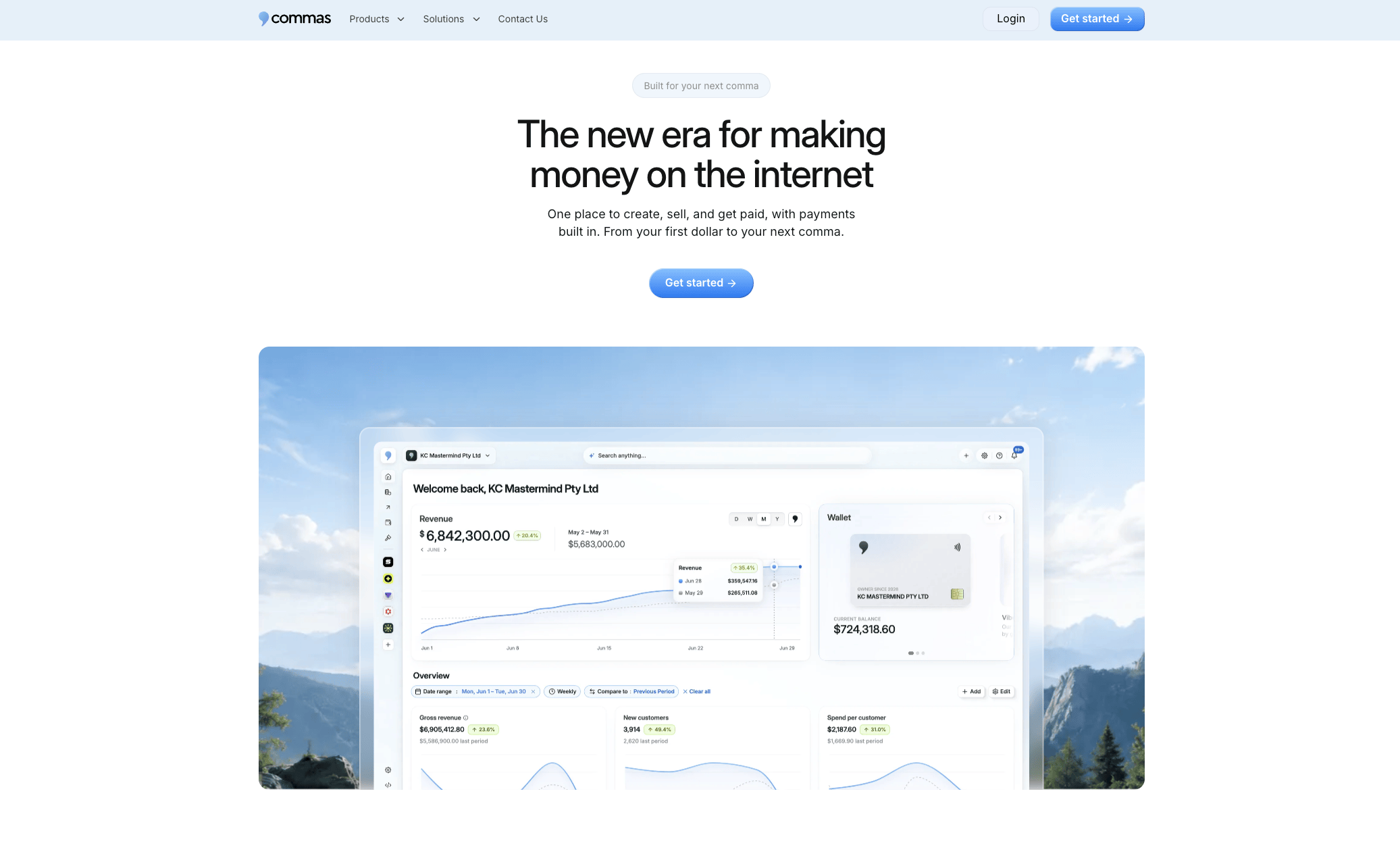
That is why our platform puts payments, funnels, courses, paid groups, webinars and affiliates in one account. Commas runs payments through regulated payment partners, and the funnel, the product delivery and the community all read from the same data. Our AI funnel builder is designed to apply proven funnel patterns so you spend less time on layout and more time on the offer.
Our advice when evaluating any platform: map your own sale from first click to final installment, then count the tools and logins it touches. The fewer handoffs, the fewer places for a buyer to drop.
Commas
Where Commas fits
Commas is built for businesses that already sell: high-ticket coaches, course creators, agencies, paid communities and service businesses. What you can run on it:
- Commas Payments for one-click payments, installments, buy now, pay later and subscriptions, with tools to recover failed subscription charges.
- Vibe Funnels for drag-and-drop funnels, AI-assisted building, upsell management and funnel import.
- Online Courses and Paid Groups for delivery and community, together in Studios.
- Commas Affiliate Center for partner tracking and commissions.
If you are comparing platforms for a high-ticket offer, see how Commas handles payments and funnels in one account. For coaching businesses specifically, our coaching page shows how the setup looks. We do not publish plan pricing in this article, so ask our team about your volume and offer type.
Agencies that bill clients can also look at agency billing and payments.
How to pick in one afternoon
Write down your average sale, your split between one-time and installment buyers, and your monthly refund count. Then score each shortlisted platform on five points:
- Does checkout support the payment plans your buyers use?
- Can the funnel, checkout and delivery share one account?
- What are total costs on a $5,000 sale, including processing and refunds?
- Is community included or a separate subscription?
- How long would a rebuild take, and who does it?
The platform that wins on the last three for your business is usually the right one, even if another tool has a prettier template gallery.
FAQ
What are the downsides of Kajabi?
Sellers most often mention cost that steps up by plan, payment fees that vary by tier, and the effort of moving once everything lives in one account. It remains a strong all-in-one option for many businesses. Compare your own volume against the plan limits to see whether the fit still holds.
Why is Kajabi so expensive?
It bundles hosting, pages, email, courses and community tools, so you pay for the whole suite rather than one piece. A 2026 pricing breakdown lists its plans in the low hundreds of dollars per month. If you only use some of those tools, a platform built around checkout and funnels may be a closer match.
Can I migrate from Kajabi without losing students or subscribers?
Yes, with a staged plan. Export contacts and files, set up and test payments first, rebuild pages and automations, then move recurring billing on a planned date. Keep the old account running until the first full billing cycle completes.
What is the best Kajabi alternative for high-ticket coaching?
Look for installments, failed-payment recovery, funnels tied to checkout and a place for your community. Commas is designed around those needs for sellers with $1,000 to $10,000 offers. Course-only or community-only tools can also work if you have other tools handling the sales side.
Sources
- Best Online Course Platforms for International Creators, CourseProfit Lab
- Kajabi Pricing 2026: All Plans Compared