

Choose ThriveCart if you want low software cost, deep upsell control and an affiliate-friendly setup. Choose SamCart if you want polished templates, AI page drafting and a lighter setup, and you accept a higher monthly bill. If you sell $1,000 to $10,000 offers, neither is the whole answer, because the checkout is only one piece of how you get paid, and we explain where Commas fits at the end.
TL;DR
- SamCart is subscription-priced at $79 (Core) and $199 (Pro) per month, with 25% off for annual billing.
- ThriveCart lists Standard at $47 per month and Pro+ at $87 per month, with lower annual rates. Check its official page, since lifetime-license pricing is also reported.
- Both cover order bumps, upsells, Stripe, PayPal, Apple Pay and Google Pay. Neither hosts video natively.
- SamCart wins on templates and ease. ThriveCart wins on upsell configuration and affiliate-led selling.
- For high-ticket sellers, payment approvals, failed-payment recovery and where the buyer lands after paying matter more than template count.
Table of Contents
- How the two platforms differ at a glance
- Pricing and fees
- Checkout, upsells and funnel optimization
- Integrations, payments and course delivery
- Ease of use and support
- Who should pick which
- Other options if neither feels right
- Our perspective: the cart is not the business
- Where Commas fits
- How to decide in an afternoon
- FAQ
- Sources
How the two platforms differ at a glance
ThriveCart and SamCart both exist to turn a sales page into a paid order. Both give you a hosted checkout, order bumps, one-click upsells and basic course hosting. The differences show up in how they are priced, how much control you get over the offer path and how much hand-holding they give you.
An independent review describes SamCart as subscription-priced and template-led, with AI features, while ThriveCart suits marketers who lean on affiliates and want flexibility in how offers are configured.
| Area | ThriveCart | SamCart |
|---|---|---|
| Core entry price | $47/month, or $37/month billed annually | $79/month (Core) |
| Higher tier | Pro+ at $87/month, or $67/month billed annually | Pro at $199/month |
| Annual discount | Lower monthly rate on annual billing | 25% off |
| Order bumps and upsells | Yes, more configuration options | Yes |
| A/B testing | Price testing reported on Standard | Pro only |
| Templates | Fewer | More |
| Payment methods | Stripe, PayPal, Apple Pay, Google Pay, Authorize.Net | Stripe, PayPal, Apple Pay, Google Pay |
| Support | 24/7 on paid plans | Live support is $19/month extra |
Prices and plan details come from a 2026 plan comparison and the course platform review. Vendors change plans often, so confirm on each official pricing page before you buy.
Pricing and fees
Pricing is where most people start, and where most comparison pages disagree.
SamCart pricing
As of October 2026, SamCart has two main subscription tiers: Core at $79 per month and Pro at $199 per month. Annual billing takes 25% off. The same source notes that SamCart charges extra for tax collection, which is easy to miss when you compare headline prices.
Live support is a separate line item. One comparison reports it as $19 per month extra. If you want a human on call during a launch, add it to your budget.
ThriveCart pricing
ThriveCart Standard is listed at $47 per month, or $37 per month billed annually. Pro+ is $87 per month, or $67 per month billed annually. Older comparison pages describe a one-time lifetime license, and some current reviews still frame ThriveCart that way. One review says reaching feature parity with SamCart Pro often means the Standard lifetime license plus a recurring Pro+ fee. Another notes the $295 per year Pro+ fee weakens the appeal of lifetime pricing.

The practical advice: do not trust any third-party page, including this one, for the exact structure. Open ThriveCart's own pricing page, write down what you need (Pro features included), and price it over three years.
Transaction fees and processing
ThriveCart says it takes no fee on your sales. Your processor still does: Stripe's domestic card rate is 2.9% plus $0.30. SamCart also runs on top of processors such as Stripe and PayPal, so processing cost is a wash between them. The real gap is the software bill.
Here is what that means on a $2,000 offer. Stripe's published domestic rate on one sale is 2.9% plus $0.30, about $58.30. Whether you pay $47 or $199 a month for the cart, the card fee dwarfs the difference per sale. What changes your economics at that price point is how many of those sales get approved, and how many recurring payments fail later.
Checkout, upsells and funnel optimization
Both platforms offer order bumps and upsells. The finer detail, per the course platform review:
- SamCart offers more templates, so a clean checkout takes less design work.
- ThriveCart offers more upsell configuration options, which helps if your offer path has branches, such as a different upsell for payment-plan buyers.
- SamCart A/B testing is Pro-only. ThriveCart Standard is reported to include price testing.
For a $1,000+ offer, a pile of bumps is rarely the point. Buyers at that price want proof, a clear payment plan and a checkout that does not feel like a $27 ebook cart. If you want to tighten that part, our guide on checkout optimization to cut cart abandonment walks through a 30/60/90 approach, and the piece on building a customizable checkout covers the build side.
Integrations, payments and course delivery
Both carts support Stripe, PayPal, Apple Pay and Google Pay, and ThriveCart also supports Authorize.Net, according to the course platform review. Both include basic built-in course hosting, but neither has native video hosting. You will pair either one with Vimeo, Wistia or similar.
That last point matters if you sell a course or program. You end up with a cart, a video host, possibly a community tool and an email tool. Every handoff is a place where a buyer can lose access or a failed payment can go unnoticed.
Ease of use and support
SamCart leans toward low-lift setup. One review points to its AI page drafting and quick setup, which helps if you do not have a designer. If you want to see how AI tooling is being used more broadly in business workflows, this directory of AI tools for business workflows is a good place to browse.
ThriveCart includes 24/7 support on paid plans, while SamCart's live support costs extra, per the same comparison. If you launch on weekends or across time zones, that gap is worth weighing.
The flip side is the learning curve. ThriveCart's flexibility comes with more settings to understand. SamCart's narrower menu gets you live faster but has less room to shape an unusual offer.

Who should pick which
ThriveCart fits you if
- You want the lowest software cost and are comfortable configuring things yourself.
- You run an affiliate program and want upsell logic that branches.
- You want testing on your entry plan.
- You want round-the-clock support included.
SamCart fits you if
- You value templates and a quick setup over configuration depth.
- You will use AI page drafting and expect to pay for Pro to get A/B testing.
- Your team is small and a simple tool beats a flexible one.
Where both fall short
Neither is a full selling system. Both are carts. You still need a funnel builder, a delivery area, a place for your community or program, webinars if you sell that way and a plan for failed subscriptions. If you run payment plans on a $5,000 offer, a single declined card in month three is a real revenue problem, and a cart alone will not chase it for you.
Other options if neither feels right
People searching for SamCart alternatives usually land in one of three places.
- A cart with lower cost. ThriveCart is the usual answer, covered above.
- A merchant of record. If you sell globally and want someone else handling international tax collection, filing and remittance, a merchant-of-record service such as Fungies.io is one route.
- One platform for the whole sales path. This is where we work.
Our perspective: the cart is not the business
We talk with sellers who have outgrown a cart. The pattern is consistent. They started with a checkout tool, then added a funnel builder, a course host, a community app, a webinar tool and an affiliate tracker. Each tool was fine. Together they made reporting messy and made recovery of failed payments a manual chore.
At $1,000 to $10,000 a sale, the cost of the cart is not the number to watch. Watch approval rates, payment-plan completion, refund requests and how quickly a buyer gets access after paying. Those depend on how payments, delivery and community connect, not on whether the template looks nice.
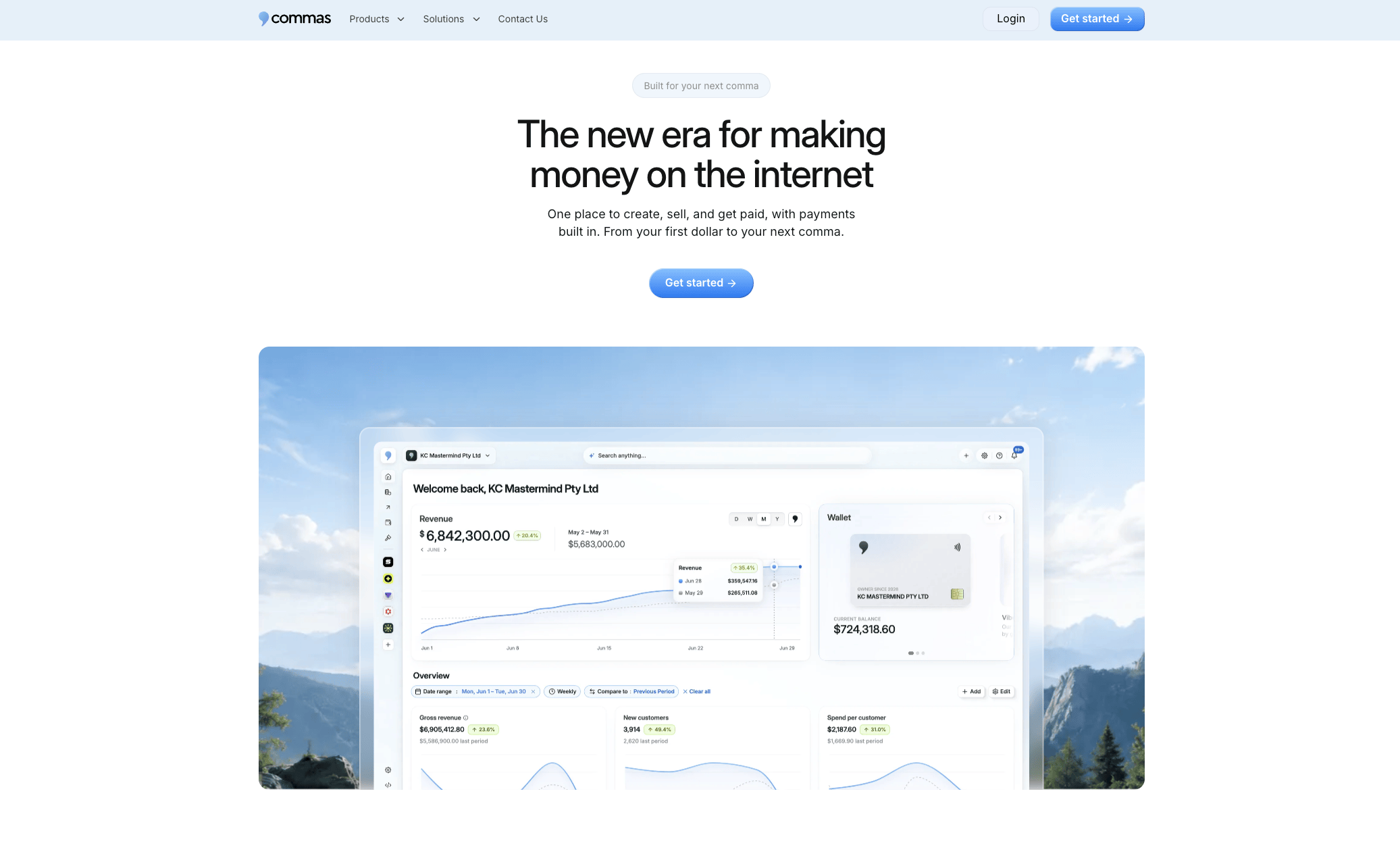
That is why we built Commas as one platform for checkout, funnels, courses, paid communities, webinars and affiliates, with payments built in. Commas runs payments through regulated payment partners. We do not promise results, and no platform can, but we think fewer handoffs means fewer places for revenue to leak.
— Commas
Where Commas fits
If you are comparing carts because your current setup feels stitched together, look at the whole path rather than just the checkout. Vibe Funnels is our AI funnel builder. Commas Payments covers checkout, one-click payments, BNPL and subscriptions, with tools to recover failed subscriptions. Courses live in Online Courses, and communities in Paid Groups.
If you sell through partners, the Affiliate Center tracks affiliates who sell for you. If you sell coaching, see how we handle coaching sales. For a closer look at how subscription tooling compares for high-ticket sellers, read our guide to the best subscription software for $1,000+ offers. To see the platform working end to end, start at commas.com.
How to decide in an afternoon
- List your monthly sales and average order value. If most orders are under $200, the cart's template library matters more. If they are $1,000 and up, payment plans and recovery matter more.
- Price three years, not one month. Include Pro tiers, tax collection (extra on SamCart per the plan comparison), support add-ons and the video host you will need either way.
- Map your offer path. Draw entry offer, bump, upsell, payment plan and the page buyers see after paying. Check that the tool can build each step without a workaround.
- Count your tools. If a new cart still leaves you with four other subscriptions, you are changing one problem for another.
- Run one real test. Sell a small offer through your choice before you move your flagship program.
FAQ
Is ThriveCart better than SamCart?
It depends on what you need. ThriveCart is generally cheaper and offers more upsell configuration and 24/7 support on paid plans. SamCart has more templates, AI page drafting and a lighter setup. Pick based on your offer path and your budget over several years.
How much does SamCart cost per month?
As of October 2026, SamCart Core is $79 per month and Pro is $199 per month, with 25% off on annual billing. Tax collection and live support cost extra. Confirm on SamCart's own pricing page before you buy.
What are some good alternatives to SamCart?
ThriveCart is the most common one. If you sell internationally and want tax handled for you, a merchant-of-record service is another route. If you want checkout, funnels, courses, community and affiliates in one account, Commas is built for that.
Do ThriveCart and SamCart host video?
No. Both include basic course hosting, but neither has native video hosting, so you need a third-party service such as Vimeo or Wistia.
Sources
- SamCart vs ThriveCart (2026): plans, upsells and fees
- Samcart vs Thrivecart: Which Is Best To Sell Online Courses
- SamCart vs ThriveCart (2026): Features, Pricing, Pros and Cons
- ThriveCart vs SamCart 2026: Which Shopping Cart Wins?
- ThriveCart Review 2026: Pricing and Verdict
- ThriveCart for PLR Sellers: Pricing, Fees and Features
- HubSpot AI Guide 2026: How to Use Breeze and Agents