
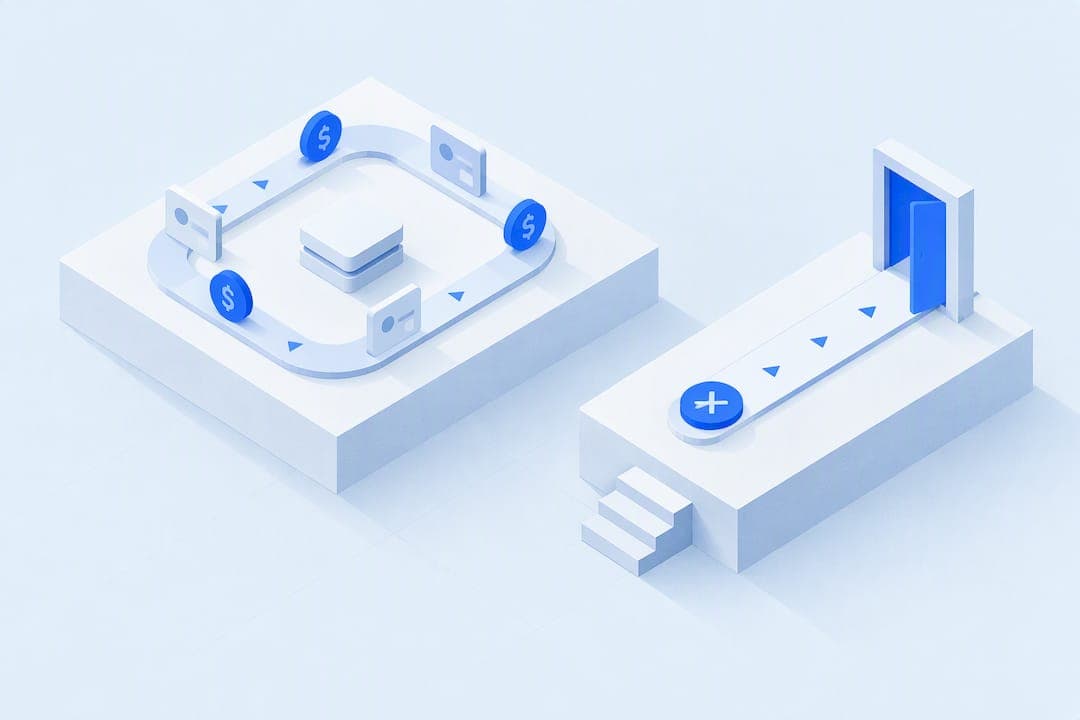
The most practical route for established creators selling $1,000 to $10,000 offers is an integrated platform that bundles checkout, subscription management, content gating and automated payment recovery into one system. We built Commas around that exact need, and this guide explains why that structure works and how to implement it, step by step, for sellers who already have paying customers and need fewer moving parts.
TL;DR:
- Hosted platforms suit flat memberships, while separate tools offer control at the cost of manual integrations; integrated systems handle upsells, payment plans, and gated access.
- Offer monthly and annual billing, build two or three tiers based on delivered value, keep high ticket trials to 3 to 7 days, and review churn monthly.
- Disclose price, billing frequency, and cancellation terms; save timestamped consent, and make cancellation as easy as signup to meet recurring billing rules.
- For third party settlement organizations, the general reporting threshold is $20,000 and 200 transactions, while payment card charges may be reported at any amount.
- Space retries across several days, update expired cards automatically, and send a payment update link within an hour of each decline.
Table of Contents
- Subscription approaches: platform types and payment setups
- Pricing and billing models creators should use
- Compliance and taxes: what to do about Click-to-Cancel, ROSCA, and Form 1099-K
- Cut involuntary churn: payment-recovery and retention tactics
- Implementation checklist: what to set up this week to launch subscriptions
- EEAT-backed perspective: how an integrated platform like Commas supports subscription businesses
- When to pick integration over best-of-breed: an experienced take
- How Commas helps you launch and scale subscription payments
- FAQ
- Sources
Subscription approaches: platform types and payment setups
Creators choosing how to collect recurring payments are really choosing between three operational models, not just three vendors.
- Hosted creator platforms handle payments and content delivery but often limit checkout customization and upsell flexibility.
- Integrated SaaS platforms combine funnels, checkout, subscription billing and community access in one dashboard, cutting the number of tools you reconcile each month.
- Best-of-breed stacks pair a payment gateway with a separate CMS and a separate subscription manager, which gives granular control but multiplies integration work.
For a seller running a $1,000 to $10,000 offer, the choice usually comes down to how much checkout and upsell control you need versus how much engineering time you have. Hosted platforms work fine for a single flat membership price, but they rarely support layered upsells, order bumps or affiliate commission splits without custom work. Best-of-breed stacks give you the most control over each component, but every webhook, every dunning rule and every tax report has to be stitched together manually, which is a real cost for a solo creator or a small team.
Integrated SaaS tends to suit high-ticket sellers best because checkout, trial logic, affiliate billing and gated content access all live behind one login. That matters most when you are running order bumps, payment plans or agency-style billing where a client pays recurring invoices for services delivered through the same platform that hosts your community or course.
Pricing and billing models creators should use
Billing cadence and tier design have a direct effect on both revenue predictability and cancellation rates, so they deserve more thought than most creators give them.
- Offer both monthly and annual pricing, but discount the annual plan enough that it reads as a clear savings rather than a rounding error.
- Build two or three tiers based on value delivered (access level, live sessions, community perks) rather than arbitrary price points.
- Keep trial periods short for high-ticket offers, often 3 to 7 days, since a longer free trial on a $1,000+ offer tends to attract browsers rather than buyers.
- Use coupons and limited-time pricing sparingly to protect perceived value instead of training your audience to wait for discounts.
- Review churn by tier monthly so you can retire or restructure a tier that consistently underperforms.
Pro Tip: Price your top tier first and build the lower tiers as clear subtractions from it, so the value drop is obvious and the upgrade path sells itself.
For a $1,000 to $10,000 offer, annual billing collected upfront reduces the exposure to failed monthly charges, while a monthly option with a short trial still captures buyers who want to test before committing to the full term.
Compliance and taxes: what to do about Click-to-Cancel, ROSCA, and Form 1099-K
Recurring billing comes with binding rules, not just best practices, and ignoring them creates real legal and reputational risk.
The Federal Trade Commission's Click-to-Cancel rule requires that canceling a subscription be as simple as signing up for one, and that recurring charges stop immediately once a valid cancellation request comes in. Enforcement is active: the FTC's settlement with Chegg involved a $7.5 million payout over cancellation flows that were harder to use than signup and continued charges after cancellation requests. Alongside Click-to-Cancel, the FTC's negative option marketing guidance requires clear disclosure of subscription terms and express informed consent before a card is charged on a recurring basis.

On the tax side, the IRS Form 1099-K guidance sets the general third-party settlement organization reporting threshold at $20,000 in gross payments and 200 transactions, but payment card transactions, meaning credit and debit charges, can trigger reporting at any amount with no minimum, since card networks report independently of the TPSO threshold.
A significant portion of news-focused creators now offer paid subscriptions as part of their monetization mix, according to Pew Research, which means subscription compliance is no longer a niche concern for a small slice of online sellers.
Build a short compliance checklist before you charge a single recurring payment:
- Disclose price, billing frequency and cancellation terms clearly at signup.
- Capture and timestamp consent records for every subscriber.
- Keep cancellation as simple as the signup flow, with no hidden steps.
- Retain consent and billing records for tax reporting and dispute defense.
Cut involuntary churn: payment-recovery and retention tactics
Failed payments, not voluntary cancellations, account for a large share of subscription revenue loss, and most of it is fixable with the right automation.
- Set a retry schedule that spaces attempts over several days rather than retrying immediately and repeatedly.
- Use a card-on-file updater so expired or reissued cards get refreshed automatically instead of silently failing.
- Trigger webhooks on decline events so your system flags a failed charge the moment it happens, not days later.
- Send proactive renewal and failure notifications with a one-click update link instead of asking subscribers to log in and dig through settings.
- Test dunning copy and timing the same way you would test a sales email, since small wording changes can shift recovery rates, using practical follow-up and reminder templates like those in freelance client reminders for collecting payments.
Pro Tip: A short, friendly text or email sent within an hour of a failed charge recovers more revenue than a generic notice sent days later.
Measuring involuntary churn separately from voluntary cancellations matters because the fixes are different: one is a retention and offer problem, the other is a payments and notification problem. Platforms that connect checkout, billing and messaging under one system remove a lot of the manual tracking this usually requires, since the 90 day playbook for reducing involuntary churn walks through recovery sequencing in more detail.
Implementation checklist: what to set up this week to launch subscriptions
Launching a compliant, conversion-minded subscription flow is a short list of concrete tasks, not a long project.
- Finalize pricing and terms of service, including cancellation language that matches Click-to-Cancel requirements.
- Confirm your banking and tax information is set up to receive payouts and generate 1099-K records correctly.
- Decide your trial length and billing cadence before you build the checkout page, not after.
- Embed your checkout on your sales page and connect webhooks for payment success, failure and subscription updates.
- Configure your dunning sequence and test a full trial-to-paid conversion before going live.
- Build your subscriber onboarding sequence and confirm gated content access triggers correctly on payment.
- Set a monthly reconciliation routine and a 30 and 90 day review to adjust pricing, tiers or dunning based on real data.
This full sequence, from checkout embed to first payout, is covered in more depth in the guide on launching compliant subscription payments.
EEAT-backed perspective: how an integrated platform like Commas supports subscription businesses
Commas was built to handle the pieces of this checklist that usually require stitching together separate tools.
- We run recurring billing, one-click checkout and BNPL options through regulated payment partners, without a separate gateway integration.
- Our platform lets you build and adjust checkout and upsell flows without rebuilding pages from scratch for every tier change.
- The platform handles membership gating so subscriber access updates automatically with payment status.
- Agency billing tools support recurring invoicing for sellers who bill clients or teams rather than individual subscribers.
Our post on reducing payment processing fees for creators covers how consolidating checkout and billing under one system avoids the layered fees that come from running separate tools for payments, email and community access. Mapped against the checklist above, these capabilities cover dunning, webhook-driven status updates, analytics and affiliate or agency billing in one dashboard instead of five.
When to pick integration over best-of-breed: an experienced take
Integration tends to win for creators running more than one offer type, since funnels, community, payments and affiliate systems rarely stay separate for long once a business grows past a single product.
— FanBasis
How Commas helps you launch and scale subscription payments
We built Commas so creators selling $1,000 to $10,000 offers can run checkout, subscriptions, content gating and recovery from one dashboard instead of juggling separate tools for each piece.

Our Payments tools handle recurring billing and card-on-file recovery, our Vibe Funnels builder manages checkout and upsell flows, and Paid Groups ties membership access directly to payment status.
- Commas Payments: recurring billing, BNPL and automated recovery through regulated payment partners.
- Vibe Funnels: checkout and upsell flows built around proven conversion patterns.
- Paid Groups: gated community access tied to live subscription status.
- Agency billing: recurring invoicing for creators who bill teams or clients.
| Checklist item | Commas feature |
|---|---|
| Checkout and upsells | Vibe Funnels |
| Recurring billing and recovery | Commas Payments |
| Membership gating | Paid Groups |
| Client or agency invoicing | Agency billing |
If you are ready to move off a patchwork of tools, start with our agency billing page or set up your first funnel with Commas Payments.
FAQ
How much do people pay for subscriptions?
Subscription prices vary widely by offer type and audience, from a few dollars a month for basic content access to $1,000 or more for high-ticket coaching and course memberships. Pricing should reflect the value delivered at each tier rather than following a single industry standard.
What does the company Chargebee do?
Chargebee is a subscription billing and revenue management tool used by some businesses to handle recurring invoicing and billing logic. It is one example of a best-of-breed billing tool, which typically needs to be paired with a separate checkout and content platform.
How to create a subscription box business?
A subscription box business requires recurring billing, inventory and fulfillment logistics, and a checkout flow that supports trial periods and tier upgrades. The billing and checkout piece works the same way as any other recurring offer, built on clear disclosure, simple cancellation and automated payment recovery.
Does paying for subscriptions help your credit score?
Paying for a subscription does not directly affect your credit score unless the charge appears on a credit account that reports to credit bureaus, and even then it is the on-time payment history that matters, not the subscription itself. Most creator subscriptions are billed to debit cards or payment apps that do not report to credit bureaus at all.
Sources
- Federal Trade Commission Announces Final “Click-to-Cancel” Rule Making It Easier for Consumers to End Recurring Subscriptions and Memberships | Federal Trade Commission
- IRS issues FAQs on Form 1099-K threshold
- America's news influencers | Pew Research Center