

The fastest way to bring that number down isn't negotiating with your processor. It's changing how you get paid: shifting bigger invoices to bank rails, billing annually instead of monthly, and raising your average ticket size so a fixed $0.30 fee stops eating a bigger slice of small sales.
TL;DR:
- Using bank transfers for large invoices can reduce processing costs from around 3% to below 1%, significantly lowering your effective rate.
- Moving to annual billing instead of monthly payments can decrease fixed costs by over 90%, especially for subscription-based offerings.
- International sales incur FX spreads near 3%, but switching to multi-currency accounts or specialist providers can cut these costs below 1%.
- For low-volume creators under $10,000 monthly, focus on increasing ticket size and optimizing checkout rather than rate negotiations.
- Consolidating payment tools into a single platform can eliminate reconciliation gaps, reduce fee leakage, and improve revenue retention.
Table of Contents
- What Do Payment Processing Fees Actually Cost Creators?
- What Are the Components of a Payment Processing Fee?
- Flat-Rate, Tiered, or Interchange-Plus: Which Pricing Model Wins?
- Payment Gateway vs. Merchant of Record: Which One Should Creators Use?
- How Do Micropayments, FX, and Chargebacks Change Your Real Rate?
- How Do You Calculate Your True Effective Fee Per Sale?
- What's the Fastest Way to Lower Payment Processing Fees?
- How Does an Integrated Platform Cut Fee Leakage?
- What's the Right Fee Strategy for Your Stage as a Creator?
- Ready to Stop Losing Revenue to Fragmented Tools?
- Where These Numbers Come From
- Sources
- FAQ
What Do Payment Processing Fees Actually Cost Creators?
Here's the quick version, before the math gets granular.
Most card processors quote something close to 2.9% + $0.30 per transaction for domestic cards, and that baseline holds across a lot of the tools creators already use. But that quoted rate is rarely what you actually keep. Once you stack platform cuts, currency conversion, and payout fees on top, effective all-in costs for creators typically land somewhere between 3% and 10% of gross revenue, and can go even higher for anyone selling internationally.
A few things drive that spread wider than most sellers expect:
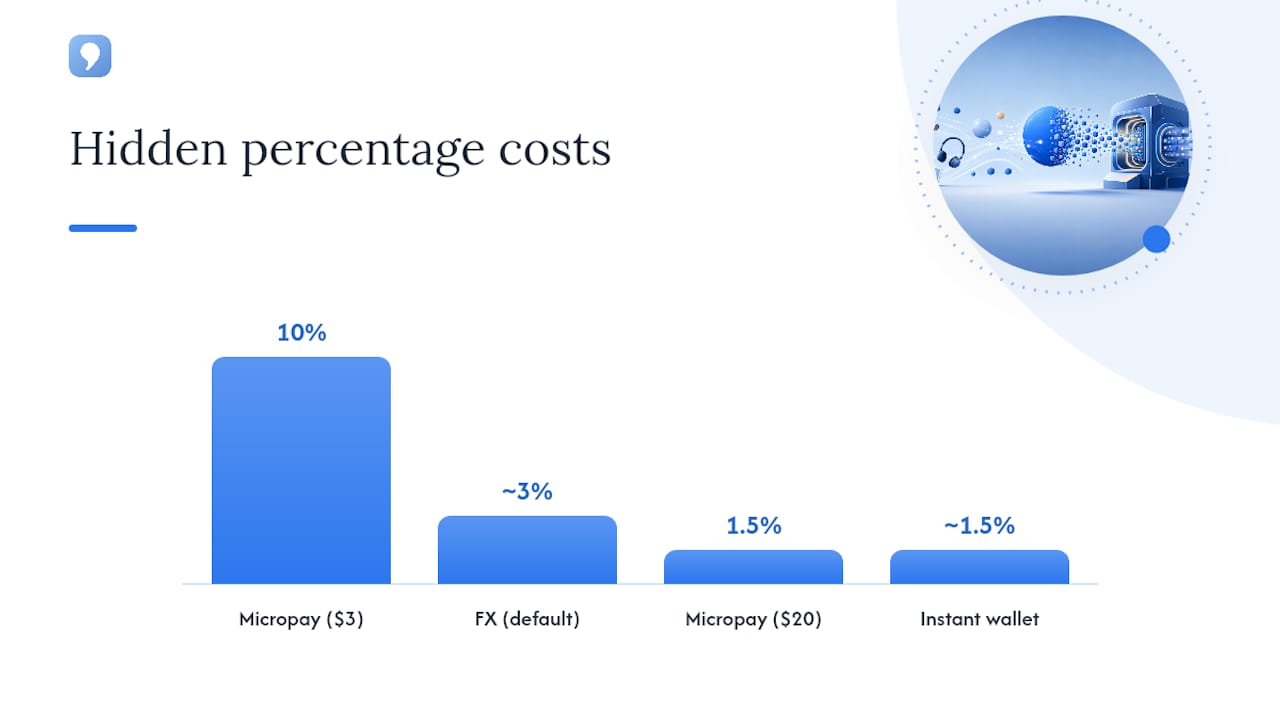
- Micropayments get hit hardest. A fixed $0.30 fee on a $3 pledge is 10% off the top before the percentage cut even applies.
- Currency conversion adds its own layer. FX spreads commonly run near 3% unless you're routing through a multi-currency account or specialist provider.
- Platform take rates compound with processing fees. A 5% platform cut plus a 3% processing rate isn't 8%, it's closer to 8% plus the platform's own currency and payout markups.
- Chargebacks and instant payouts quietly inflate the total. Dispute fees commonly run $15 to $100 per incident, and instant payout options often carry a premium of their own.
The result: creators regularly lose 2% to 8% of annual earnings to payment inefficiencies, and international creators lose 5% to 12%, according to industry estimates. That's not one bad fee. It's several small ones stacking silently across every sale.
What Are the Components of a Payment Processing Fee?
Every card transaction fee is actually three separate charges bundled into one number, plus whatever your processor tacks on.
Interchange is the biggest piece. It's a variable fee set by the card-issuing bank, and it changes based on card type, transaction method, and risk profile. A rewards card usually costs more to accept than a basic debit card, because the issuing bank charges more to fund those rewards.
Assessment fees come from the card networks themselves, Visa, Mastercard, and the rest, and they're a much smaller, flatter percentage layered on top of interchange.
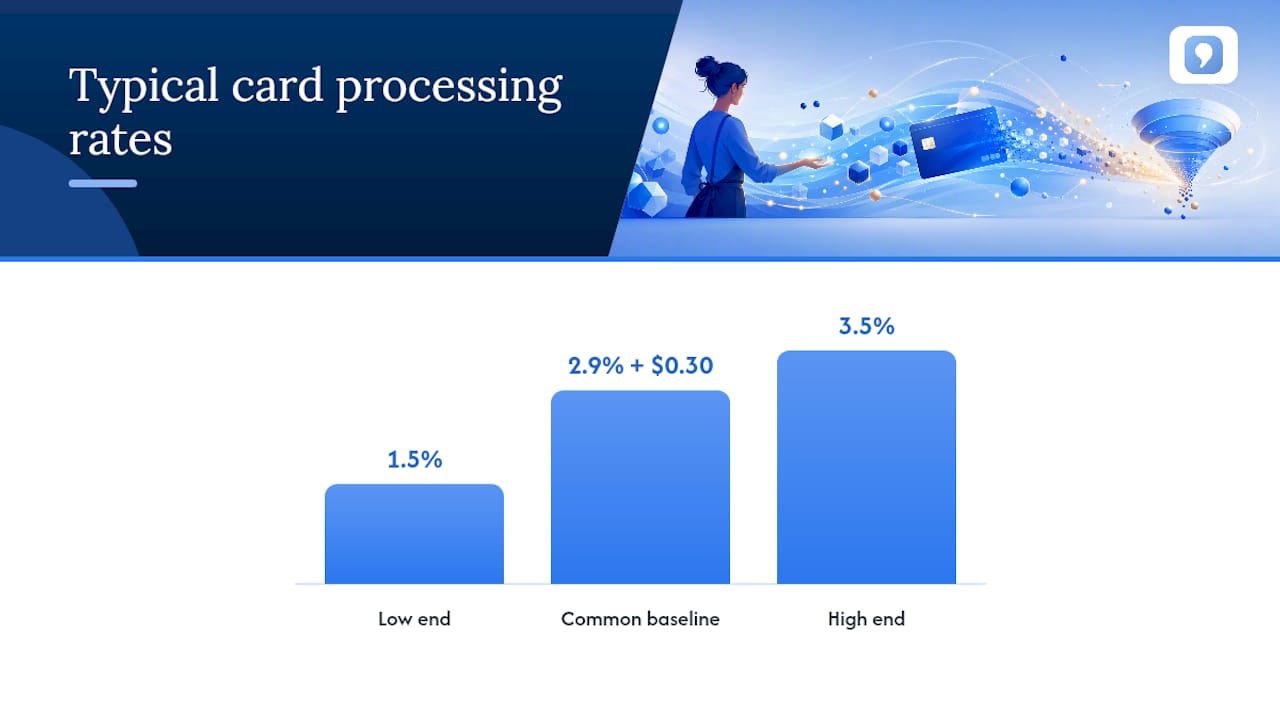
Processor markup is what your payment provider adds for running the infrastructure, the fraud checks, and the support. This is the only piece you can meaningfully negotiate, and it's usually presented as the percentage-plus-cents figure you see on pricing pages, like 2.9% + $0.30.
Card processing rates for most platforms fall in the 1.5% to 3.5% range depending on card mix and add-ons, with a common baseline of 2.9% plus $0.30 per transaction for standard domestic cards.
Beyond that base rate, a handful of add-ons quietly raise the effective cost:
- Subscription billing fees, sometimes a small extra percentage for recurring charges versus one-time payments.
- Dispute fees, charged whether or not you win the chargeback, typically $15 to $100 per incident.
- Buy now, pay later surcharges, which run noticeably higher than standard card rates because the BNPL provider is fronting the risk of installment default.
- Cross-border fees, an added percentage anytime the card was issued in a different country than your business.
None of these show up clearly on a homepage pricing table. They show up in your monthly statement, usually itemized in a way that takes real effort to decode. That's the part most sellers miss: the advertised rate is the floor, not the ceiling.
Flat-Rate, Tiered, or Interchange-Plus: Which Pricing Model Wins?
The pricing model you're on matters almost as much as the rate itself, and most creators never actually choose one, they just accept whatever their platform defaults to.
- Flat-rate pricing charges one predictable percentage plus a flat fee on every transaction, regardless of card type. It's simple to forecast and easy to reconcile, which is why most creator platforms default to it. The tradeoff shows up at volume: because the flat rate has to cover the processor's worst-case interchange costs, you're effectively overpaying on the transactions that would have qualified for cheaper interchange categories.
- Tiered pricing buckets transactions into "qualified," "mid-qualified," and "non-qualified" categories, each with its own rate. It looks cheaper on the surface because the headline qualified rate is often lower than flat-rate pricing. In practice, processors control which tier a transaction lands in, and a lot of everyday card-not-present transactions, which cover most digital product sales, get pushed into the more expensive tiers without much explanation.
- Interchange-plus pricing shows you the actual interchange cost plus a fixed processor markup, transaction by transaction. It's the most transparent model and, at real volume, usually the cheapest. The catch is that it only becomes accessible once you're doing enough monthly revenue to negotiate directly, often north of $50,000 a month, which puts it out of reach for most solo creators.
Pro Tip: If you're under $10K a month in sales, don't spend energy chasing interchange-plus rates. Optimize your checkout and average order value first. The savings from raising your average ticket from $20 to $35 will beat almost any rate negotiation available to you at that volume.
The rule of thumb holds up well in practice: low-volume sellers should prioritize flat-rate simplicity and spend their time on conversion, not rate-shopping; tools like BabyLoveGrowth's affiliate-driven revenue boosts can also help maximize your net revenue by optimizing traffic and affiliate strategies. Once you're consistently clearing five figures a month, interchange-plus negotiations start paying for the time they cost.
Payment Gateway vs. Merchant of Record: Which One Should Creators Use?
This decision matters more than most creators realize, because it determines who's legally on the hook for sales tax.
A payment gateway, think of it as the plumbing that moves money from buyer to seller, keeps you as the seller of record. You collect the payment, but you're also responsible for calculating and remitting sales tax or VAT in every jurisdiction where you have customers. For a creator selling into dozens of countries, that can mean tracking tax obligations across dozens of different rule sets. Gateway fees are lower, but the compliance work lands entirely on you.
A merchant of record (MoR) takes over as the legal seller. The MoR collects the payment, calculates and remits the applicable tax, handles refunds, and issues compliant invoices on your behalf. In exchange, MoR pricing typically runs higher, often around 5% plus $0.50 per transaction in published comparisons, well above a standard gateway's baseline rate.
Here's how that split plays out in practice:
- Solo creators selling primarily in one country rarely need an MoR. The tax complexity is manageable, and the fee savings from a gateway add up fast.
- Creators selling globally, especially digital products subject to VAT in the EU or UK, often find the MoR premium worth it purely to avoid registering for tax in a dozen jurisdictions.
- Anyone running a subscription business with international customers should weigh the MoR option seriously. Tax rules on recurring digital services change often, and getting it wrong carries real penalty risk.
- High-volume sellers with in-house finance support usually save more by staying on a gateway and handling compliance directly, since the MoR premium scales with revenue.
Neither option is objectively better. It's a trade between a lower fee and a higher administrative burden, and the right call depends entirely on how much of that burden you're equipped to carry yourself.
How Do Micropayments, FX, and Chargebacks Change Your Real Rate?
The advertised processing rate is just the starting line. Four platform-level factors move the real number, often by more than the base rate itself.
Micropayment tiers are the most underestimated one. Creator platforms often apply a separate, higher rate to small pledges. Patreon's published fee structure shows how a fixed per-transaction fee, applied to a $3 pledge, can push the effective rate well past what the same fee structure would cost on a $20 purchase. The math is brutal at the low end: a $0.30 fixed fee is 1.5% of a $20 sale, but 10% of a $3 sale.
Currency conversion adds a spread that rarely gets disclosed clearly. FX conversion costs commonly sit near 3% through default processing, though multi-currency accounts and specialist providers can bring that under 1%.
Payout timing creates its own tradeoff between cost and cash flow.
| Payout type | Typical cost premium | Cash-flow impact |
|---|---|---|
| Standard next-business-day | None (included in base rate) | Funds available in 1-2 business days |
| Instant/real-time settlement | 0.2% to 0.5% premium | Funds available in minutes |
| Instant transfer via digital wallet | Up to ~1.5% on the transferred amount | Funds available almost immediately |
Chargebacks carry both a direct fee, typically $15 to $100 per dispute, and an indirect cost: processors can place a reserve hold on your funds if your dispute rate climbs. A creator doing $10,000 a month with even a 1% chargeback rate is looking at real annual cost from disputes alone, on top of the base processing rate.
The behavioral fix is boring but effective: clear product descriptions, visible refund policies, and prompt customer support cut chargebacks more reliably than any dispute-management tool. On surcharging customers directly for card acceptance, the FTC is clear that it's legal in most U.S. jurisdictions as long as the surcharge doesn't exceed your actual cost of acceptance and is clearly disclosed before checkout. Some states and countries ban surcharging outright, so check local rules before adding one.
How Do You Calculate Your True Effective Fee Per Sale?
Most creators know their headline rate. Almost none know their effective rate, the number that actually determines what lands in their bank account.
The formula is straightforward:
Effective fee = processor % + (flat cents ÷ sale price) + platform % + FX % (if applicable) + payout fee (if applicable)
The flat-cents piece is where most people's mental math breaks down, because it's not a flat percentage, it scales inversely with your ticket size. Run it across four realistic scenarios:
- A $3 micro-pledge. At 2.9% + $0.30, that's $0.087 plus $0.30, or $0.387 total, an effective rate of 12.9%. This is exactly why micropayments are the worst economics in the creator toolkit.
- A $20 standard digital product. Same 2.9% + $0.30 structure gives you $0.58 plus $0.30, or $0.88 total, an effective rate of 4.4%. Already less than a third of the micro-pledge rate.
- A $500 high-ticket course or coaching package. The math becomes $14.50 plus $0.30, or $14.80 total, an effective rate of just 2.96%. The flat fee has essentially disappeared into the percentage.
- A $50 international sale with FX conversion. Add a 3% currency conversion spread on top of the 2.9% + $0.30 base: $1.45 processing plus $1.50 FX plus $0.30 flat, for $3.25 total, an effective rate of 6.5%, more than double the domestic equivalent at the same price point.
The pattern is consistent across every fee structure you'll encounter: fixed costs punish small transactions, and percentage costs punish international ones. Once you know your own ticket size and customer mix, you can plug the same formula in and get a number that's actually yours, not an industry average.
What's the Fastest Way to Lower Payment Processing Fees?
Once you know your effective rate, the levers to pull become obvious. Rank them by how much control you actually have over each one.
- Move large invoices to bank-transfer rails. ACH commonly costs 0.8% to 1.0% with a fixed cap, versus 2.9%+ for cards. For a $2,000 coaching package or enterprise course license, that's the difference between paying roughly $58 and paying under $20.
- Switch to annual billing where it makes sense. One $240 annual charge carries one flat fee instead of twelve. That alone can cut the fixed-cost drag on a subscription business by more than 90%.
- Raise average order value through bundling and upsells. Packaging a course with a community add-on or a bonus template pack pushes more of your revenue into the cheaper high-ticket end of the effective-rate curve.
- Negotiate rates once you clear real volume, and stay on flat-rate below that. Interchange-plus negotiations start making sense around $50,000 in monthly revenue. Below that, the time spent negotiating usually costs more than it saves.
Pro Tip: *Track your chargeback rate monthly, not annually.
Instant payouts deserve a specific mention here, because the tradeoff is easy to get backwards.
How Does an Integrated Platform Cut Fee Leakage?
Most of the fee bleed described above doesn't come from any single bad rate. It comes from running five disconnected tools, a checkout provider, an email platform, a course host, a community app, and a separate payout system, each taking its own cut and each adding its own reconciliation overhead.
A unified system like Commas Payments collapses that stack into one dashboard, and the savings show up in places that don't appear on any single invoice:
- Fewer reconciliation gaps. When checkout, delivery, and payout live in one system, there's no double-counted fee or lost transaction between platforms, the kind of quiet leakage that shows up as a mystery gap in your monthly total.
- Funnel tools built to raise average order value. Since fixed processing costs shrink as a percentage on bigger tickets, a funnel that pushes buyers toward a bundle or an upsell is doing fee optimization even when nobody frames it that way.
- Multi-currency and payout handling in the same flow as checkout. Instead of routing an international sale through one processor and then a separate FX conversion step, an integrated account can absorb both, cutting the number of places a currency spread can hide.
- One system for subscriptions, communities, and one-time sales. That matters because failed-payment recovery on recurring billing is one of the highest-leverage, lowest-effort ways to protect revenue that would otherwise just disappear into a declined card notification.
None of this replaces knowing your own effective rate. But once you've run the math from the section above, the fastest way to act on it is usually consolidation, not another rate negotiation.
What's the Right Fee Strategy for Your Stage as a Creator?
The honest answer is that the cheapest option isn't always the right one, and creators who chase the lowest rate on every transaction usually burn more time than they save.
Accept higher fees when the alternative is doing tax compliance or dispute management yourself with no support system in place. A merchant-of-record premium is cheap insurance against getting VAT registration wrong in a market you barely sell into.
For hobbyist creators under a few thousand dollars a month, don't touch pricing models at all. Fix your ticket size and reduce micropayment volume first; that's where the real percentage points are hiding.
For growing creators clearing $5,000 to $50,000 monthly, this is where bank rails, annual billing, and FX optimization start paying for themselves. Rate negotiation still isn't worth your time.
For creators at scale past $50,000 a month, interchange-plus and direct negotiation become realistic, and even a quarter-point improvement compounds fast at that volume.
Whatever stage you're at, check your effective rate quarterly using the formula above, watch your chargeback rate for creep past 1%, and confirm your FX spread hasn't drifted back toward 3% on autopilot.
— FanBasis
Ready to Stop Losing Revenue to Fragmented Tools?
If you've been stitching together a checkout provider, a course platform, and a separate payout tool, the fee leakage described throughout this article isn't really about any one rate, it's about the seams between systems. Commas Payments puts checkout, subscriptions, and payouts into one account, so there's no reconciliation gap between what a buyer pays and what actually lands in your payout.

Pairing that with Vibe Funnels means the same dashboard that processes your payment is also optimizing the checkout flow that determines your average order value, the single biggest lever for shrinking fixed-cost drag on smaller sales. Whether you're selling a course through Commas Studios, running a paid community, or managing a webinar funnel with checkout built into the room, the goal is the same: fewer tools, fewer seams, less revenue disappearing between them. Visit Commas Payments to see the pricing and setup details for your specific sales mix.
Where These Numbers Come From
The processing rates, fee ranges, and creator-economy figures cited throughout this article draw from a mix of regulatory guidance, financial infrastructure documentation, and creator-platform data.
- The Federal Reserve's overview of ACH for bank-transfer rail costs and structure.
- The FeeFlow payment gateway comparison matrix for baseline card-processing rates and merchant-of-record pricing benchmarks.
Sources
FAQ
What Is a Typical Payment Processing Fee?
Most card processors advertise a baseline of roughly 2.9% plus $0.30 per transaction for domestic cards, with effective rates ranging from about 1.5% to 3.5% depending on card mix.
Is It Illegal to Charge a Credit Card Surcharge?
No, surcharging is legal in most U.S. states as long as the fee doesn't exceed your actual cost of accepting the card and is clearly disclosed to the buyer before checkout, according to the FTC. Some states and countries ban surcharging entirely, so check local rules before adding one to your checkout.
How Much Should I Charge for a Processing Fee?
A surcharge should never exceed what you actually pay in processing costs, since charging more than that risks violating card network rules and, in some states, local law. Most creators are better off building the fee into their price rather than passing it through as a separate line item, especially at lower price points where a visible surcharge can hurt conversion more than it recovers in fees.
Can Merchants Charge a 2% Surcharge on Credit Card Payments?
Yes, a 2% surcharge is generally allowed as long as it doesn't exceed your real cost of acceptance and is disclosed clearly at checkout, per FTC guidance.
Does an Integrated Platform Like Commas Reduce My Effective Fee?
Commas doesn't change the underlying interchange or network fees, but consolidating checkout, funnels, and payouts into one platform removes the reconciliation gaps and fragmented-tool costs that often inflate a creator's true effective rate. Current pricing details are available directly on the Commas site.