

Gumroad is the faster way to start and Shopify is the better way to own a brand, but neither was built around a high-ticket offer. Gumroad takes a percentage of every sale, which grows painful at $1,000 and up. Shopify needs apps to deliver digital files, run upsells and manage members. If you sell coaching, courses or paid communities, the cleaner answer is one platform where checkout, funnels, courses, community and payments sit in the same account, which is what Commas is built to be.
This comparison is written for sellers who already make sales: coaches, course creators, agencies and paid communities pricing offers from $1,000 to $10,000. It covers fees, tax, delivery, upsells and customer ownership, then shows where each option breaks.
TL;DR
- Gumroad has no monthly fee but takes 10% + $0.50 per direct sale before card processing, so a $2,000 offer costs $200.50 in commission alone.
- Shopify Basic is $39 a month and cheaper per sale at volume, but digital delivery, license keys, memberships and subscriptions need apps.
- Gumroad acts as merchant of record and handles sales tax. On Shopify you set up and manage tax yourself.
- Neither is a funnel, course and community platform. Commas puts checkout, funnels, upsells, courses, paid groups, webinars and affiliates in one account.
Table of Contents
- The short verdict
- What each platform is built for
- Fees: what a high-ticket sale really costs
- Tax: merchant of record or your own setup
- Delivering digital products
- Customization, ownership and the customer list
- Upsells, funnels and payment plans
- Comparison at a glance
- Which one fits which seller
- Perspective
- Where Commas fits
- FAQ
- Sources
The short verdict
Pick Gumroad if you sell occasionally, want zero fixed cost and want tax handled for you. Pick Shopify if you sell recurring digital products, want your own branded store and customer list, and can tolerate configuring apps. Both are reasonable for a $29 template pack. A $3,000 coaching program is a different job: it needs a sales page, a payment plan, an upsell, onboarding and a place for clients to live afterward.
That gap is why many sellers at this level end up stitching together three or four tools. The rest of this article shows where that happens on each platform.
What each platform is built for
Gumroad is a creator storefront. You upload a product, share a link, and Gumroad hosts the page, takes payment and delivers the file. It acts as merchant of record, meaning it is the legal seller of record for each sale and collects and remits sales tax, VAT and GST. Gumroad has done this for every sale since January 1, 2025.
Shopify is an ecommerce store builder. It gives you a branded storefront, themes, an app store and tools for online, in-person and social selling in one admin. It was designed around physical goods first. A Shopify store can be very powerful, but the more channels and options it offers, the more you configure.
The trade-off is simple. Gumroad narrows your decisions. Shopify widens them.

Fees: what a high-ticket sale really costs
Headline fees mislead because the two platforms charge in different shapes.
| Gumroad | Shopify Basic | |
|---|---|---|
| Monthly fee | None | $39 |
| Per-sale cut | 10% + $0.50 on direct sales, 30% via Discover | No extra transaction fee when you use Shopify Payments |
| Card processing | Charged on top of the 10% on direct sales | 2.9% + $0.30 online on Basic |
| Tax | Merchant of record | Seller's responsibility |
Gumroad's help center, as summarized here, says the 10% + $0.50 does not include card processing. Add the standard card rate and one analysis puts the effective cost near 13.7% on a $100 sale.
Now run it on the offers you actually sell. These are our own calculations from the published rates above, before card processing and any tax work:
- $1,000 offer: Gumroad commission is $100.50. Shopify Basic is $39 for the month, however many you sell.
- $2,000 offer: Gumroad commission is $200.50 per sale. Three sales in a month is $601.50.
- $5,000 offer: Gumroad commission is $500.50 per sale. Four sales is $2,002.
On small products the break-even is low too. One analysis finds that for a $20 product, Shopify Basic is cheaper from the 16th direct sale of the month. For anything priced in four figures, the percentage model stops being a convenience and becomes the biggest line in your cost of selling.
Shopify's flat fee is not free of friction either. The subscription is due even in a quiet month, and paid apps for digital delivery, memberships or upsells add to it. For a wider look at how processing and platform fees stack up on a large sale, see our breakdown of what a $2,000 sale really costs and our guide on payment processing fees for creators.

Tax: merchant of record or your own setup
This is where Gumroad earns its simplicity. As merchant of record it calculates, collects and remits tax on your behalf, so selling to a buyer in another country does not create a registration project for you.
On Shopify you are the seller. You register where required, charge the right tax and remit it. In the EU, for example, digital-goods VAT is destination-based: an EU-established seller can charge their home rate while cross-border consumer sales stay under EUR 10,000 a year, and above that the buyer's local rate applies. A seller based outside the EU has no threshold and registers through the Non-Union One Stop Shop scheme.
Two cautions apply to both. Merchant-of-record handling does not remove every tax or reporting obligation your business has, such as income tax on your own earnings. And rules differ by country, so confirm your position with an accountant in the country where you are established. If you sell across borders, our guide to accepting international payments online covers the payment side.
Delivering digital products
Gumroad delivers files by design. It also includes memberships, license keys and pay-what-you-want pricing out of the box.
Shopify does not deliver digital files natively. Its free Digital Downloads app handles automatic delivery after purchase, with a 5GB maximum file size. License keys, download limits, a customer portal and subscriptions for digital goods need additional apps.
For a coaching or course business, delivery is rarely the real question. The real question is what happens after the payment: lesson access, a community, a call booking, a payment plan reminder. Neither Gumroad nor Shopify treats that whole journey as one product.
Customization, ownership and the customer list
Shopify wins on brand control. You keep the customer list, emails and order history for remarketing, and you can shape the store with themes and apps. On Gumroad, the customer relationship largely sits with the platform and storefront customization is restricted.
For a $5,000 offer, that matters. Buyers at that price want a page that looks like your business, a clear path to a call or checkout, and follow-up you control. A generic product card with a Buy button rarely carries that weight.
Owning a store also means getting people to it. Shopify has stronger SEO tools than Gumroad, and if search traffic is part of your plan, Shopify SEO automation can take over keyword research and content publishing so the store keeps attracting buyers.
Upsells, funnels and payment plans
This is the weakest area on both platforms for high-ticket selling.
Gumroad has no upselling and basic analytics. Shopify can add upsells through apps, but each one is another subscription and another thing to configure. A high-ticket offer usually needs a page sequence, an order bump, a post-purchase upsell and a split-payment option. If you are going down the Shopify road, our posts on post-purchase upsells and one-click upsells show how that looks in practice.
This is the problem Commas was designed around. Vibe Funnels is our AI funnel builder, and the funnels sit on the same account as checkout, so an upsell does not depend on a third-party app. Commas also offers one-click payments, buy now, pay later and subscriptions, and automated tools to recover failed subscription payments. Commas runs payments through regulated payment partners.
Comparison at a glance
| Need | Gumroad | Shopify | Commas |
|---|---|---|---|
| Fast first sale | Yes, link and done | Takes more setup | Drag-and-drop funnels with AI optimization |
| Branded sales experience | Limited | Strong | Customizable funnels and branded community spaces |
| Upsells and funnels | Not built in | Through apps | Built in, with upsell management |
| Courses and community | Basic memberships | Through apps | Courses and paid groups in the same account |
| Webinars | No | Through apps | Included |
| Affiliates | Built in | Through apps | Affiliate Center |
| Payment plans and BNPL | Limited | Depends on setup | One-click payments, BNPL and subscriptions |
| Tax handling | Merchant of record | Your setup | Confirm with your accountant |
| Customer list and data | Largely the platform's | You own it | One dashboard for sales and members |
Which one fits which seller
Gumroad fits a seller with occasional sales, low prices and no appetite for fixed costs. It is a sensible place to validate a product. One hybrid approach is to use Gumroad as a zero-cost testing ground and move winners to a branded store.
Shopify fits a seller who publishes content, builds a larger catalog or mixes physical and digital goods, and who wants to own the customer list. The cost is configuration time and a monthly bill that rises with apps.
Commas fits a seller whose product is an offer, not a file: a coaching program, a course with a cohort, a paid community, an agency retainer. Those sellers need the checkout, the funnel, the delivery and the member space to talk to each other. Our Online Courses, Paid Groups and coaching pages show how each business type runs.
If you are already comparing checkout tools at this price point, our comparison of ThriveCart and SamCart for a $1,000+ offer and our list of subscription software for sellers of $1,000+ offers go deeper.
Perspective
The platform is rarely what limits a high-ticket seller. The gaps between tools are.
A $3,000 program passes through a sales page, a checkout, a payment plan, an access system, a community and an affiliate link. When each of those is a different app, the failure points multiply: a failed card on a subscription, an upsell that does not fire, a member who paid but never got access.
That is why we built Commas as one platform where you make money on the internet. Payments, funnels, courses, paid groups, webinars and affiliates share an account, so the data about who bought and who is still engaged lives in one place. Our AI builds and optimizes funnels from proven patterns, so you are not rebuilding the page every time you test an offer.
A percentage fee that made sense on a $29 download is hard to defend on a $5,000 sale, and a flat monthly fee only helps if the tool also does the work. We would rather you judge a platform on the full path from first click to delivered offer.
Commas
Where Commas fits
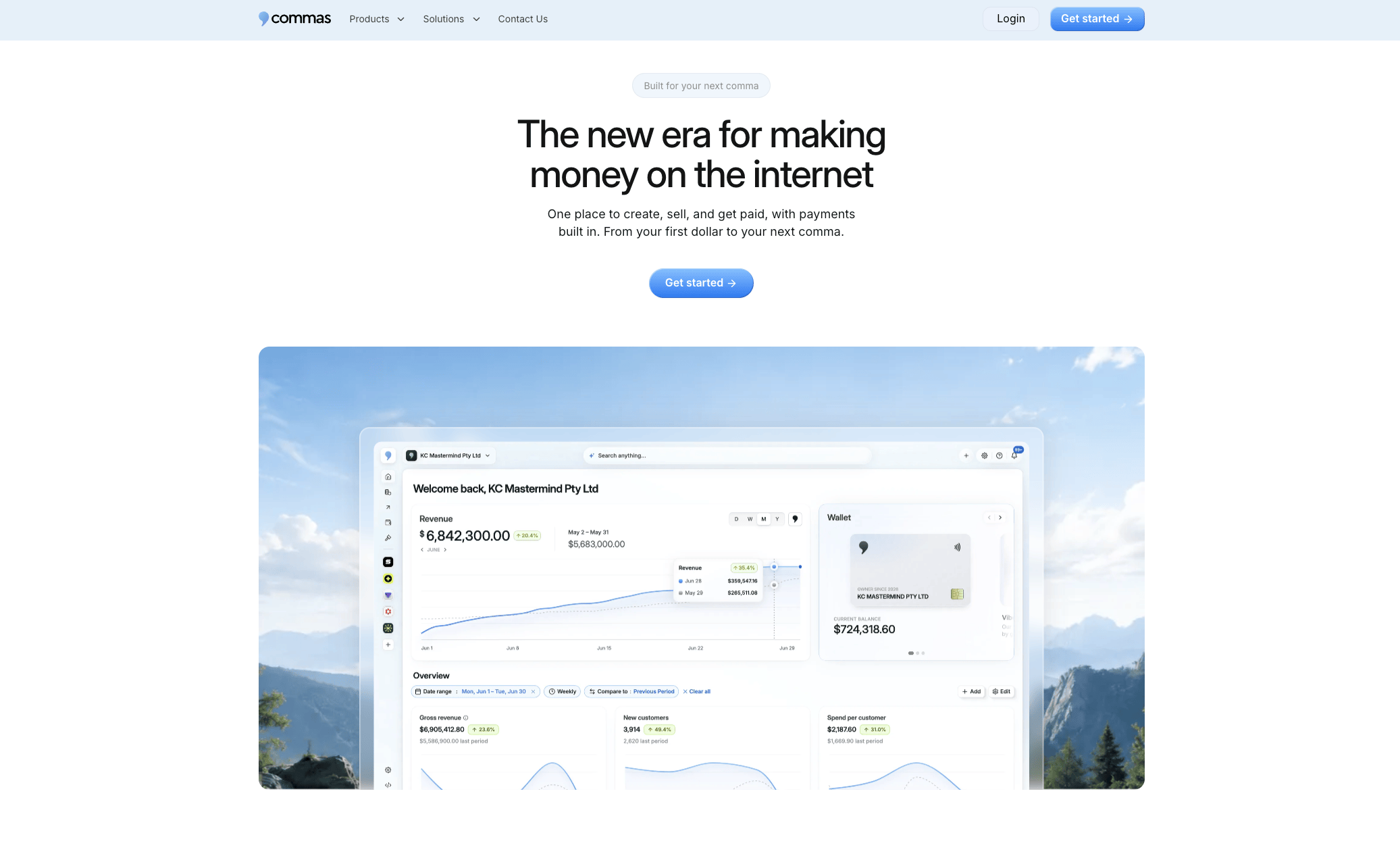
If you are choosing between Gumroad and Shopify because your offers are growing past the point where a product link works, look at the whole path before you decide. Commas combines checkout, AI-built funnels, upsell management, courses, paid communities, webinars and an affiliate system in a single dashboard.
Start with Vibe Funnels for the sales path and Commas Payments for the checkout side, or book a demo from the main site.
FAQ
Is Gumroad or Shopify better for digital products?
Gumroad is built for digital products and delivers files, memberships and license keys without extra apps. Shopify needs apps for digital delivery but gives you a branded store and your own customer list. For high-ticket offers that need funnels, upsells and community, a platform built around those, such as Commas, covers more of the journey in one account.
Which is cheaper, Gumroad or Shopify?
It depends on volume and price. Gumroad has no monthly fee and takes 10% + $0.50 per direct sale, so it is cheapest when sales are rare. Shopify Basic is $39 a month, so it becomes cheaper as sales grow. On a $2,000 offer, Gumroad's commission alone is $200.50 per sale.
Does Gumroad handle sales tax?
Yes. Gumroad has acted as merchant of record since January 1, 2025, collecting and remitting sales tax, VAT and GST. That does not cover your own income tax or every reporting duty, so check your situation with an accountant. On Shopify, you handle tax registration and remittance yourself.
Can I use Gumroad and Shopify together?
Yes. Sellers embed Gumroad checkout buttons in Shopify pages or keep digital products on Gumroad and physical goods on Shopify as separate catalogs. It works, but it splits your customer data across two systems, which is one reason sellers of larger offers prefer a single platform.
Sources
- Where to sell digital products: 2026 fees compared
- Shopify Fees 2026: What You Really Pay Per Sale
- Gumroad Pricing 2026
- Gumroad vs Shopify (2026): Fees, Plans and Fit
- Use Shopify + Gumroad Together 2026
- Gumroad vs Shopify (2026): Fees, Tax and Break-Even
- Best Platform to Sell Digital Products: Fees Compared (2026)
- Gumroad vs Shopify (2026): Fees & Digital Products
- Shopify vs WooCommerce 2026 for Digital Products
- Shopify vs Gumroad (2026): Which Is Better for Creators?
- Shopify vs Gumroad: Best for Creator Commerce (2026)