

The right FastSpring alternative depends on what you sell. Software companies that want someone else to carry global tax liability usually look at Paddle or Lemon Squeezy. Sellers of courses, coaching, communities and other $1,000 to $10,000 offers usually need something different: checkout, funnels, delivery and payments in one place. That is where Commas fits. This guide compares the main options on fees, tax handling, checkout control and fit, so you can narrow the list in one sitting.
TL;DR
- FastSpring is a merchant of record (MoR) built mainly for software sales. It does not publish a price page, and third-party reviews put its baseline rate around 5.9% + $0.95 per transaction.
- Paddle is the closest like-for-like replacement. Lemon Squeezy, Polar and Gumroad suit smaller or simpler catalogs. Stripe gives you lower fees but leaves tax liability with you.
- If you sell high-ticket courses, coaching, paid communities or webinar offers, a platform that joins funnels, checkout, delivery and payments can replace several tools at once.
- Compare options by effective rate on your real orders, not by the headline percentage.
Table of Contents
- Why sellers look beyond FastSpring
- Quick comparison
- Paddle
- Lemon Squeezy
- Polar and Gumroad
- Stripe
- Commas for high-ticket courses, coaching and communities
- How to choose
- Switching without losing sales
- Perspective
- Try Commas for your next offer
- FAQ
- Sources
Why sellers look beyond FastSpring
FastSpring acts as the merchant of record in 200+ countries and handles VAT, GST and US sales tax, with strong support for upgrade pricing, cross-sells and order bumps. For a software vendor with global buyers, that is a real strength. The reasons people start searching for an alternative tend to be the same few.
Opaque pricing. FastSpring has no public pricing page. According to one review, you enter a sales process, share volume and product mix, and receive a custom quote that bundles processing, tax, subscription billing and fraud operations into one revenue share. That makes side-by-side comparison hard.
Cost once everything is counted. A pricing review confirmed on November 5, 2026 puts the baseline at roughly 5.9% + $0.95 per transaction for growth-stage companies. It says rates can reach 8.9% for low-volume or high-risk accounts, and that effective fees on monthly subscriptions land at 9% to 11% once all costs are included. Treat these as third-party estimates and get your own quote.
Payout timing. The same review reports payouts twice a month, on the 15th and at month end, with a 45-day hold on initial payouts for new accounts. If you run paid ads against a high-ticket offer, cash timing matters as much as the rate.
Dashboard and customization. A review summarizing Fungies' view says the dashboard feels dated and the analytics trail dedicated tools, while checkout is more customizable than Paddle's. Opinions differ, so look at the screens yourself.
None of this makes FastSpring a bad choice for the right business. It means the question to answer first is what you actually sell.

Quick comparison
Figures below come from the cited pages and reflect when each was published. Confirm current terms on each provider's own site before you decide.
| Option | Model | Published rate | Best for |
|---|---|---|---|
| FastSpring | Merchant of record | Custom quote; reviews cite about 5.9% + $0.95 | Software with complex catalogs and global buyers |
| Paddle | Merchant of record | Check Paddle's pricing page | SaaS replacing FastSpring directly |
| Lemon Squeezy | Merchant of record | 5% + $0.50, plus extras | Early-stage digital products |
| Polar | Merchant of record | 4% per transaction | Developer tools and open source |
| Gumroad | Marketplace-style seller platform | 10% flat | Small creator products |
| Stripe | Payment provider, you stay merchant | 2.9% + $0.30 | Teams that handle tax themselves |
| Commas | Sales platform with payments built in | Contact Commas for pricing | High-ticket courses, coaching, communities, webinars |
Paddle
Paddle is the option most reviewers name first. Its checkout is fully hosted but embeddable, which answers the customization complaint without making you build your own. It supports subscription billing, trials, coupons and metered usage. On tax, it covers VAT in 200+ countries and territories, US sales tax in states with economic nexus, and compliant invoices for business buyers.
One developer who wired up Stripe, Paddle and Lemon Squeezy found that Paddle has flexible pricing models but the trickiest webhook signature format. Budget developer time for the integration.
For a longer look at the field, see our guide to Paddle alternatives for high-ticket sellers.
Lemon Squeezy
Lemon Squeezy charges 5% + $0.50 per transaction with no monthly fee. Extras apply: 1.5% for non-US cards, 0.5% for subscription renewals and 1.5% for PayPal. Stripe acquired it in July 2024, and in January 2026 it announced it would move merchants to Stripe Managed Payments, per the same source. If you are choosing today, check the current migration status on Lemon Squeezy's own pages.
The same reviewer notes that the MoR tax handling can justify the premium for international sellers, while US-only sellers with simpler tax needs may find Stripe's lower rate more economical.
We cover the details in Lemon Squeezy alternatives for high-ticket sellers.
Polar and Gumroad
Polar charges 4% per transaction with MoR included and is aimed at developer tools and open-source monetization. If your buyers are developers and your product ships through repositories, it deserves a look.
Gumroad charges a flat 10% per transaction and has no B2B invoicing or subscription complexity. It works for small creator products. A $3,000 program at a flat 10% costs $300 in fees on one sale, so the math changes quickly as ticket size grows.
Stripe
Stripe is a payment provider, not a merchant of record. When you process through it, you remain the merchant of record and keep VAT, GST and sales tax obligations. Adding Avalara or TaxJar handles calculation and filing, but the liability stays with you. The headline rate of 2.9% + $0.30 is lower than any MoR above, which is why teams with an accountant and mostly domestic sales often pick it.
Stripe is a building block. You still need funnels, a checkout experience, course or community delivery, upsells and an affiliate system, either built or bought. Our roundup of the best subscription software for sellers of $1,000+ offers and the guides to Chargebee alternatives and Recurly alternatives cover the billing layer on top.
Commas for high-ticket courses, coaching and communities
FastSpring and its closest rivals were designed around software licenses and SaaS plans. If you sell a $1,000 to $10,000 offer, such as a coaching program, a cohort course, a paid community or an agency retainer, your problem is usually different. You are stitching together a funnel builder, a checkout, a payment plan tool, a course host and a community app, and the handoffs between them leak revenue.
Commas is one platform where online businesses sell and get paid. It combines:
- Checkout and payments, including one-click payments, buy now pay later and subscriptions. Commas runs payments through regulated payment partners.
- Funnels, built with drag-and-drop tools and AI-assisted building in Vibe Funnels, plus funnel import, automation and upsell management.
- Delivery, through online courses and paid groups.
- Webinars with checkout in the room, and an affiliate center for partner sales.
- Analytics in one dashboard, so you see the offer from first click to payment.
Our positioning is simple: fewer apps between the ad and the payment. We also build tools to recover failed subscription payments and to help maximize approvals, which matters when a payment plan runs for six or twelve months.
How to choose
Work through these questions in order.
1. What are you selling?
Software licenses and SaaS plans point toward FastSpring, Paddle or Lemon Squeezy. Courses, coaching, communities and webinars point toward a platform that includes delivery and funnels. Developer tools point toward Polar.
2. Where do your buyers live?
If most buyers are international and you want tax handling bundled into the fee, MoR providers are built for that. If most buyers are in one country, the calculation is simpler. For a view of cross-border selling on one platform, read how to accept international payments online.
3. What is your effective rate?

The headline percentage is only part of it. Before signing with any provider, one reviewer advises asking whether the fee is retained on refunds, what the currency-conversion spread is on non-USD payouts, and how long payouts take. Then model the total on a real basket of orders.
Here is a worked example with figures from the pages above, using a $3,000 offer and ignoring tax, refunds and currency:
| Option | Calculation | Fee on one $3,000 sale |
|---|---|---|
| FastSpring (estimate) | 5.9% of $3,000 + $0.95 | $177.95 |
| Lemon Squeezy | 5% of $3,000 + $0.50 | $150.50 |
| Polar | 4% of $3,000 | $120.00 |
| Gumroad | 10% of $3,000 | $300.00 |
| Stripe | 2.9% of $3,000 + $0.30 | $87.30 |
This is arithmetic on published or reported rates, not a quote, and each option includes different services. Our guide to payment processing fees explains how to build the same model for your own offers.
4. How will you take payment?
High-ticket buyers often want to split the price. Check that the platform supports payment plans, buy now pay later and subscriptions, and what it does when a card fails. Our primer on subscription payments and click-to-cancel rules covers billing practice, and launching compliant subscription payments walks through setup.
5. How much do you want to stitch together?
Every extra tool is another login, another integration and another place where a buyer can drop off. Count the tools in your current stack. If it is more than three, consolidating may save more than a lower fee would.
Switching without losing sales
A few steps keep a migration calm.
- List every product and price point, including bumps, upsells and payment plans.
- Export customer and subscription data and ask the new provider how existing subscribers are handled.
- Rebuild the funnel on the new platform and test a full purchase end to end before you point traffic at it.
- Run both systems in parallel for a short period for new sales only, so existing customers and payouts are not disrupted.
- Check payout timing with the new provider and plan cash flow around the change, especially if the new account has an initial hold.
If you already have funnels elsewhere, Commas supports funnel import so you are not starting from a blank page.
Perspective
We talk to sellers every week who started on a software-oriented checkout and ended up with a course host, a funnel builder, a community app and a payment plan tool bolted on beside it. The invoice for each tool is visible. The cost of the gaps between them is not: a buyer who leaves between the sales page and the checkout, a failed card on payment two of six, an affiliate sale that never reaches the right dashboard.
That is why we built Commas as one platform. For a $1,000 to $10,000 offer, the sale is a sequence: the page, the call or webinar, the checkout, the payment plan, the access, the follow-up. When those steps share one account, you can see where people drop and change it without waiting on three vendors.
Our funnel tools are designed to apply proven patterns, our payments run through regulated payment partners, and our recovery tools are designed to help you keep subscriptions that would otherwise lapse. If your product is a software license sold to developers in 100 countries, a dedicated merchant of record may be the closer fit. If your product is expertise, access or community, we think one connected platform is the stronger starting point.
Commas
Try Commas for your next offer
If you sell courses, coaching, paid communities or webinar-led offers, start with how your payments and funnels fit together. Commas puts checkout, funnels, delivery and affiliates in one dashboard, with payments run through regulated payment partners.
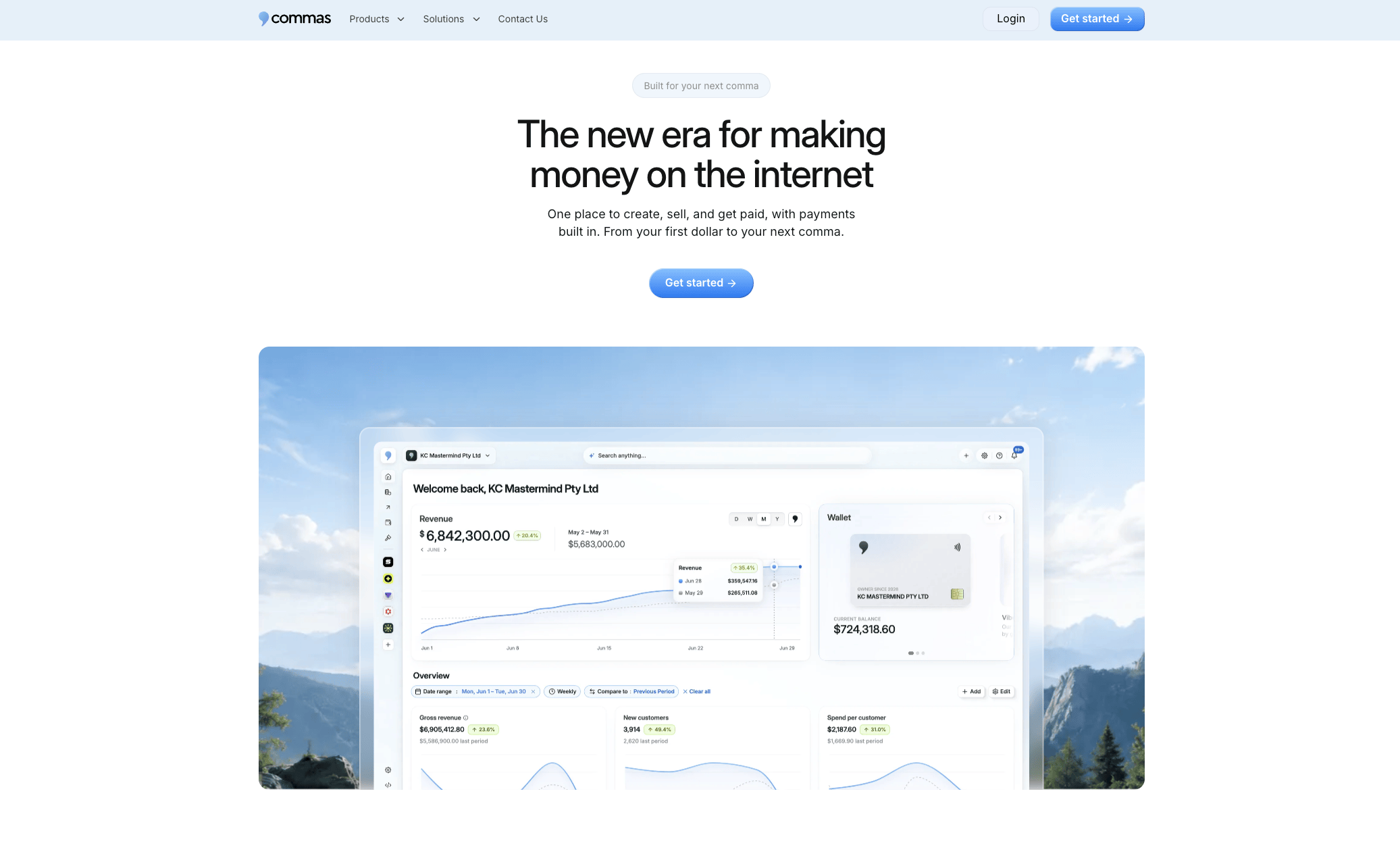
See how it works on Commas Payments, or book a look at the platform with your own offer in mind.
FAQ
How much does FastSpring cost?
FastSpring does not publish a price page. You request a custom quote based on volume and product mix. A pricing review confirmed in November 2026 cites about 5.9% + $0.95 per transaction as a baseline for growth-stage companies, so treat that as an estimate and ask FastSpring for current terms.
What is the closest alternative to FastSpring?
Paddle is the one most comparison pages name as the nearest match, since both are merchants of record with tax handling, subscription billing and hosted checkout. Lemon Squeezy and Polar are lighter options for earlier-stage or developer-focused products.
Do I need a merchant of record?
It depends on where you sell and who handles tax. With a provider like Stripe, you stay the merchant of record and keep the VAT, GST and sales tax obligations. With a merchant of record, the provider takes on that role. Talk to your accountant about your specific countries and thresholds before choosing.
Which option suits courses and coaching?
Courses, coaching and communities need more than a payment page: funnels, delivery, payment plans and upsells. A platform that joins these, such as Commas, is designed for that kind of $1,000 to $10,000 sale. Software-license sellers have different needs, so match the tool to the product.
Sources
- Best Merchant of Record Platforms for Digital Products
- 9 Best FastSpring Alternatives for B2B SaaS (MoR Compared)
- FastSpring Pricing 2026: Plans, Hidden Costs and Alternatives
- Can FastSpring Simplify Global Software Sales?
- Best Stripe Alternatives for Indie Hackers in 2026
- FastSpring Review 2026
- Stripe vs Paddle vs Lemon Squeezy: Wiring All Three