
Pick one narrow digital product, run a smoke test for a week, and only build after you see real buyer intent. If ten people click "buy" on a landing page or reply to a direct pitch, you have enough proof to launch. Sellers who validate this way often land their first sale within a few weeks, and a platform can handle checkout, delivery, and funnels in one place so you're not stitching together multiple tools before you've made a dollar.
TL;DR:
- Validate demand with a smoke test landing page or direct outreach, focusing on real commitments or purchase signals from at least three out of ten contacts.
- Use a hybrid selling approach, starting with marketplaces for initial discovery and shifting to owned stores and email lists for long-term control and customer retention.
- Price digital products based on the outcome delivered, experiment with two price points during the first sales phase, and bundle offerings to increase average order value.
- Choose sales platforms that provide integrated checkout, delivery, tax handling, and analytics to avoid fragmentation and streamline the launch process.
- Track key metrics such as conversion rate, average order value, and refund rate to identify issues and optimize during the first thirty days of sales.
Table of Contents
- Which Digital Product Should You Sell First?
- How Do You Validate Demand Before You Build?
- Where to Sell: Your Own Store, a Marketplace, or a Merchant of Record
- What Price Should You Charge, and How Should You Package It?
- What Checkout, Delivery, and Legal Basics Do You Need?
- How Do You Launch and Get Your First Sales?
- Which Tools Actually Handle a Digital Product Launch?
- Your 30-Day Launch Checklist
- How Should You Handle Support and Refunds?
- How Do You Scale After Your First Sales?
- What Metrics Should You Track for Digital Product Sales?
- What I've Learned Watching Digital Product Launches Succeed and Fail
- Let Commas Run the Parts You'd Rather Not Build Yourself
- Sources
Which Digital Product Should You Sell First?
The best first product is narrow, fast to make, and solves one specific problem for one specific person. Digital products cover a wide range of formats, but they share one trait: once you build them, they scale with almost no cost to reproduce, unlike physical inventory that needs restocking.
Here's what's realistic to build in under two weeks:
- Ebooks and guides: low production cost, best for topics you can explain in 5,000 to 15,000 words.
- Templates and swipe files: spreadsheets, Notion boards, design files, contracts. These sell well because buyers save hours instead of learning a skill.
- Mini-courses: five to ten short videos solving one transformation, not a full curriculum.
- Software and tools: higher effort, but strong margins once built, especially browser extensions or simple SaaS tools.
- Memberships and communities: recurring revenue, but require ongoing content or engagement to retain members.
- Digital assets: stock photos, fonts, audio packs, icon sets sold individually or in bundles.
The decision rule is simple: pick the outcome first, then pick the format. Don't ask "should I make a course or an ebook?" Ask "what result does my audience want fastest?" A tired freelancer wants an invoice template, not a 40-lesson course on financial literacy. Match the format to the smallest believable promise you can deliver this week.
How Do You Validate Demand Before You Build?
Test demand before you spend a single hour building the full product. This one step separates sellers who make money in month one from sellers who spend three months building something nobody wants.
- Build a smoke-test landing page. Write the offer, the price, and a "Buy Now" or "Join Waitlist" button, then drive a small amount of targeted traffic to it. Measuring click-to-buy and waitlist conversion tells you fast whether the offer resonates or falls flat.
- Run a pre-sale. Charge full price before the product exists, with a clear delivery date. Real money moving is a far stronger signal than likes or comments.
- Message ten potential buyers directly. Skip the ads. Send a personal DM or email describing the product and ask if they'd pay for it. Vague interest doesn't count. A yes with a card number does.
What counts as a green light? If your landing page converts at a low but meaningful rate on cold traffic, or three or more of your ten direct outreach contacts commit to buying, you have enough signal to build. If you get polite interest but zero commitments, the idea needs a new angle, not a bigger marketing budget.
Pro Tip: Run the outreach test before the landing page. It's free, it's faster, and rejection at this stage teaches you more about pricing and positioning than any amount of A/B testing later.
Where to Sell: Your Own Store, a Marketplace, or a Merchant of Record
Your selling route depends on how much margin you want to keep versus how much traffic you need someone else to bring you. There are three real options, and each trades control for convenience differently.
Owned store. You control the checkout, the customer data, the branding, and you keep the largest share of revenue. The tradeoff: you're responsible for driving your own traffic, and depending on your platform, you may need to handle sales tax and VAT collection yourself.
Merchant of record. A merchant-of-record service processes the payment and takes on tax compliance for you, usually for a percentage fee. This route works well if you're selling across many countries and don't want to manage VAT registration in each one, but you give up some margin for that convenience.
Marketplace. Third-party platforms give you built-in discovery, meaning buyers who weren't already looking for you can find your product. The cost is a larger cut of each sale, less control over pricing and branding, and no direct relationship with the buyer's email or data.
Quick decision guide:
- Small existing audience, want max margin and full customer ownership → owned store
- Selling globally, want to avoid tax paperwork → merchant of record
- No audience yet, need visibility to get first sales → marketplace, then migrate to owned store once you have proof
Most sellers land on a hybrid: list on a marketplace for early discovery, then push buyers toward an owned store and email list for repeat purchases. An owned email list stays the most durable asset you build, since it keeps you independent of any platform's algorithm or policy change.
What Price Should You Charge, and How Should You Package It?
Price on the outcome the buyer gets, not on how many hours you spent making the product. A template that saves someone significant time is worth more than its file size suggests.
Common starting price ranges vary broadly depending on complexity and value delivered. Membership pricing depends on ongoing content volume.
Subscriptions make sense when you're delivering continuous value, like fresh templates monthly or an active community. Tiering works when different buyers want different depth. Offer a "core" tier at your baseline price and a "complete" tier that bundles in templates, coaching calls, or bonus modules.
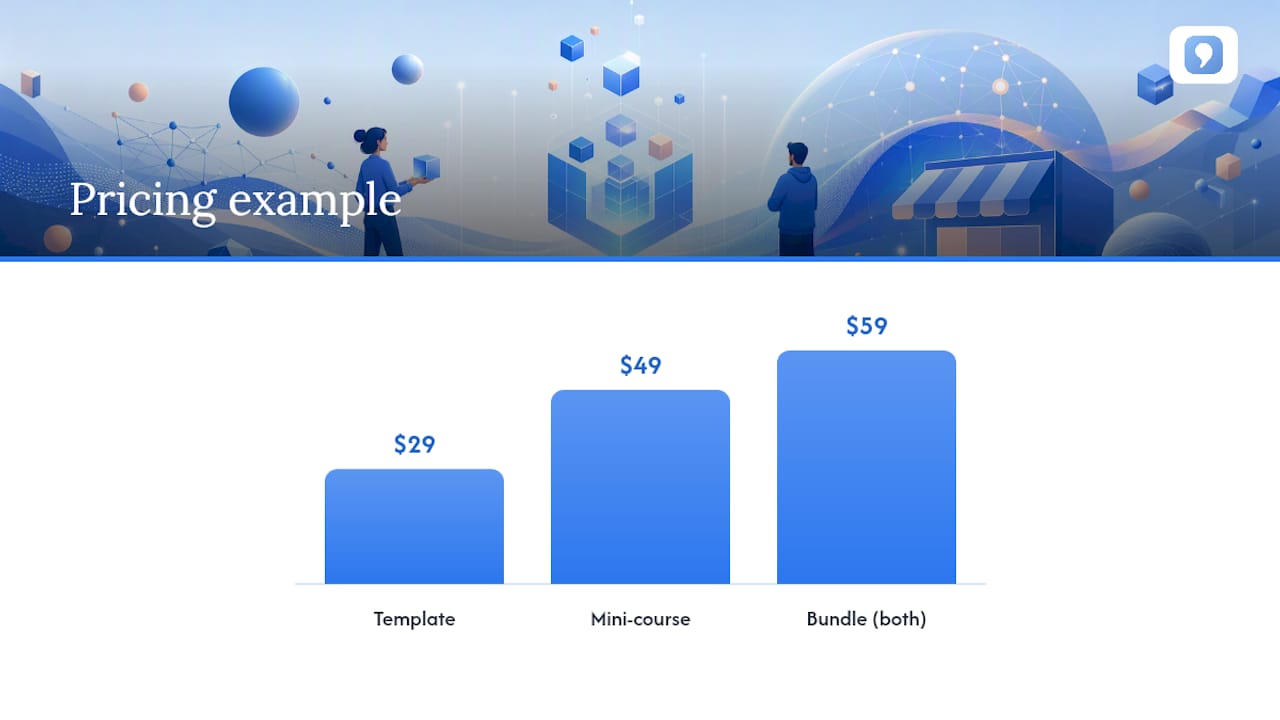
Bundling raises average order value fast. Pairing your $29 template with a $49 mini-course as a $59 bundle feels like a deal to the buyer while lifting your revenue per transaction.
Pro Tip: Test two price points during your first two weeks of sales, not two features. A $10 gap in price tells you more about buyer sensitivity than any survey question ever will.
What Checkout, Delivery, and Legal Basics Do You Need?
Getting paid and delivering the file are the two moments where sales quietly fall apart. A slow checkout or a broken download link loses a customer who already had their card out.
Checkout features worth checking before you commit to a platform:
- One-click or saved-payment checkout to cut abandonment at the final step
- Support for digital wallets like Apple Pay and Google Pay
- Built-in subscription billing if you're selling memberships
- A clear refund workflow that doesn't require manual intervention every time
File delivery needs its own protection layer. Expiring download links, watermarked PDFs, and license keys for software all reduce casual sharing without punishing legitimate buyers. None of these stop a determined pirate, but they cut down on the accidental resharing that costs you real sales.
Tax handling depends on your route. If you're using an owned store without built-in automation, you're often responsible for collecting and remitting VAT or sales tax yourself once you cross certain revenue thresholds in specific countries. A merchant-of-record setup handles this automatically for a fee. Either way, talk to an accountant once you're selling in more than one or two countries. Tax rules for digital goods vary sharply by jurisdiction, and guessing wrong gets expensive fast.
How Do You Launch and Get Your First Sales?
Your launch sequence depends entirely on whether you already have an audience.
If you have an email list or social following:
- Send a three-part email sequence: announce the problem, reveal the solution, then close with early-bird pricing and a deadline.
- Offer the first 48 hours at a discount to reward your most engaged followers and create urgency.
- Collect testimonials from your earliest buyers immediately, then feature them on your sales page within days, not weeks.
If you're starting with zero audience:
- List on one or two relevant marketplaces first, since they bring built-in search traffic you don't have to generate yourself.
- Reach out directly to 20 to 30 people in relevant online communities or forums with a specific, non-spammy pitch.
- Run a small paid test, $20 to $50, on a single platform to see if cold traffic converts at all before scaling spend.
Conversion optimization matters as much as traffic. Your product page copy should state the outcome in the headline, not the feature list. Your call-to-action button should say what happens next ("Get the Template" beats "Submit"). And your post-purchase flow should immediately deliver the file and set up the next offer. Pairing this with CRM-driven outreach keeps your early buyer list organized instead of scattered across spreadsheets and inboxes.
Pro Tip: Your first 10 sales matter more for feedback than revenue. Ask every early buyer one question: "What almost stopped you from buying?" That answer fixes more conversion problems than any headline tweak.
Which Tools Actually Handle a Digital Product Launch?
Before picking a platform, check it against six things: automatic file delivery, checkout speed, tax handling, analytics, funnel building, and affiliate support. Missing any one of these means you'll be duct-taping a second tool into your stack within weeks.
Most sellers start with separate tools for payments, email, landing pages, and course hosting, then spend months reconnecting them every time one updates its API. That fragmentation is the real cost of "flexible" tool stacks, not the subscription fees.
An integrated platform removes that friction by putting funnel building, checkout and payments, and analytics under one login. One platform takes this approach specifically for creators selling courses, communities, and digital downloads, with AI-assisted funnel optimization built on patterns from existing high-converting pages rather than manual guesswork.
This setup fits best for creators, coaches, and small teams who want one dashboard instead of five logins. If you're already deep into a specific marketplace's audience and don't need your own store yet, staying there a while longer makes sense. But once you're ready to own your customer relationship and stop paying a marketplace's discovery tax on every sale, an integrated funnel and payment system becomes worth the switch.
Your 30-Day Launch Checklist
- Week 1: Pick one narrow product idea. Build a one-page landing site with your offer, price, and a buy or waitlist button.
- Week 2: Drive outreach and small traffic to that page. Message ten potential buyers directly and track how many commit.
- Week 3: Build the minimum viable version of the product. Set up checkout and file delivery so a real transaction can complete end to end.
- Week 4: Launch publicly, send your announcement sequence, and track your first sales. Adjust price or messaging based on what actually converts.
How Should You Handle Support and Refunds?
A clear refund policy builds more trust before the sale than it costs you after it. Post your policy on the product page itself, not buried in a footer link. A simple short refund window for digital products, stated plainly, removes the biggest hesitation buyers have: "what if this doesn't work for me?"
Refund requests for digital goods are usually low if the product page set accurate expectations. Most refund requests trace back to a mismatch between what the sales page promised and what the buyer actually received, not buyer's remorse. That means your best refund policy is a more honest product description, not a stricter refund rule.
For support, set expectations up front: a response window (24 to 48 hours is standard for solo sellers), and one clear channel, whether that's email or a help widget. Don't scatter support across five platforms where messages get lost. For memberships and courses, a simple FAQ page or pinned community post handles 80% of repeat questions without needing a live reply every time.
Track refund rate as a metric from day one. An increasing refund rate on a low-ticket digital product usually signals a page copy problem, not a product quality problem. Fix the description before you touch the product itself.
How Do You Scale After Your First Sales?
Scaling starts with the product ladder, not with more ads. Once your first narrow product sells consistently, add a higher-ticket offer above it and a smaller lead magnet below it. This structure, moving buyers from a free or low-cost entry point toward mid and high-ticket offers, increases how much each customer spends over time instead of relying only on new traffic.

The second lever is distribution you don't have to run yourself. Setting up an affiliate program lets other creators promote your product for a commission, which multiplies your reach without multiplying your own marketing hours. This works especially well once you have a proven product with real conversion data to show potential affiliates.
The third lever is your email list. Every new subscriber you capture from a sale or a lead magnet becomes a channel for your next launch, your next price test, and your next bundle offer, all without paying for traffic again. Sellers who treat list growth as a core metric, not a side effect, tend to scale faster than those chasing new customers for every single sale.
Resist the urge to build five products before your first one is fully validated. A product ladder works only once the bottom rung is proven. Add the next rung, then the next, watching each one's numbers before committing more time.
What Metrics Should You Track for Digital Product Sales?
Three numbers matter more than the rest combined: conversion rate, average order value, and refund rate. Everything else is supporting detail.
Conversion rate tells you whether your page and offer are working. Track it separately for cold traffic versus warm traffic (email list, social followers), since mixing them hides whether your organic audience or your outreach is doing the real work.
Average order value shows whether your bundling and upsell strategy is paying off. If it's flat month over month, your post-purchase offers aren't landing, regardless of how many new customers you bring in.
Refund rate, covered above, is your early warning system for a mismatch between promise and delivery.
Beyond those three, watch email list growth rate and repeat purchase rate if you're running a product ladder. A healthy digital product business usually sees a meaningful share of revenue coming from repeat buyers within a few months, not just first-time sales. If that number stays near zero past your first 90 days, your product ladder or your follow-up emails need work, not your traffic volume.
Set up analytics before launch, not after. Trying to reconstruct what happened during your first sales week from memory loses the exact data that would tell you what to fix.
What I've Learned Watching Digital Product Launches Succeed and Fail
The sellers who win aren't the ones with the best product. They're the ones who validated before building and who owned their customer relationship from sale one. Every failed launch I've studied shares a pattern: months spent perfecting a product nobody asked to buy, followed by a scramble to find an audience after the fact.
Run the smoke test first. Keep your email list no matter which platform you sell through. Treat your first ten sales as research, not revenue. Small, fast experiments beat big, slow bets almost every time in this business.
— FanBasis
Let Commas Run the Parts You'd Rather Not Build Yourself
Stitching together a landing page tool, a separate checkout processor, an email platform, and a course host is exactly the fragmentation this guide just walked you through avoiding. Commas puts funnel building, checkout, community hosting, and analytics into one dashboard, so the 30-day plan above doesn't require five different logins to execute.

This fits creators, coaches, and small teams selling courses, templates, or memberships who want their smoke test, their checkout, and their launch emails running from the same account instead of using multiple disconnected tools that break when one updates. The AI-assisted funnel optimization inside the platform draws on proven conversion patterns, so your product page and checkout flow start closer to "working" instead of "guessing."
If you're past the outreach stage and ready to build your landing page, checkout, and delivery system in one place, start with the Commas platform and set up your first funnel, or go straight to selling online courses if that's the format you validated this week.
Sources
- How to Sell Digital Products: your Guide to Getting Started | Salesforce
- Sell Digital Products Online: The Complete 2026 Guide