

If you are looking for Ghost alternatives because your business now sells coaching, courses, memberships or services at $1,000 to $10,000, the best replacement is not another publishing tool. It is a platform where checkout, funnels, courses, community and payments live in one account. That is what Commas is built for, and the rest of this guide shows how it compares with WordPress, Webflow, HubSpot Content Hub, Substack, beehiiv and Kit.
Ghost does one job very well: it publishes. The trouble starts when your revenue depends on what happens after the reader finishes the article.
TL;DR
- Ghost is a clean, open-source publishing platform. It was not designed to run a high-ticket sales process with funnels, upsells, installment plans and affiliates.
- If you sell $1,000 to $10,000 offers, pick a platform by what happens at checkout and after it, not by editor quality.
- Commas puts payments, funnels, courses, paid groups, webinars and affiliates in one dashboard, so you stop stitching apps together.
- WordPress, Webflow and HubSpot Content Hub are stronger as site builders, but each leaves memberships, payments or email to add-ons.
- Moving off Ghost takes a few weeks for one publication. Export content and members first, and keep suppressed contacts suppressed.
Table of Contents
- Why sellers outgrow Ghost
- What to check before you choose
- The main Ghost alternatives compared
- Match the platform to your offer
- What moving off Ghost involves
- Perspective
- Where to start with Commas
- FAQ
- Sources
Why sellers outgrow Ghost
Ghost is open-source software under the MIT license, run by a non-profit foundation founded in 2013. It suits newsletter-led publications with built-in memberships and simple operations. Those are real strengths, and they are why a writer with a paid newsletter is happy there.
A seller of a $5,000 program has a different list of needs:
- A checkout that offers one-click payment, installment plans or buy now, pay later.
- A funnel with a sales page, an application or booking step, upsells and a follow-up sequence.
- Delivery of a course or a private community after payment.
- Recovery of failed subscription payments, because a declined card on a $500 monthly plan is real money.
- Affiliates or partners who send buyers and need tracked commissions.
Ghost's own review notes that its content is fixed to posts and pages and that it lacks multi-site management and multilingual support. The same reviewer rates its publishing surface as deliberately small: two content types and six API resources. Small is good for publishing. For a sales operation it means the funnel, the payments logic and the customer area all have to come from somewhere else.
That "somewhere else" is the hidden cost. A common setup pairs Ghost with a separate email tool, which means two tools, two subscriber lists and unsubscribe sync to maintain. Add a checkout app, a course host and a community app, and you have five logins and five places where a customer record can go out of date.
What to check before you choose
Use these questions on every option, including ours.
- Where does the money go through? Does checkout, subscription billing and failed-payment recovery sit inside the platform, or in a third-party add-on?
- Can you build the whole funnel? Sales page, order form, upsell, follow-up, all without a developer.
- Can you deliver what you sold? Courses, a paid community, live sessions.
- Can partners sell for you? Affiliate tracking and payouts.
- What does one customer record look like? One buyer, one profile, one history, or several.
- What does migration cost in time? Content, members and subscription state all have to move.
The main Ghost alternatives compared
| Option | Best at | Where it leaves work for you |
|---|---|---|
| Commas | Selling and getting paid: checkout, funnels, courses, paid groups, webinars, affiliates | Not a blog-first CMS, so it is built around offers rather than long editorial archives |
| WordPress | Flexible sites and large content libraries | Memberships and newsletters come from plugins |
| Webflow | Visual design and custom CMS collections | No built-in memberships or email engine |
| HubSpot Content Hub | Publishing tied to a CRM, forms and automation | Setup and cost grow with the structure you add |
| Substack | Writers building a paid newsletter audience | Not a funnel or course platform |
| beehiiv | High-volume newsletters with ads and list growth | Built around newsletters, not high-ticket sales |
| Kit | Email sequences | Not a CMS, so it cannot gate content by tier |
Commas: the pick for high-ticket sellers
Commas is one platform where online businesses sell and get paid. Checkout, funnels, courses, paid communities, webinars and affiliates sit in a single dashboard, with payments built in. Commas runs payments through regulated payment partners, and the checkout supports one-click payments, buy now, pay later and subscriptions. Automated tools help recover failed subscription payments.
On the funnel side, Vibe Funnels is our AI-powered drag-and-drop builder. It is designed to shape funnels on proven patterns, and it can import and automate funnels you already have. Upsell management sits in the same place as the checkout.
For delivery, online courses and paid groups share the account that took the payment. When a customer buys, the access follows from the same record. The Affiliate Center lets partners promote your offer, and analytics show what is converting.
This is the answer for a coach, course creator, agency or paid community that already makes sales and wants fewer moving parts. If you are weighing the same question from other directions, our guides on Substack alternatives for high-ticket sellers and ThriveCart alternatives cover the neighboring decisions.

WordPress
WordPress is the safest choice if your main asset is a large content archive and you have a developer or agency. The cost is operational. One review counted 11,334 new vulnerabilities across the WordPress ecosystem in 2025, 91% of them in plugins, and it points out that newsletters and memberships are plugins rather than a product. For a business that takes $3,000 payments, every plugin that touches checkout or member access is something to keep updated and secured.
Webflow
Webflow offers a visual builder with custom CMS collections and real-time collaboration. The same review notes that Webflow retired its User Accounts feature in January 2026, so paywalls and memberships need a third party, and there is no email engine. It is a strong choice for a design-led marketing site. Selling and delivering a program still requires other tools.
HubSpot Content Hub
HubSpot adds forms, email, automation and a CRM to publishing, with plans starting at $15 a month per the same scorecard, which rated it 6.8 out of 10 among Ghost alternatives. It suits marketing teams that already live in the HubSpot ecosystem. It is a content and marketing system first, not a place to deliver a course or host a paid community.
Substack, beehiiv and Kit
These are newsletter tools, and they answer a newsletter question. One comparison recommends Substack for writers starting with no audience, and beehiiv for high-volume, ad-supported newsletter operations. Kit is strong at email sequences, but it is not a CMS and cannot gate content by membership tier. If your product is a $2,500 program rather than a subscription to writing, none of these replaces the checkout, funnel and delivery layer.
Headless options
Storyblok, DatoCMS and Prismic stay closest to Ghost's simplicity, according to the DXP Scorecard. They are developer tools. They suit teams that want to build their own front end, not sellers who want a funnel live this week.
Match the platform to your offer
You sell a $1,000 to $10,000 program with a sales call. You need an application or booking step, a checkout with installment options and a follow-up sequence. This is the clearest case for Commas, because the funnel and the payment plan live in the same system. See our page on selling coaching online.

You run a course with upsells. Course delivery, order bumps and one-click upsells belong together. Splitting them across a CMS, a checkout app and a course host is where abandoned carts and manual access fixes come from.
You run a paid community. Billing, failed-payment recovery and access control have to agree with each other. When a card fails, the member's access should follow the payment status.
You publish daily and sell nothing above a subscription. Ghost, Substack or beehiiv remain reasonable. Most of our readers are not in this group, which is why this guide centers on sellers.
What moving off Ghost involves
Migration is manageable when you know the pieces. Ghost exports all content as JSON and members as CSV. The work is rebuilding the theme, moving members and subscription state to a new payments and email stack, and setting up redirects. Plan a few weeks for a single publication.
A practical order:
- Export everything first. Content, members and the list of unsubscribed and bounced contacts. Suppressed contacts must stay suppressed in the new system, or you risk emailing people who opted out.
- Decide what stays as a blog. Many sellers keep articles on a simple site and move the selling to the new platform.
- Rebuild the offer path. Sales page, checkout, upsell and delivery, in that order.
- Move paying members carefully. Active subscriptions need their billing state mapped, so nobody is charged twice or dropped.
- Redirect old URLs. Articles that earn search traffic should point to their new homes.
- Test with a real purchase before you announce anything.
If you also want to move without losing sales, our guide to the creator sales stack for $1k to $10k offers walks through the sequence. For billing rules on recurring plans, read about subscription payments and click to cancel rules.
If you keep a self-hosted Ghost site for your articles while the selling moves to a new platform, keep it protected. Our backup plugins for Ghost reference lists options for that.
Perspective
Most sellers who leave Ghost are not unhappy with Ghost. They are unhappy with the pile of tools around it. A $5,000 sale touches an ad, a landing page, a checkout, an installment plan, a welcome sequence, a course and a community. When each of those is a different app, the customer record is split across all of them, and you spend the week on connections instead of offers.
We built Commas around the opposite idea: one account where the sale is made and the payment is taken, with the funnel, the course, the group, the webinar and the affiliate program attached to the same record. Our AI funnel builder is designed to start from proven funnel patterns, so you are editing a working structure rather than a blank page.
If your revenue comes from high-ticket offers, ask one question of any platform: does it run the whole path from first click to delivered product? We think that is the right test, and it is the one we designed for.
Commas
Where to start with Commas
If you sell offers in the $1,000 to $10,000 range, start with the piece that hurts most. For many sellers that is the funnel and checkout. Vibe Funnels builds the funnel, and Commas Payments handles one-click payment, buy now, pay later and subscriptions through regulated payment partners.
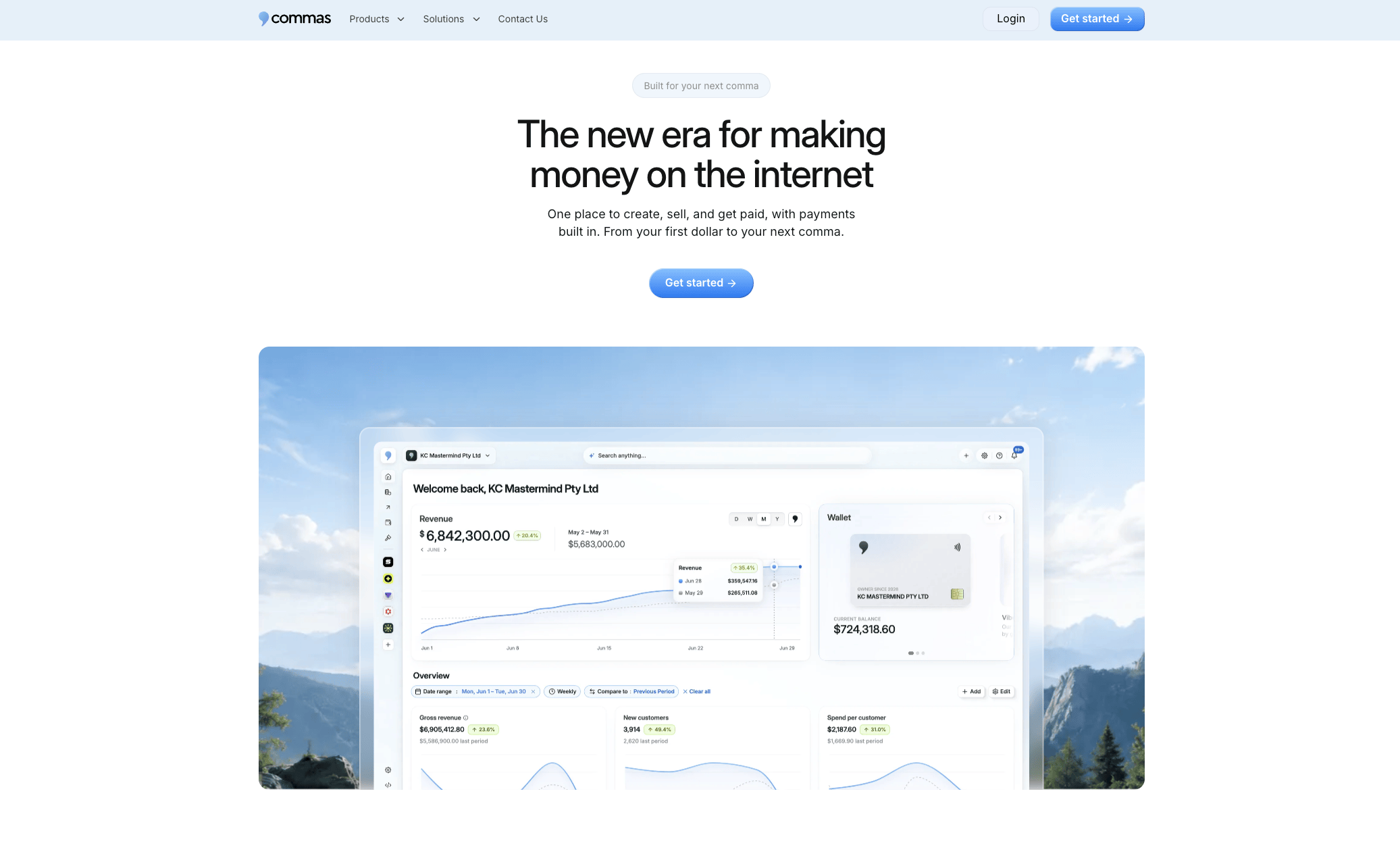
Courses, paid groups, webinars and the affiliate program can be added to the same account as your business grows, and the free trial or demo is the place to see how your own offer would look inside it. Start at commas.com.
FAQ
Can I use Ghost for free?
Ghost is open-source software under the MIT license, so you can self-host it without a license fee. You still pay for a server and for the time to maintain it, and you handle updates and backups yourself. Hosted plans exist for those who prefer not to run a server.
Is Ghost better than Substack?
They solve different problems. Ghost gives you ownership of your site and design, while Substack gives you a ready-made audience network for newsletters. For a seller of high-ticket offers, neither is built around funnels, installment checkout and course delivery.
What is the best Ghost alternative for selling courses and memberships?
Pick a platform where payments, course delivery and community access sit in one account. Commas is built that way, with checkout, courses, paid groups and affiliates in one dashboard. Publishing tools like WordPress or Webflow usually need add-ons for each of those pieces.
How long does it take to migrate from Ghost?
Plan a few weeks for a single publication. The time goes into rebuilding the theme, moving members and subscription state, and setting up redirects, not into the content export itself.
Sources
- Best Ghost Alternatives in 2026, The DXP Scorecard
- Ghost Review 2026: Pros, Cons, Pricing, The DXP Scorecard
- Kit (ConvertKit) vs Ghost, Sequenzy
- Substack vs. Ghost vs. Beehiiv, Dawat Free Media