
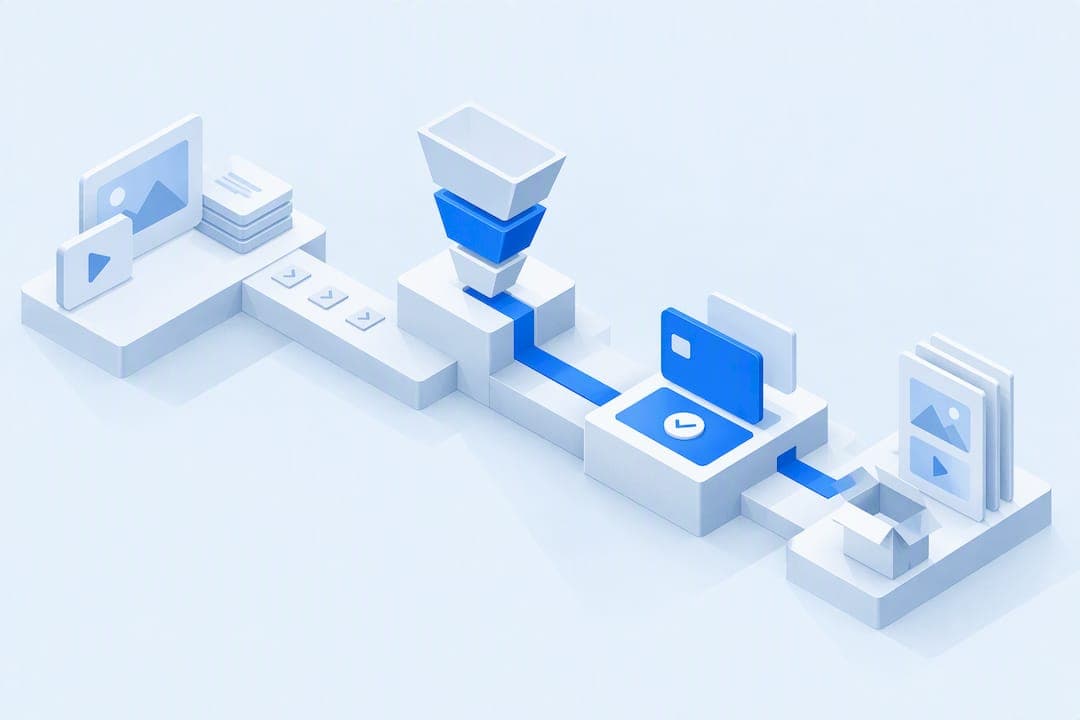
A creator sales stack is the set of integrated tools that handle checkout, funnels, product delivery, subscriptions and BNPL, upsells, affiliate sales, and analytics. For creators selling offers between $1,000 and $10,000, the fastest route to reliable revenue is an integrated funnel, payments, and delivery platform, not a patchwork of disconnected apps stitched together with automations.
TL;DR:
- An integrated creator sales stack must connect checkout, funnels, delivery, revenue tools, and analytics to prevent revenue leaks and ensure smooth customer flow.
- Reliable billing, including retry logic for failed payments and easy online cancellation, is essential for high-ticket offers and compliance with FTC regulations.
- Cross-device smoothness, fast checkout, and clear refund policies directly influence conversion rates for high-value digital products and memberships.
- Consolidating tools into a single platform reduces integration issues that cause data and webhook failures, boosting sales efficiency.
- Platforms like Commas offer all core components, from funnel creation to payment processing and affiliate management, built around seamless integration and automation.
Table of Contents
- Core Components of a Creator Sales Stack
- How to Evaluate a Platform Before You Commit
- Step-by-Step: Building or Migrating Your Stack
- Why Consolidation and AI Funnel Optimization Matter
- Where Commas Fits in Your Stack
- FAQ
- Sources
Core Components of a Creator Sales Stack
Every creator selling at this price point needs the same functional pieces, even if the tools vary. The difference between a stack that converts and one that leaks revenue usually comes down to how well these pieces talk to each other.
Checkout and payments form the foundation. For high-ticket offers, buyers expect tokenized card storage, subscription billing for payment plans, and increasingly, BNPL options that split a $3,000 program into smaller installments. One-click repeat purchases matter for creators running upsells or recurring cohorts.
Funnel paths need to match how the offer actually sells. A $200 course might convert on a single landing page, but a $5,000 coaching program usually needs a qualification flow, an application step, or a booked call before checkout ever happens.
Product delivery is where the sale becomes a relationship. Courses, paid communities, webinars, and gated content all require their own access logic, and a buyer who pays and then can't find their content inside ten minutes is a refund request waiting to happen.
Revenue optimization tools extend the first sale. Order bumps, post-purchase upsells, trial-to-subscription conversions, and affiliate tracking all add revenue without adding new buyers.
Analytics closes the loop. Without visibility into conversion events, cohort revenue, lifetime value, churn, and failed payments, a creator is optimizing blind.
- Checkout and payments: tokenized cards, saved payment methods, BNPL, and subscription billing.
- Funnels: landing pages, qualification flows, and application or booking steps for high-touch offers.
- Delivery: courses, communities, webinars, and gated membership access.
- Revenue tools: upsells, order bumps, trial conversions, and affiliate tracking.
- Analytics: conversion events, cohort revenue, lifetime value, churn, and failed-payment reporting.
How to Evaluate a Platform Before You Commit
Choosing or rebuilding a stack comes down to five questions worth asking before you sign up for anything or move a single product.
- Does it live in one account or require stitching together several apps? Every integration point is a place where data breaks or a webhook silently fails.
- How does it handle billing reliability? Ask specifically about retry logic for failed cards and whether subscription recovery is automatic or something you configure manually.
- What does checkout actually feel like? Guest checkout, stored payment methods, and a flow that works the same on mobile as on desktop all affect whether a buyer finishes the purchase.
- Does it cover your actual product mix? A platform built for one-time digital downloads may not handle a membership community or a live webinar funnel.
- Is cancellation as easy as signup? The FTC's negative option rule requires that if a consumer signs up online, they can cancel online too, without calling a rep or chatting with a bot designed to stall them.
Pro Tip: Ask any platform you're evaluating to show you their failed-payment retry schedule in writing, not just describe it on a sales call.
Compliance deserves more weight than most creators give it. Refund terms buried in fine print, testimonials without disclosed incentives, and cancellation flows that require a phone call are all patterns regulators have flagged directly.
Step-by-Step: Building or Migrating Your Stack
Moving platforms, or setting one up for the first time, goes smoother when you treat it like a launch, not a flip of a switch.
- Audit what you have. List every product, active subscription, affiliate relationship, and export your customer and payment data before touching anything.
- Map the buyer journey. Note where people start on one device and finish on another, since cross-device handoffs are where carts get abandoned.
- Configure payments first. Set up tokenized storage, retry rules for failed charges, and BNPL options before you build a single funnel page.
- Build and soft-launch. Test the full checkout-to-delivery flow with a small cohort of real buyers before sending full traffic.
- Validate your analytics. Confirm that conversion events, subscription status changes, and churn are all logging correctly, not just that the dashboard loads.
- Train support and confirm compliance. Your team needs to know the refund policy cold, and your cancellation flow needs to meet the FTC's click-to-cancel standard before launch.
Checkout speed is not a cosmetic detail. Google's research on mobile performance found that small gains in load time correlate with meaningfully higher conversion, which means a slow cart page on a $4,000 offer is costing you sales you'll never see in a report.
Run the failed-payment scenario specifically. A subscription that silently stops billing because a card expired is lost revenue you won't notice until a customer asks why their access disappeared.

Why Consolidation and AI Funnel Optimization Matter
Most creators don't lose revenue to bad offers. They lose it to friction between tools that were never meant to work together: a funnel builder that doesn't talk to the payment processor, a course platform that can't see subscription status, and an affiliate system tracked in a separate spreadsheet.
Commas was built around collapsing that fragmentation into a single account, which removes the integration gaps where failed webhooks and mismatched data tend to live. Its funnel tools use AI to optimize page layouts and flows based on patterns that already convert, which cuts down on the manual testing creators would otherwise do themselves. Users may see improvements in sales efficiency and conversion after consolidating onto one platform. For creators running agencies or larger operations, built-in support for agency-level billing shows the platform is built to handle volume beyond a single seller's funnel.
— FanBasis
Where Commas Fits in Your Stack
If you're mapping the checklist above onto an actual platform, Commas covers most of it directly. Vibe Funnels handles the funnel side, including the qualification and application flows that high-ticket offers need. Commas Payments runs tokenized checkout, subscription billing, and BNPL through regulated payment partners, with retry logic built in rather than bolted on. For delivery, Online Courses and Paid Groups handle course content and community access, and webinars run with checkout built into the room itself.

For affiliate-driven sales, the Commas Affiliate Center tracks partner sales and payouts without a separate spreadsheet or third-party tool. Agencies managing billing for multiple clients can look at agency billing and payments for a setup built around that scale. If your offer is coaching specifically, selling coaching online walks through how the qualification and checkout flow fits that format.
If you're ready to see how your own offer maps onto one account instead of five, start with Commas and look at the pieces that match where your current stack is breaking down.

FAQ
What tools make up a creator sales stack?
A creator sales stack includes checkout and payments, a funnel builder, product delivery for courses or communities, subscription and BNPL billing, upsell tools, affiliate tracking, and analytics. The goal is covering all seven without needing separate logins and integrations for each one.
Why does billing reliability matter for high-ticket offers?
Failed payments on a $1,000 to $10,000 subscription or payment plan can silently cut off a customer's access and cost you revenue you won't notice until much later. Retry logic and subscription recovery tools catch expired cards and failed charges automatically, which protects revenue without added marketing spend, a pattern noted in industry guidance on reducing involuntary churn.
What does the FTC's click-to-cancel rule require?
The FTC's amended negative option rule requires that if a consumer signs up for a subscription online, they must be able to cancel it online too, without talking to a representative. This applies directly to any creator running recurring billing or memberships, and the full rule explanation outlines the specifics.
How does checkout speed affect conversion on high-ticket offers?
Checkout speed has a measurable effect on whether buyers complete a purchase, with Google's mobile performance research pointing to guest checkout and prefilled fields as patterns that reduce drop-off. For a $5,000 offer, a slow or confusing checkout page is often the real reason a sale doesn't close, not the price itself.
Does Commas replace separate funnel and payment tools?
Commas combines funnel building, checkout, product delivery, and affiliate tracking into one account rather than requiring separate apps for each. Pricing for specific products like Commas Payments and Vibe Funnels is available directly on request through those product pages.
Sources
- Click to cancel: FTC's amended negative option rule — what it means for your business
- Milliseconds make millions (Think With Google)