

If you sell a $1,000 to $10,000 offer, the best ThriveCart alternative is the one that puts checkout, funnel, payments, delivery and follow-up in one account, so a failed card or a missed upsell is not a problem between three apps. For that kind of business, Commas is our pick. It runs funnels, checkout, courses, paid communities, webinars and affiliates together, and runs payments through regulated payment partners. The sections below cover when to stay on ThriveCart, when to leave, and how SamCart, Kartra, Kajabi, PayKickstart and others compare.
TL;DR
- ThriveCart is a strong cart, but the checkout is only one piece. Sellers at higher ticket sizes often outgrow a cart that needs separate tools for pages, community, webinars and delivery.
- Commas combines AI-built funnels, checkout with one-click payments, BNPL and subscriptions, courses, paid groups, webinars and an affiliate system in one dashboard.
- SamCart, Kartra, Kajabi and PayKickstart each solve part of the problem. Match them to your bottleneck: checkout conversion, all-in-one marketing, content delivery or recurring billing.
- Compare options on written fees for the features you actually use, who handles sales tax, and how failed payments are recovered, not on the headline monthly price.
Table of Contents
- Why sellers look past ThriveCart
- What to compare before you switch
- The alternatives compared
- How to choose by problem
- A worked example: a $4,000 coaching program
- Moving off ThriveCart without losing sales
- Perspective
- Try Commas for your next offer
- FAQ
- Sources
Why sellers look past ThriveCart
ThriveCart earned its reputation with a one-time-licence model and a fast cart. In 2026 its pricing changed shape. According to a ThriveCart review published in 2026, a subscription lineup launched on July 17, 2026: Standard at $37 a month billed annually or $47 monthly, Pro+ at $67 annually or $87 monthly, and Enterprise on request. The $495 one-time Standard licence is still sold, and the same review notes that a lifetime buyer who wants the affiliate center pays $295 a year for Pro+ on top, which makes $790 in year one.

Those are fair numbers for a cart. The reason higher-ticket sellers shop around is different. At $1,000 and up, the sale rarely happens on the checkout page alone. It happens across a webinar or call, a sales page, a payment plan, a follow-up sequence and, after the sale, a course or community your buyer needs access to. A cart sits in the middle of that chain. One review puts the issue plainly: you pay for the cart and still need pages in front of it.
Three situations usually trigger the search:
- Too many tools. Pages in one app, email in another, community in a third, checkout in a fourth. Every handoff is a place where buyers or data drop.
- Payment plan friction. Higher-ticket offers depend on split pay, BNPL and recovering declined subscription charges. A cart that treats those as add-ons costs you sales.
- Delivery and retention. Course completion and community engagement decide refunds and renewals, and those live outside a pure cart.
If none of these describes you, staying on ThriveCart is reasonable. If one does, read on.
What to compare before you switch
Price tables dominate the pages that rank for this search, but a $79 plan and a $99 plan are not the real difference when you move $50,000 a month. Compare these instead:
- Fees on the features you use. Ask for the written fee schedule covering payment plans, BNPL, subscriptions and international cards. Some platforms charge a percentage on lower plans and none on higher ones, and the card-processing fee comes on top of both.
- Who is the seller of record. If you sell internationally, tax handling matters. Some platforms act as full merchant of record and handle global sales tax. Others, like Payhip, collect and remit only EU and UK VAT, which leaves US, Canadian and Australian tax with you.
- Failed payment recovery. On a $2,000 plan paid in installments, one declined card is real money. Look for automated retries and recovery flows.
- Upsells and order bumps. One-click upsells after the first payment lift average order value only if they work on the same checkout without re-entering a card. Our guide to automated upsell funnels covers the rules that apply to $1,000 to $10,000 sellers, including FTC requirements.
- Where the customer lives after purchase. Course, community, webinar replay, affiliate dashboard. The more of this in one account, the fewer logins your buyer has to remember.
- Migration effort. Can you import existing funnels, or do you rebuild every page?
The alternatives compared
The table uses pricing as reported by the sources named below, mostly from October 2026. Plans, caps and fees change, so confirm each on the provider's own pricing page before you commit. We list no Commas price here because Commas does not publish one on its site.
| Platform | Best fit | Reported entry pricing | Main trade-off to check |
|---|---|---|---|
| Commas | Established sellers of $1,000+ offers who want funnels, payments, courses, community, webinars and affiliates together | Ask for written fees | Built for sellers who already make sales |
| SamCart | Checkout conversion with existing traffic | $79/mo, 7-day trial | Pages, community and webinars handled elsewhere |
| Kartra | All-in-one marketing with helpdesk and affiliates | $59/mo, 5% fee on Essentials, 0% from $119, 14-day trial | Intro offers can renew higher |
| Kajabi | Course and content delivery | Basic $179/mo, or $143/mo billed annually | Processing and taxes are extra |
| PayKickstart | Recurring billing and affiliates | Starter $99/mo with a $10,000 monthly revenue cap | Revenue caps and overage percentages |
| Podia | Simple course and downloads store | $42/mo billed annually, 5% fee on Mover | Lighter funnel tooling |
| Teachable | Course schools | $39/mo, 7.5% fee on Starter | Fee until higher tiers |
| Systeme.io | Budget all-in-one | Free plan, paid from $17/mo | Better for smaller offers |
| Whop | Lower-ticket digital products and gated chat communities | 2.7% + $0.30 per domestic card sale | Add-ons, payout fees and tax settings |
Commas
Commas is one platform where online businesses sell and get paid. You build funnels with a drag-and-drop editor and AI that applies proven funnel patterns, take payments through a checkout that supports one-click payments, BNPL and subscriptions, and deliver what you sold through courses and paid groups. Webinars, an affiliate system, upsell management and analytics sit in the same dashboard. Commas runs payments through regulated payment partners.
Two features matter most at higher ticket sizes. First, automated tools to recover failed subscriptions and maximize approvals. Second, funnel import and automation, so a move does not mean rebuilding everything from zero. You can look at Vibe Funnels, our AI funnel builder, and Commas Payments to see how the pieces connect.
The fit is strongest for high-ticket coaches, course creators, agencies, paid communities and service businesses that already close sales and want fewer moving parts.
SamCart
SamCart is the closest like-for-like swap for ThriveCart. Its Pro plan includes order bumps, one-click upsells, Subscription Saver and A/B testing, according to the same comparison, and it lists 0% on its own payment option. It makes sense when checkout conversion is your one bottleneck and you already have traffic and pages. We compare the two directly in ThriveCart vs SamCart: which checkout fits a $1,000+ offer.
Kartra
Kartra bundles checkout, pages, email, helpdesk and affiliates. That breadth helps if you want one marketing suite, though the platform fee on the entry tier and the way an intro price renews are worth reading closely. A July 2026 funnel-builder roundup and the ToolVerdict comparison list different starting prices, which is a good reason to get the quote in writing.
Kajabi
Kajabi leans toward content: courses, coaching and memberships with a polished member experience. Its Basic plan is priced as shown above, with processing and taxes extra, a trial of up to 14 days and up to 10 upsells per offer, per the funnel-builder roundup. It fits a seller whose business is mainly a course library.
PayKickstart
PayKickstart is built around checkout and subscription billing, with dunning for failed payments, cancellation recovery, one-click upsells, order bumps and an affiliate center. Its tiers are capped by monthly revenue, with an overage percentage above the cap, according to a 2026 pricing report. At $10,000 a month the Starter cap arrives quickly for a high-ticket seller, so model your real volume first.
Podia, Teachable and Systeme.io
These three suit simpler businesses. Podia is positioned as the easiest course and downloads store for solo sellers. Teachable concentrates on courses, with a 7.5% fee on the Starter plan and 0% from Builder, per the ToolVerdict comparison. Systeme.io has a permanent free plan and low entry pricing, which attracts sellers with lower-priced offers who are just starting.
Whop, Gumroad, Lemon Squeezy, Paddle and Payhip
These are marketplace or merchant-of-record style tools, best known for lower-priced digital products and software. Whop suits gated Discord or Telegram communities and marketplace reach. Gumroad takes 10% + $0.50 on direct sales and 30% through its Discover marketplace. Paddle and Lemon Squeezy charge 5% + 50¢ per transaction and take over global tax. On a $12 sale, one worked example puts effective fees between 5.4% and 30%. At a $3,000 offer, a percentage-based model costs far more than the headline suggests, which is why these tools are mostly chosen for small tickets.
How to choose by problem
Your checkout converts, but your stack is a mess. Consolidate. Moving funnel, checkout, delivery and community into one account removes handoffs. This is where Commas is strongest. Our best sales funnel software guide compares eight platforms on this question.
Your payment plans leak revenue. Failed installments and expired cards are quiet losses. Look for retry logic, recovery sequences and flexible plan options such as BNPL. Commas includes tools to recover failed subscriptions and maximize approvals.
You need affiliates to sell for you. Check whether the affiliate system is native or an add-on, and whether commissions, tracking and payouts are in the same account as checkout. The Commas Affiliate Center is part of the platform.
You sell a course and want people to finish it. Delivery and engagement matter as much as the sale. Online Courses and Paid Groups keep content and community inside the same account as billing. For community options in general, see best community platforms for sellers.
Your bottleneck is traffic, not checkout. No cart change fixes an empty funnel. If this is you, fix acquisition first, for example with automated SEO content tools, then revisit the checkout.
You sell worldwide. Ask who is the legal seller and who files tax. Merchant-of-record tools take that on, but fee structures differ by region: one analysis notes Lemon Squeezy and Polar document a 1.5% surcharge on international cards that Paddle does not list. Our guide to accepting international payments online covers the workflow.
A worked example: a $4,000 coaching program
Say you sell a $4,000 program as four payments of $1,000, with a $297 add-on offered right after purchase. On a stack of separate tools, the sales page lives in one app, the cart in another, the community in a third and the add-on in a bundled plugin. If one installment card fails in month two, the recovery email may come from a fourth place with its own rules, or never.

On a single platform, the same offer runs through one checkout. The add-on is a one-click upsell on the same payment method, the installment schedule and failed-payment recovery are managed in the same dashboard, and the buyer gets community and course access from the same account. That is the practical case for consolidating, and it is the case Commas is built around. Results vary by business, so judge any platform on your own numbers.
Moving off ThriveCart without losing sales
- List what runs through the cart today: products, bump and upsell offers, payment plans, coupons, affiliate links.
- Export your customer and subscription data and confirm how active subscriptions will migrate. Do this before cancelling anything.
- Import or rebuild funnels. Commas supports funnel import and automation, which shortens this step.
- Test the full flow with a real low-value transaction, including the upsell and the confirmation email.
- Switch traffic gradually, sending one offer first and the rest after it checks out.
- Keep the old cart live until active payment plans have been moved or completed.
Perspective
We built Commas because most sellers we talk to at the $1,000 to $10,000 level are not short of tools. They have too many. A cart here, a page builder there, a community in a third place, and a spreadsheet holding it together.
Our view is that the sale is a single journey: the click, the payment plan, the upsell, the first lesson, the second payment, the referral. When one account holds all of it, the numbers you read are the same numbers your buyers experienced, and you fix the right thing.
That is why we put checkout, funnels, courses, paid groups, webinars and affiliates together, with payments run through regulated payment partners. It is also why the funnel builder uses AI to apply proven patterns, so you spend your time on the offer rather than on page mechanics.
If you are choosing a ThriveCart alternative, ask each vendor the same three questions: what exactly do I pay for the features I use, what happens when a payment fails, and where does my buyer go after they pay. We are happy to be measured against those.
Commas
Try Commas for your next offer
If you want funnels, checkout, courses, community, webinars and affiliates in a single account, Commas is built for it. You can start with a free trial or demo and see how a $1,000 to $10,000 offer would run from first click to recurring payment.
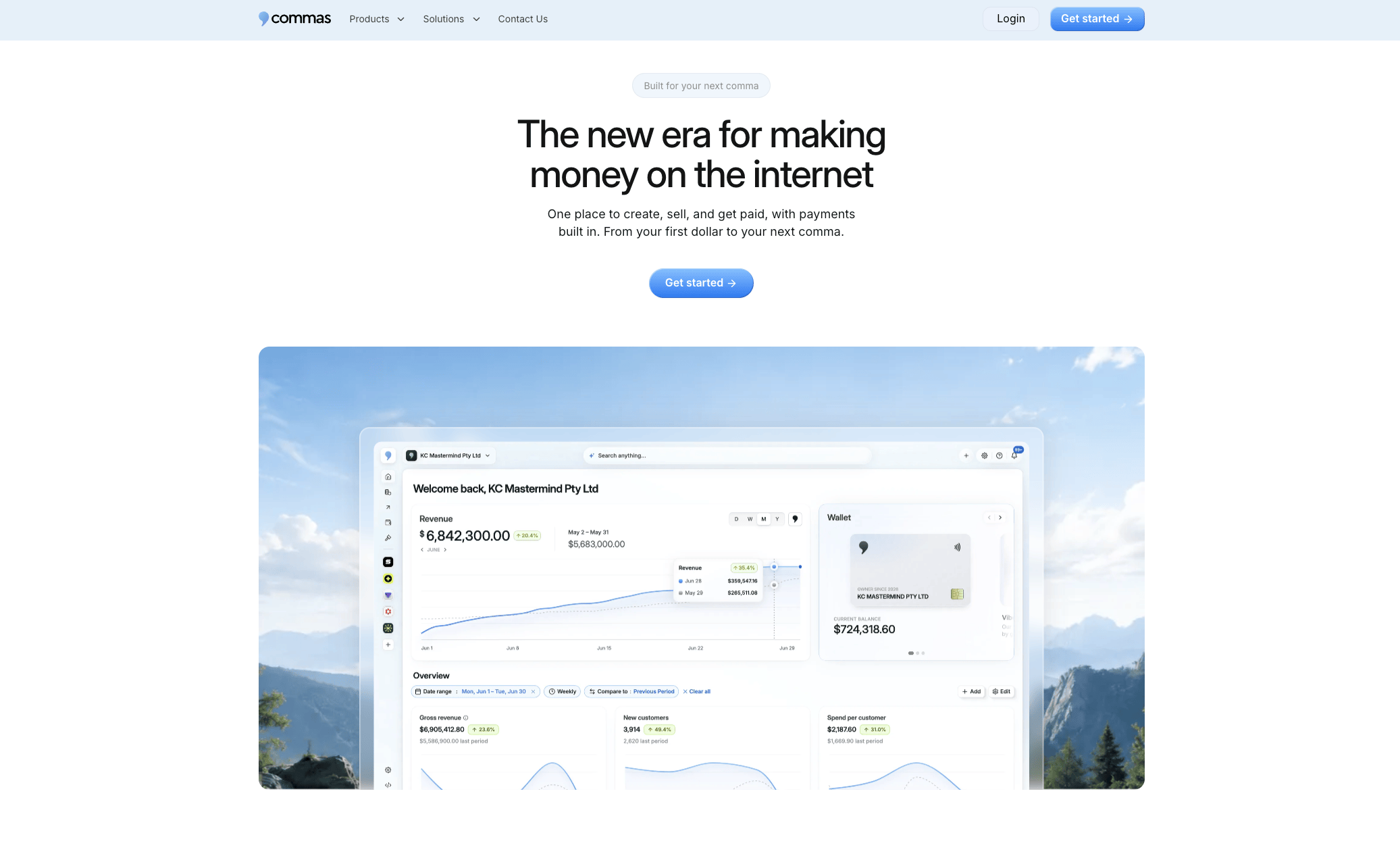
Start on the Commas home page, or go straight to Commas Payments if checkout and installment recovery are your priority. If you manage client billing, see agency billing and payments.
FAQ
How much does ThriveCart cost?
The $495 one-time Standard licence remains available, and the 2026 subscription plans start at $37 a month billed annually or $47 monthly, according to a 2026 review. Pro+ is $67 annually or $87 monthly. Check ThriveCart's own page for the latest prices before buying.
Is ThriveCart or SamCart better?
They solve a similar problem: a checkout with bumps, upsells and subscriptions. ThriveCart's licence option suits sellers who want to avoid a monthly fee. SamCart is priced at $79 a month and is aimed at conversion work. Our ThriveCart vs SamCart breakdown goes through the details for $1,000+ offers.
What is the difference between ThriveCart and ThriveCart Pro?
Pro+ adds the affiliate center and other advanced features on top of Standard. On a lifetime licence it costs $295 a year after the initial purchase. If affiliates are central to your sales, compare that against platforms where the affiliate system is part of the main account.
What should I check before switching to an alternative?
Get the fees in writing for the features and financing you will use, confirm who handles sales tax in the countries you sell to, and ask how failed payments are retried and recovered. Then check that your existing funnels and subscriptions can be moved. Processor and tax rules differ: a professional comparison lists the item to verify for each platform.
Does an all-in-one platform make sense for a high-ticket seller?
It does when your sale spans several steps: pages, calls or webinars, payment plans, upsells and delivery. Keeping those in one account means fewer handoffs and one place to read your numbers. That is the idea behind Commas.
Sources
- ThriveCart Review 2026: Is the Lifetime Deal Worth It?
- ThriveCart Alternatives (2026): 6 Options Compared
- ThriveCart Alternatives: When to Switch and When to Stay
- Best Funnel Builders for 2026: Top Sales Tools Compared
- PayKickstart Pricing 2026: Starter, Growth, Scale Plans
- Gumroad vs Lemon Squeezy vs Payhip | What I Pocket
- Gumroad vs Payhip vs Lemon Squeezy: What a $12 Sale Nets
- ThriveCart Alternatives 2026: Top Picks