

The best community platform for a seller with a $1,000 to $10,000 offer is the one that keeps your members, your checkout and your course content in one place. A community tool that only hosts conversation leaves you stitching together payments, funnels and delivery. Below we compare Circle, Skool, Mighty Networks, Kajabi, Bettermode, Discord and Commas on what matters once you already have buyers: how you get paid, what the platform takes, how members learn, and how many tools you end up running.
TL;DR
- Circle suits a branded, standalone community. Mighty Networks suits community plus courses and events. Skool suits simple, gamified groups with little setup.
- Transaction fees and plan tiers change the real cost of a high-ticket sale more than the sticker price does. Check each vendor's pricing page before you commit.
- Discord, Slack and Facebook Groups are free to start but give you no checkout, no course delivery and no ownership of the member relationship.
- Commas puts checkout, funnels, courses, paid communities, webinars and affiliates in one account, with payments run through regulated payment partners.
- Pick on your offer: a $2,000 program needs payment plans, onboarding and completion support, not just a feed.
Table of Contents
- What to check before you pick a community platform
- Circle: branded standalone communities
- Mighty Networks: community with courses and events
- Skool: simple groups with gamification
- Kajabi: courses and community under one roof
- Bettermode: community for brands and products
- Discord, Slack and Facebook Groups: free, but you build the rest
- Commas: where members pay, learn and belong
- How they compare
- Our perspective: the community is part of the sale
- See it with your own offer
- How to choose in practice
- FAQ
- Sources
What to check before you pick a community platform
Most comparison pages rank platforms by feature count. For a seller, that is the wrong lens. A comparison of creator platforms points to the same practical checklist: the features you need, subscription cost, transaction fees, and the effort of running and moderating the space. We would add four questions that matter more at a higher price point.
- How does the member pay? A $3,000 program is rarely a one-click impulse buy. You want payment plans, buy now pay later, card retries and a clear way to handle failed renewals.
- Where does the sale happen? If your funnel, checkout and community live in different apps, every handoff loses people and creates support tickets.
- What does the platform keep? Add the monthly plan, the platform's own transaction fee and the processor fee. On a large ticket, a one or two point difference is real money. We break this down in what a $2,000 sale really costs.
- Does the community help members finish? Completion drives referrals, renewals and the next purchase. Events, cohorts, live rooms and progress tracking matter more than badges.
The right answer also depends on your model. A paid membership, a cohort course and a coaching community each need a different setup. If you are still mapping that out, this guide to building community online for growth helps match platform capabilities to a business model.
Circle: branded standalone communities
Circle gives you branded spaces for discussions, courses, events, live rooms and payments. It is the usual first pick for people who want a polished, member-facing community under their own brand, and the platform most readers compare against when they search for alternatives.
Where it fits: established communities where the discussion space is the product, and you want control over spaces, access groups and look.
Where to look closer: Circle is community-first, so course depth, funnels and sales pages tend to come from other tools. Check its current plan tiers and transaction fees on the vendor's pricing page, since features such as workflows and branding removal are tied to higher plans. For a deeper side-by-side, see our look at Circle versus Mighty Networks pricing and architecture.
Mighty Networks: community with courses and events
Mighty Networks combines community spaces, course hosting, event management and member subscriptions in one product, with a mobile app experience for members.
Its published pricing is tiered: Launch at $79 a month, Scale at $179 a month and Growth at $354 a month, with a lower effective rate on annual billing. The higher tiers add automations, integrations and API access.
Where it fits: sellers who want programs, events and community inside one member experience and can work within its structure.
Where to look closer: the jump between tiers is where costs climb. If you need integrations or API access, you are on a higher plan. Funnels and checkout design are not its focus.
Skool: simple groups with gamification
Skool is built around a short learning curve. Members get a feed, a classroom, a calendar and a leaderboard, and you get little to configure. Many coaches choose it for exactly that reason.
Fees are the thing to read closely. Skool's help center lists a Pro plan rate of 2.9% plus 30 cents per transaction up to $899, and 3.9% plus 30 cents above $900, while the Hobby plan takes 10% plus 30 cents. For someone selling $1,000 to $10,000 offers, the higher rate applies to nearly every sale.

Where it fits: straightforward paid groups where the leaderboard and simplicity drive engagement.
Where to look closer: limited design control, your funnel and sales pages live elsewhere, and the fee bracket above $900 matters at your ticket size.
Kajabi: courses and community under one roof
Kajabi is a course and coaching platform that added communities. It makes sense if your offer is mostly a course with community as a supporting feature, and you want landing pages, email and products together. Compare its current plan limits and fees on its pricing page before deciding, because member and product caps vary by tier.
Where to look closer: the community is an add-on to a course product rather than the center of the experience, and a paid-community model with tiered access can feel more constrained.
Bettermode: community for brands and products
Bettermode is aimed at businesses that want a customer community, support forum or product hub, with deep customization and app integrations. It is a strong choice for software companies and brands running a community around a product.
Where it fits: customer communities, support and feedback spaces.
Where to look closer: it is less oriented to selling a high-ticket program, so checkout, payment plans and course delivery usually need other tools.
Discord, Slack and Facebook Groups: free, but you build the rest
These are where many communities start. They are good at fast, short-form conversation and your members are probably already there. But none of them gives you checkout, course delivery, payment plans or a way to see who paid, who is behind on payments and who finished. You also do not control the audience relationship or the algorithm. They work as a free lobby around a paid product, not as the product's home.
Commas: where members pay, learn and belong
Commas is built for sellers who already make sales and want the community to sit next to the money, not away from it. It is one platform for checkout, funnels, courses, paid communities, webinars and affiliates. Commas runs payments through regulated payment partners, so the payment experience is native to the community rather than a separate tool you wire in.
What that looks like for a seller with a high-ticket offer:
- Paid communities and groups. Paid groups with branded spaces, access tied to payment, and subscription billing, so a lapsed payment and a lapsed membership are the same event.
- Courses and community together. Commas Studios keeps lessons and the community in the same member area, so students are not switching between a course host and a chat app.
- Payments built for larger tickets. Commas Payments includes one-click payments, subscriptions and buy now pay later, plus tools to recover failed subscriptions and maximize approvals. Our notes on subscription billing and click to cancel rules cover what to get right on renewals.
- Funnels in the same account. Vibe Funnels is an AI funnel builder with drag-and-drop editing, upsells and funnel import, so the page that sells and the space that serves share one login.
- Affiliates. The Affiliate Center lets partners promote your offer and get tracked inside the same system.
The tradeoff to weigh honestly: if what you need is only a lightweight discussion space with no sales activity, a dedicated community tool may be all you require. Commas is strongest when the community is part of a paid offer and you are tired of reconciling four dashboards.
How they compare
| Platform | Best for | Courses | Payments and fees | Funnels and checkout |
|---|---|---|---|---|
| Circle | Branded standalone community | Yes, community-first | Plan tiers with transaction fees, see vendor page | Limited, relies on other tools |
| Mighty Networks | Community plus programs and events | Yes | Tiered plans from $79 a month | Limited |
| Skool | Simple gamified groups | Classroom | 2.9% plus 30 cents up to $899, 3.9% plus 30 cents above $900 on Pro | Limited |
| Kajabi | Course-led businesses | Core product | Check current plan terms | Pages and email included |
| Bettermode | Customer and product communities | Not the focus | Check current plan terms | Not the focus |
| Discord, Slack, Facebook Groups | Free conversation | No | None built in | None |
| Commas | Sellers who want payments, funnels, courses and community in one account | Yes | Payments through regulated partners, see our pricing page for terms | Built in |
Prices were read from vendor pages in 2026 and can change, so confirm on each pricing page.
Our perspective: the community is part of the sale
We talk with sellers who run high-ticket coaching, cohort programs, agencies and paid memberships. A pattern repeats. They chose a community tool because the feed looked good, then spent the next year patching the gaps: a separate checkout, a separate course host, a spreadsheet of who is behind on payment, a funnel tool that does not know who joined.
That sprawl is a revenue problem, not an inconvenience. When a card fails and nobody sees it, a member stays in the community for free, or gets removed by mistake and writes a support ticket. When the funnel and the community do not share data, you cannot tell which page produced your best members.
So our view is simple. For an offer priced between $1,000 and $10,000, judge a platform by how it handles the money and the member journey together. Ask where the checkout lives, what happens on a failed payment, how members move from sales page to first lesson to first conversation, and how many logins you need. A community platform that answers those questions in one account saves you time, and it also gives you cleaner numbers to decide what to fix. We go deeper in our guides on course community strategy for $1K to $10K offers and building a paid community in 90 days without tool sprawl.
See it with your own offer
If you sell a high-ticket program and your community, checkout and funnel live in separate apps, Commas can bring them into one account. You can run paid groups, courses, webinars and affiliates alongside payments, so the member journey is visible end to end.
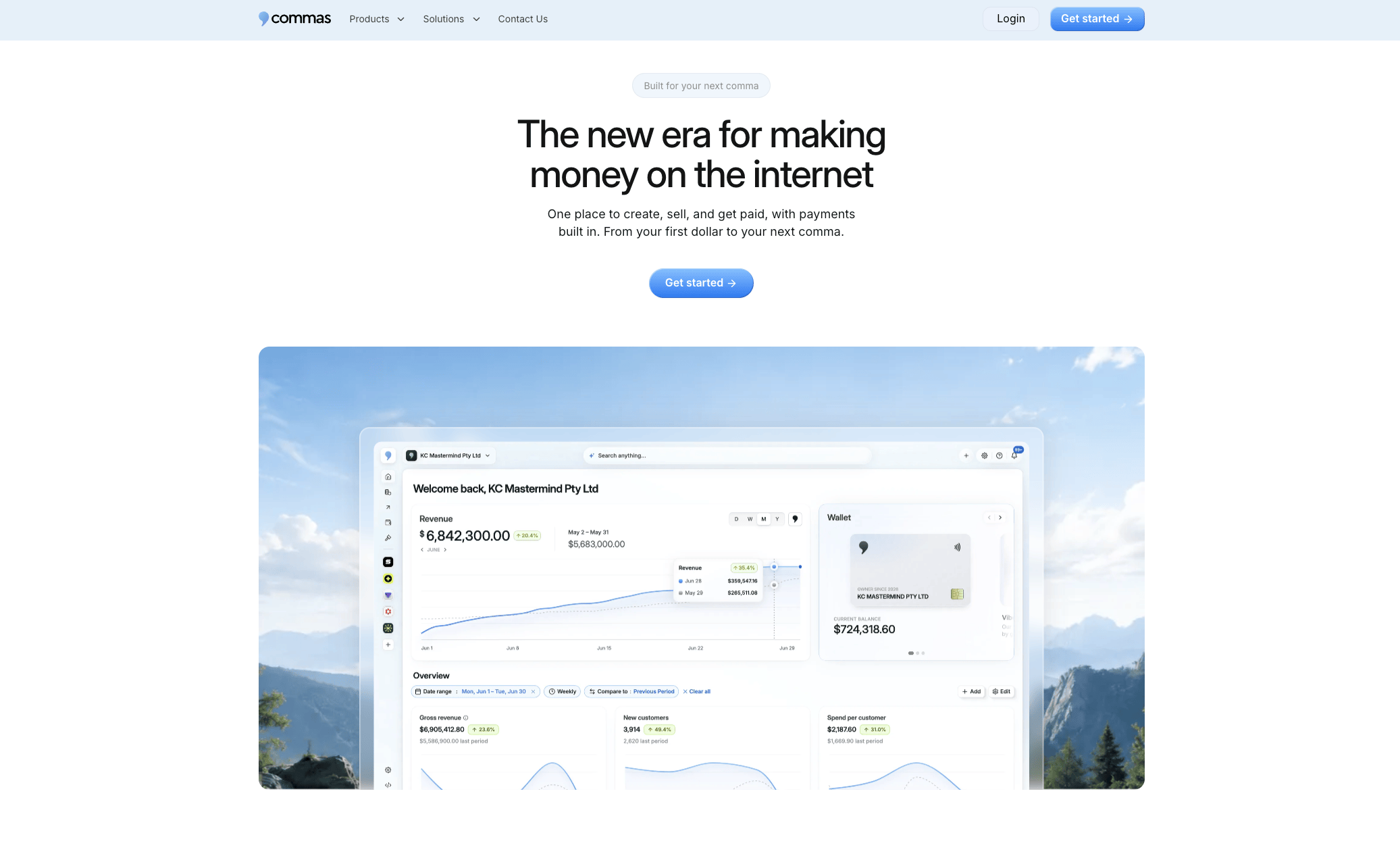
Look at Commas Studios if your offer is a course with a community, or start from the Commas homepage to see the full set of tools.
How to choose in practice
Run a short test before you migrate anything.
- Write down your offer path. Sales page, call or checkout, payment plan, onboarding, first week, renewal. Mark every tool that touches it.
- Count the handoffs. Each place a member has to create a new login or re-enter a card is a place you lose people.
- Price a real sale. Take a $2,000 offer, split in three payments, and add plan cost plus every fee. Compare the net across platforms.
- Check the failure path. Ask what happens when a payment fails on month two, and who sees it.
- Look at the member's first 48 hours. Can they find their first lesson and introduce themselves without help from you?
If two platforms tie, choose the one that removes more tools from your stack.
FAQ
What is the best online community platform for selling courses?
It depends on whether the course or the community leads. Mighty Networks and Circle are community-first with courses added, Kajabi is course-first, and Commas combines courses, community, funnels and payments in one account. For a $1,000 to $10,000 offer, prioritize payment plans and completion support over feed design.
What are good alternatives to Circle?
Common alternatives are Mighty Networks for community plus programs, Skool for simple gamified groups, Bettermode for brand and customer communities, Kajabi for course-led businesses, and Commas if you want checkout and funnels in the same place. The right one depends on your business model and how much you want to consolidate.
Are Discord and Facebook Groups enough for a paid community?
They can host conversation, but they do not handle checkout, subscriptions, course delivery or failed payment recovery. Many sellers use them as a free entry point and keep the paid experience on a platform that ties access to payment.
How much do community platforms cost?
Most charge a monthly plan, and several add transaction fees on top. Mighty Networks lists plans from $79 a month, and Skool lists a Pro rate of 2.9% plus 30 cents per transaction up to $899. Always check the vendor pricing page, because tiers and fees change.
Sources
- Mighty Networks pricing
- Skool payments FAQs
- 5 Skool alternatives for creators who want their own app
- Best online community platforms for creators