
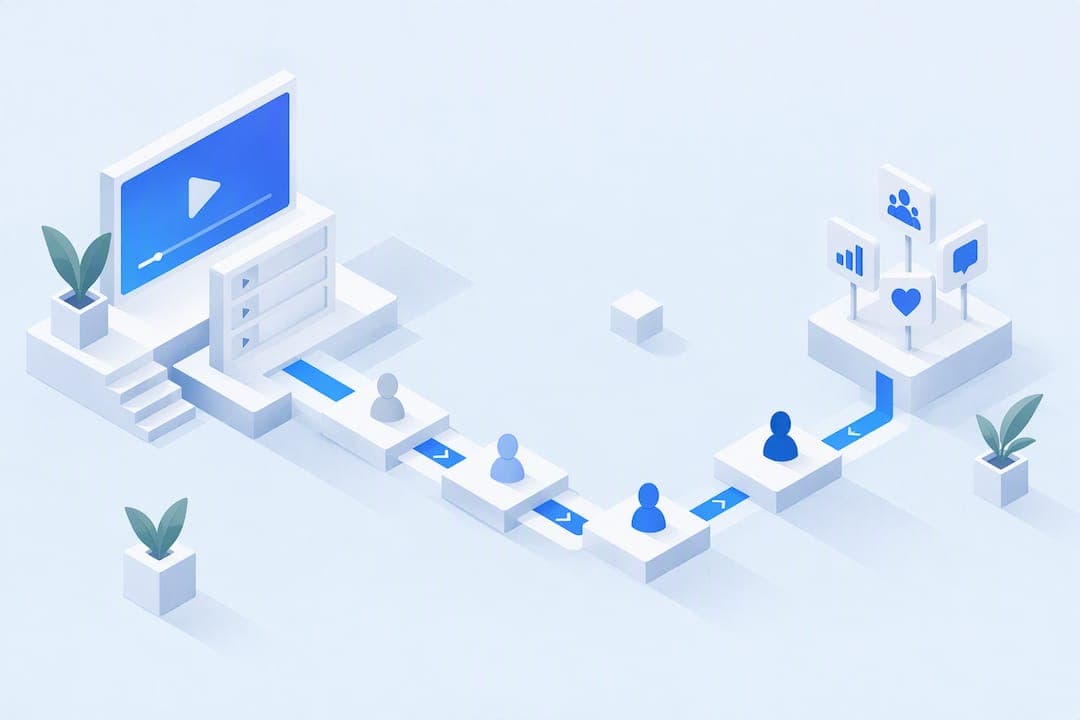
A course community strategy is a documented plan that connects what members learn, how they interact, and what the business needs to achieve, built on a chosen framework, a mapped member journey, and measurable outcomes. We recommend pairing the Community of Inquiry model with an engagement spectrum to set intensity, then tracking KPIs from day one. Platforms like Commas can host the course, the community, and the payments in one place once that plan exists.
TL;DR:
- Document a business outcome, member segments, the value exchange, moderation ownership, and weekly workload on one page before choosing tools or writing content.
- Map acquisition, conversion, onboarding, engagement, and retention to specific tactics, from an orientation checklist and early activity to milestone nudges and an alumni space.
- Use Community of Inquiry to structure teaching, social, and cognitive presence, while an engagement spectrum sets touchpoints and facilitator hours to match cohort needs.
- Track completion, retention, attendance, and conversion alongside survey or interview feedback; keep facilitation judgment internal and use AI analytics only as support.
- When team time is limited, prioritize onboarding and an early small win; delegate scheduling, reminders, and reporting templates, but retain facilitation and judgment calls internally.
Table of Contents
- Core components of a course community strategy
- Mapping the member journey from signup to advocacy
- Which frameworks turn strategy into a session plan?
- Who runs the course community day to day?
- Measuring what matters beyond vanity metrics
- Sample timelines you can adapt to your cohort
- What sellers of high-ticket courses should prioritize first
- Running course and community delivery in one place
- FAQ
- Sources
Core components of a course community strategy
Before picking tools or writing content, a workable strategy needs four pieces written down in one short document.
Start with goals tied to a business outcome, not vague engagement hopes. A cohort completion target, a conversion rate to a higher priced offer, or a retention figure gives the whole team something to design against. Vague goals like "build engagement" produce busywork instead of decisions.
Next, segment the audience into a small number of member types rather than treating everyone the same. A small number of profiles, such as new buyers, returning alumni, and high-touch mentorship clients, can shape onboarding and content without overcomplicating moderation.
- Define the value exchange: what members receive (live sessions, templates, peer feedback) and what participation requires of them (posting cadence, attendance, project submissions).
- Set governance: name who owns moderation, what the escalation path looks like for conflicts, and how many hours per week the role actually takes.
- Document resourcing: which tasks are handled internally and which are templated for a part-time facilitator.
- Write the whole thing as a one-page reference the team can revisit before every cohort launch.
A one-size-fits-all engagement plan tends to underperform compared to a segmented approach that mixes qualitative and quantitative input when setting these choices, according to guidance from the University of Missouri's community engagement resources.
Mapping the member journey from signup to advocacy
A course community strategy succeeds or fails on the stages between a prospect's first touch and their eventual renewal or referral. Map each stage with a specific tactic rather than a general intention.
- Acquire: Match messaging and channel mix to a high-ticket buyer, using cohort start dates as a natural urgency trigger rather than generic lead magnets.
- Convert: Use milestone-driven triggers, such as a live workshop or a limited number of cohort seats, to move prospects from interest to paid enrollment. Our course sales funnel guide covers how to structure that path from launch to evergreen.
- Onboard: Give new members an orientation checklist, confirm their technical setup, and assign one small activity inside the community soon after enrollment so they get an early win.
- Engage: Run protocol-based discussions, small-group projects, and a predictable live session schedule so members know when and how to show up.
- Retain: Send progress nudges tied to course milestones, open an alumni space for past cohorts, and sequence a next offer for members who finish strong.
Our guide to course engagement strategies walks through a diagnostic approach for figuring out where a specific cohort is losing momentum, and the membership retention tests article offers two 30-day experiments worth running before a full rebuild.
Pro Tip: Treat the period after enrollment as its own mini campaign: an early small win can help members get started, but engagement also depends on what happens throughout the cohort.
Which frameworks turn strategy into a session plan?
Three frameworks do most of the heavy lifting for course communities, and each converts into something concrete you can put on a calendar.
- Community of Inquiry (CoI): teaching presence shows up as structured facilitation and clear session agendas; social presence shows up as icebreakers and peer introductions; cognitive presence shows up as discussion prompts that push members to apply what they learned. Protocol-based discussions, where roles, rules, and deadlines are spelled out in advance, have been linked to statistically significant increases in perceived cognitive presence in large enrollment online courses.
- Engagement spectrum: borrowed from public engagement models, it helps decide how many touchpoints, live events, and facilitator hours a given cohort actually needs based on the stakes and complexity of the material, rather than defaulting to maximum effort everywhere.
- Logic model: a simple inputs, activities, outputs, outcomes chain. Inputs might be facilitator hours and a content calendar; activities are the live sessions and discussion threads; outputs are posts, attendance, and completed projects; the outcome is the commercial goal, such as a measurable lift in upgrades to a higher-ticket program.
Who runs the course community day to day?
A course community does not need a large team, but it does need clear ownership across a handful of roles.
- Course lead: owns curriculum quality and session content.
- Community manager or facilitator: runs daily moderation, welcomes new members, and keeps discussions on protocol.
- Analytics owner: tracks KPIs and flags drop-off points early.
- Content owner: maintains the content calendar and asynchronous materials.
- Marketing liaison: connects community activity back to funnel and conversion data.
Several workstreams keep these roles coordinated: moderation and community health checks, the content calendar, cohort operations (scheduling, technical setup, reminders), and measurement and reporting. A short regular standup, periodic KPI reviews, and a retrospective after each cohort launch can keep the group aligned without adding meetings for their own sake.
Measuring what matters beyond vanity metrics
A measurement plan needs both numbers and context, or it ends up tracking activity that looks good without explaining why members stay or leave.
- Active members and engagement per active member (posts, replies, session attendance).
- Cohort completion rate and retention over time.
- Member satisfaction or an NPS style score collected after key milestones.
- Conversion lift tied to community activity feeding into funnels.
Quantitative metrics alone miss the reasoning behind member behavior, which is why data-driven community management works best when active member counts and post frequency are paired with qualitative feedback from surveys and short interviews, according to University of Michigan's review of Community of Inquiry research.
AI-supported analytics can help with personalization, forecasting engagement drops, and routine monitoring of discussion health, but industry curricula consistently frame these tools as support for human judgment rather than a replacement for it, a distinction covered in Coursera's data-driven community management course. Our course completion rates article breaks down common exit points worth watching in a dashboard. A regular report with active members, completion rate, retention, and a qualitative theme from member interviews gives stakeholders enough to act on without drowning them in metrics.

Sample timelines you can adapt to your cohort
Two structures cover most high-ticket course formats, short and intensive versus longer and tiered.
- Short cohort: Begin with orientation and a small win activity, alternate live workshops with small-group protocol discussions, then close with a peer project review, a capstone session, and an alumni invitation.
- Longer program: build around engagement tiers, with lighter asynchronous lessons and office hours at the start, moving into higher-touch live group workshops and small-group projects, then tapering to community-led events and peer mentoring toward the end.
Session formats worth mixing across either timeline include live group workshops, structured small-group protocols, asynchronous lessons for flexibility, scheduled office hours, and occasional community-wide events to mark milestones.
What sellers of high-ticket courses should prioritize first
If team time is limited, prioritize onboarding and the first small win over polishing every later module. Keep facilitation and judgment calls internal, but templates for scheduling, reminders, and reporting can be handed off early. Tie every community metric back to a commercial objective you can actually influence, and avoid promising outcomes a strategy document cannot guarantee.
Running course and community delivery in one place
A strategy document is only useful once it is built, and most teams lose time stitching together a course tool, a community platform, and a separate checkout. We bring courses, paid groups, funnels, and payments into one product family, so the member journey mapped above does not depend on three different logins staying in sync.

Commas Studios hosts courses and paid communities together, and our Online Courses product handles cohort delivery while Paid Groups manages the community side with built-in payments. For engagement tactics specifically, our partner resource on improving user engagement is worth a look alongside your own KPI plan. If you want to see how a course and community flow works end to end, visit Commas Studios or request a walkthrough of the Online Courses product.
FAQ
What are the 7 types of community?
Community typology frameworks vary by source, so there is no single universal list of seven types. In practice, course creators tend to work with a narrower set, such as learning cohorts, peer support groups, alumni networks, and mentorship circles, each requiring a different mix of structure and facilitation.
What are the 10 key elements of a community?
Definitions differ across frameworks, but recurring elements include shared goals, clear governance, a value exchange, onboarding, regular touchpoints, moderation, content cadence, measurement, and a path to advocacy or renewal. A course community strategy document should capture each of these rather than relying on a fixed checklist.
Can you give me an example of community management?
Community management often includes daily moderation, running structured discussions using a protocol with set roles and deadlines, welcoming new members during onboarding, and tracking engagement metrics alongside qualitative feedback. The Community of Inquiry research shows how protocol-based discussion management can measurably increase perceived cognitive presence.
What are some examples of community-based intervention strategies?
Common strategies include milestone-driven onboarding activities, small-group projects paired with live facilitation, progress nudges tied to course checkpoints, and alumni spaces that keep past cohorts engaged. These map closely to the acquire-to-retain journey used in course community strategy planning.
Sources
For readers who want to study the frameworks referenced here in more depth, the original Community of Inquiry instrument research explains how teaching, social, and cognitive presence were measured across large online courses. Coursera's Meta Community Management Professional Certificate offers a structured curriculum for anyone building out a full community management practice, from engagement programs to AI-supported analytics.
- Measuring Presence: A Review of Research Using the Community of Inquiry Instrument
- Teaching
- Onlineteaching