
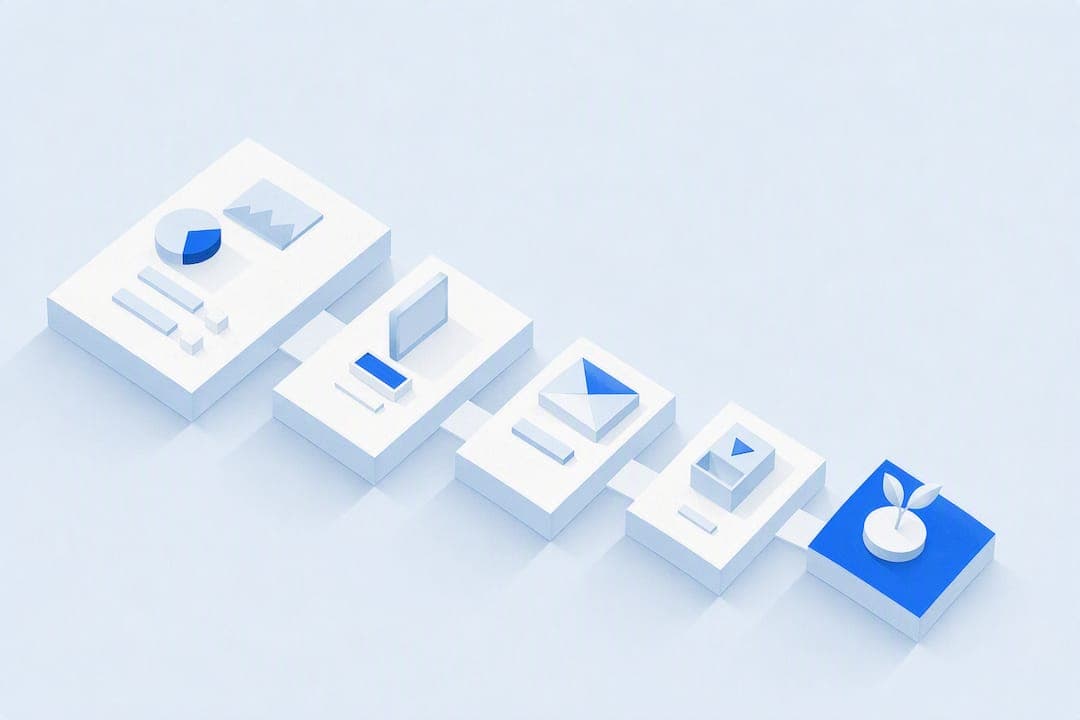
A course sales funnel is the sequence that turns a stranger into a paying student: lead magnet, then a webinar or preview lesson, then a clear offer with an optimized checkout, then onboarding that keeps them enrolled. The pattern that works right now for most course creators is attract with a benefit-first freebie, engage through a live or automated webinar, convert with a tightly written offer, and retain with a fast, guided onboarding sequence. Everything else is refinement.
TL;DR:
- A benefit-first lead magnet and dedicated landing page are crucial for attracting qualified email opt-ins, rather than broad or vague promises.
- Automation should connect landing pages, email sequences, checkout, and analytics to reduce friction and enable quick iteration.
- Building your sales page and checkout options, including payment plans and objections, before recording lessons speeds up the entire funnel development.
- Validating interest through a waitlist or presale before course creation reduces risk and ensures market demand.
- A fully integrated platform with AI assistance streamlines funnel setup, reduces technical breakdowns, and accelerates time to launch.
Table of Contents
- What Each Funnel Stage Has To Do For Course Enrollments
- How To Build Your Course Sales Funnel Step by Step
- Which Parts of the Funnel Should Run on Autopilot?
- What Does a Realistic Course Launch Timeline Look Like?
- Which Metrics Actually Tell You Where the Funnel Leaks?
- Why an Integrated Platform Changes How Fast You Can Iterate
- Build the Funnel Without Stitching Five Tools Together
- Where To Go Deeper on Each Funnel Piece
- Sources
- FAQ
What Each Funnel Stage Has To Do For Course Enrollments
Course creators tend to obsess over the offer and ignore the four stages around it. That is backward. A five-stage structure — awareness, interest, consideration, decision, and enrollment — gives you distinct jobs and distinct conversion points to track, and each one fails for a different reason.
- Attract: the only goal is the opt-in. You're trading a specific promise for an email address, not trying to explain your whole course. A checklist, template, or five-minute video that solves one narrow problem outperforms a generic "free guide" every time.
- Engage: this is where your landing page and webinar (or sample lesson) do the heavy lifting. The page should sell the transformation, not list modules, and the webinar should teach one real win while naturally exposing the gap your course fills.
- Nurture: segment by behavior, not just by how they signed up. Someone who watched 80% of your webinar gets a different email than someone who never opened it. Send proof (student results), objection handling, and urgency, in that order.
- Decision/convert: your offer needs bonuses that solve the "yeah but" objections, a plain-language guarantee, and a payment plan option. Courses priced above $300 lose buyers who could say yes at $97 a month for four months.
- Retain: a fast onboarding sequence in the first 48 hours after purchase does more for refund rates than anything in your sales copy. This is also your best upsell window.
How To Build Your Course Sales Funnel Step by Step
Most creators build funnel pieces in the wrong order, writing email sequences before they've nailed down what the course actually promises. Build in this sequence instead, and each step forces clarity the next one needs.
- Write the sales page first, even before you've recorded a single lesson. If you cannot write a specific headline, a curriculum outline, and a price, your course likely needs repositioning before you build anything else. This single exercise saves weeks of rework.
- Design a benefit-first lead magnet and a dedicated landing page. The magnet should promise one outcome ("get your first 10 email subscribers") rather than a category ("email marketing tips"). Give it its own landing page, not a pop-up buried in a blog post.
- Create a low-ticket tripwire and an order bump. A $17 to $47 product that solves an adjacent problem converts new subscribers into buyers fast, and a well-placed order bump at checkout can lift average order value without a single extra ad dollar. This is a standard piece of what practitioners call the perfect course funnel: tripwire, order bump, upsell, downsell, working together instead of relying on one big offer to do everything.
- Build the sales page and checkout together. Payment plans need to be visible above the fold, not buried in an FAQ. Write your FAQ section by pulling the actual objections your last five customers raised on sales calls or in DMs.
- Collect proof before you need it. A recorded sample lesson, one detailed case study, and three specific testimonials (not "great course!" but "I went from X to Y in six weeks") should exist before you drive a single paid click.
Pro Tip: Record your testimonial requests as a two-question form: "What result did you get?" and "What almost stopped you from buying?" The second answer becomes your next sales page's FAQ section.
Which Parts of the Funnel Should Run on Autopilot?
Automation only works if the pieces are actually connected. Your minimal integration map needs four links: landing page feeds into your email platform or CRM, which feeds into checkout, which feeds into analytics. If any of those four hand off manually, something breaks the moment you get real traffic.
Four sequences are worth automating before anything else:
- A welcome and warm-up series that delivers the lead magnet and starts building trust within the first three emails.
- Webinar reminder sequences, sent at 24 hours, one hour, and 15 minutes before start time, which reliably lift show rates more than any other single automation.
- Cart-abandonment triggers that fire within an hour of someone leaving checkout, while the intent is still warm.
- An onboarding sequence that starts the moment payment clears, not the next morning.
Tagging and behavior-based segments matter more than most creators realize. A subscriber who attended the webinar, clicked the offer link, but didn't buy needs a different email than someone who never opened a single message. Automated funnel pages, opt-in, delivery, sales, and checkout, tied to these email triggers, form the backbone most automated course funnels run on.
Pro Tip: Put checkout inside the webinar room itself instead of sending attendees to a separate page. That single change removes the handoff moment where most buyers hesitate and close the tab.
What Does a Realistic Course Launch Timeline Look Like?
A launch works best when you plan it backward from launch week, not forward from "whenever the course is ready." Structured phases, validation, pre-launch, launch week, and post-launch, lower your risk and raise your close rate compared to winging it.
- Validation: run a waitlist or presale before you build anything beyond an outline. If fewer than a few dozen people join a free waitlist for a topic you've tested on social media, that's a real signal to reposition, not to push through anyway.
- Pre-launch (3 to 6 weeks out): seed content that teaches a piece of your framework, line up two or three partners or affiliates, and start warming your email list with story-driven content instead of pitches.
- Launch week: shift to daily emails, run at least one live event (webinar or Q&A), and use real scarcity, an actual cart-close date, not a fake countdown timer that resets. Many creators see 40% to 60% of total launch revenue land in the final 24 hours when the deadline is genuine.
- Post-launch: kick off onboarding immediately, request testimonials from your first cohort within two weeks while the win is fresh, and start converting your live launch sequence into an automated webinar or video sales letter funnel. That conversion is how a one-time launch becomes an evergreen revenue stream.
Which Metrics Actually Tell You Where the Funnel Leaks?
You only need four numbers to diagnose most course funnels: opt-in rate, webinar show rate, offer click-through rate, and checkout completion rate. Tracking conversions at each stage, rather than just watching total revenue, lets you fix the exact leak instead of guessing at the whole funnel.
- Opt-in rate below industry norms usually means your lead magnet promise is too vague, not that your traffic is bad.
- Webinar show rate drops when reminder emails are weak or the registration-to-airtime gap is too long.
- Offer click-through stalls when the pitch buries the price or the outcome under too much backstory.
- Checkout completion is the one creators fix last and should fix first: missing payment plans and confusing FAQs kill more sales than weak copy ever does.
Run one test at a time: change the headline, clarify the CTA, add a payment plan, or move testimonials higher on the page. Fixing the stage with the largest leak relative to your own baseline beats optimizing every page at once.
Why an Integrated Platform Changes How Fast You Can Iterate
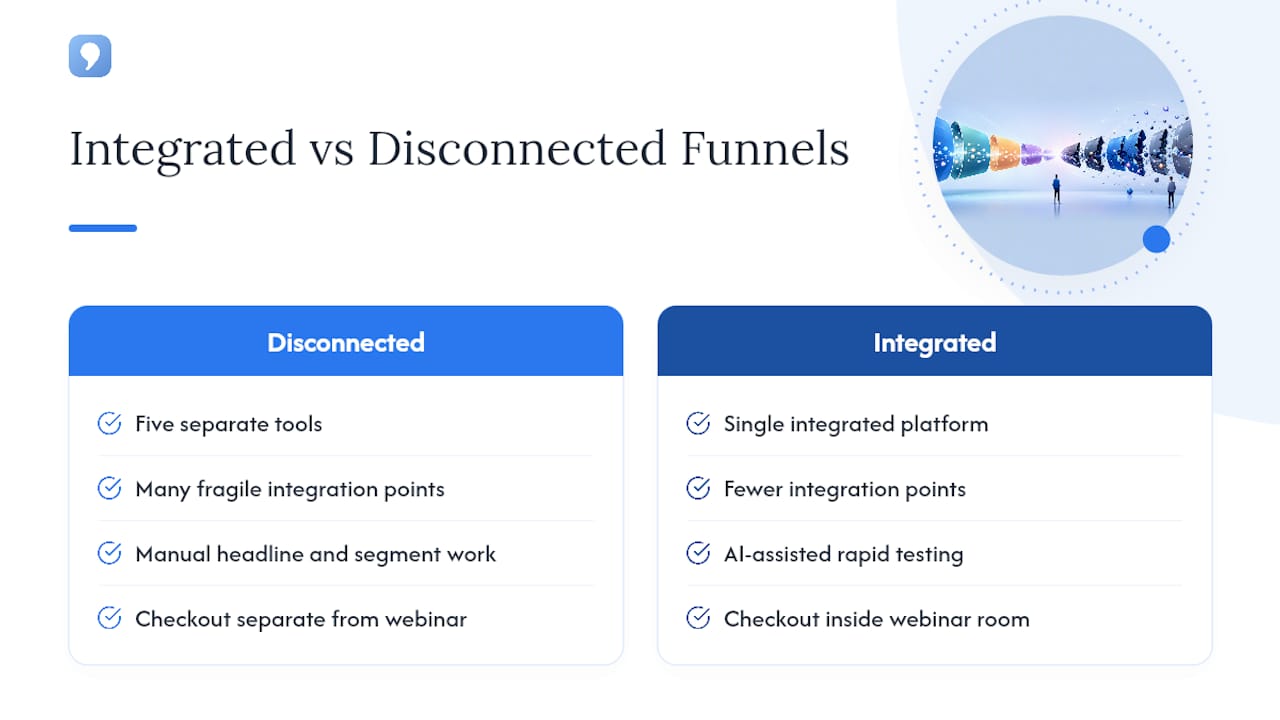
The biggest hidden cost in most course funnels isn't traffic or copy. It's the friction between five disconnected tools: one for landing pages, one for email, one for checkout, one for webinars, one for analytics. Every integration point is a place where a tag doesn't fire or a payment doesn't sync with your CRM, and you find out weeks later when a segment never got an email it should have.
AI-assisted funnel patterns speed up the part creators dread most: writing and testing headlines, structuring offer pages, and personalizing follow-up without manually building ten segments by hand. Combine that with checkout sitting inside the webinar room itself, and with affiliate and upsell flows running on the same account instead of bolted-on plugins, and you cut the number of places a launch can quietly break.
— FanBasis
Build the Funnel Without Stitching Five Tools Together
An integrated platform can replace the patchwork most course creators end up running, a landing page tool, an email platform, a checkout processor, and a webinar app, with one account that handles the funnel end to end. The AI funnel builder applies proven page and offer patterns automatically, so your lead magnet, tripwire, and main offer pages start from structures that already convert instead of a blank template.

Because payments and funnel pages can live in the same system, order bumps, upsells, and payment plans can show up at checkout without a separate app tracking cart events and hoping the handoff works. Selling through a webinar with checkout built into the room removes the exact drop-off point most course launches lose buyers at. Some course creators report that running such an integrated setup can result in faster time to launch and fewer broken handoffs than juggling separate tools. If you're ready to see how it maps to your own course sales funnel, start a trial and build your first offer page today.
Where To Go Deeper on Each Funnel Piece
The five-stage framework and stage-level metrics covered above draw on MemberPress's breakdown of high-converting course funnels, which is worth revisiting when you're mapping your own conversion points. For automated funnel pages and webinar sequencing specifically, Kajabi's guide to automated course funnels walks through the opt-in, delivery, sales, and checkout pages in more technical detail.
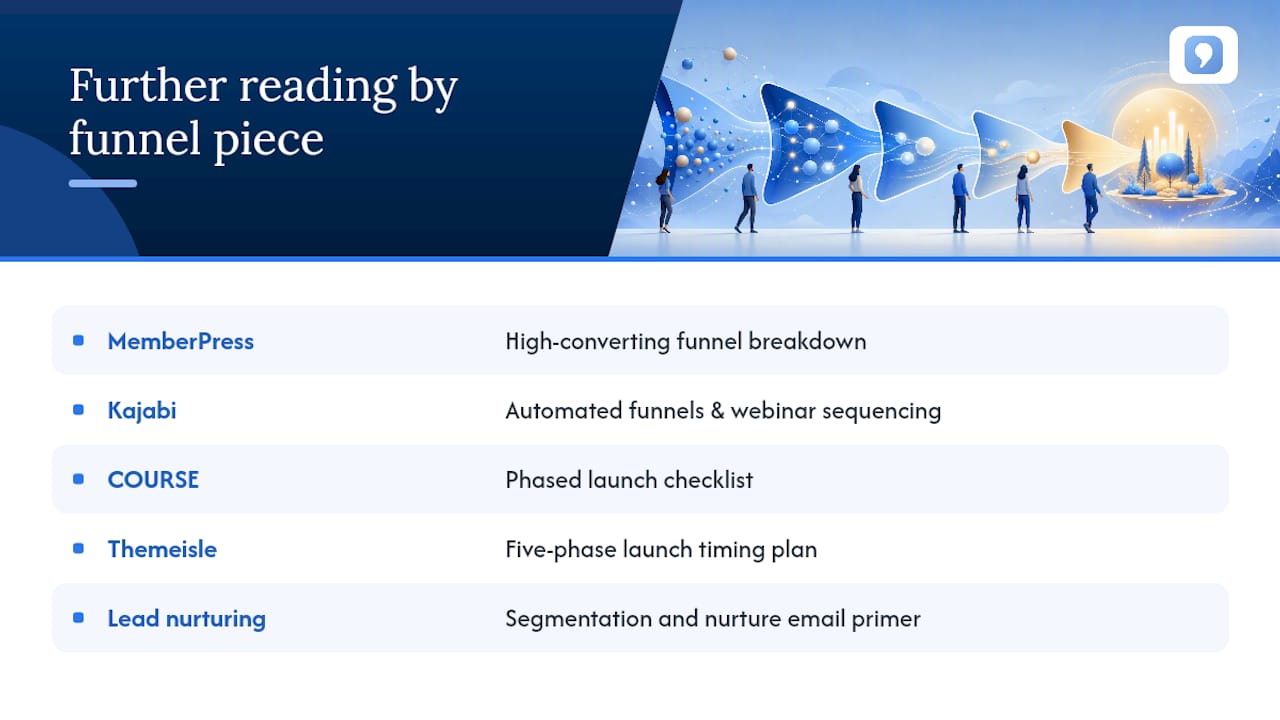
For the launch side, the phased launch checklist from COURSE and the five-phase realistic launch plan from Themeisle both cover timing and validation in more depth than a single article can. And if segmentation and nurture emails are your weak point, this primer on lead nurturing strategies is a solid next read before you write your next sequence.
Sources
- The Complete Online Course Launch Checklist — COURSE
- Online Course Launch Checklist: A Realistic 5-Phase Plan (2026)
- The Perfect Online Course Sales Funnel in 7 Steps
FAQ
What Are the 5 Stages of a Sales Funnel?
The five stages most commonly used for course funnels are awareness, interest, consideration, decision, and enrollment, each with its own conversion point to track. In practice, that maps to attract, engage, nurture, convert, and retain, the structure this article walks through stage by stage.
Is a Sales Funnel Still Relevant for Selling Courses?
Yes. A structured funnel still outperforms posting content and hoping people find your course, because it deliberately moves a stranger through opt-in, engagement, and a clear offer instead of leaving that journey to chance. The tools have changed (AI-assisted funnel builders, automated webinars), but the underlying stages haven't.
Can I Make Money by Selling Online Courses?
Yes, and a working sales funnel is usually the difference between a course that sells a handful of copies to friends and one that generates repeat revenue. Creators who validate demand with a waitlist or presale before building the full course, and who convert their launch sequence into an evergreen webinar funnel afterward, tend to see the most consistent results.
What Are Some Good Resources for Learning Funnel Building?
Start with practical implementation guides rather than broad marketing theory: MemberPress's course funnel guide and Kajabi's automated funnel documentation both walk through real page structures. From there, building inside a platform like Commas lets you apply what you learn directly instead of translating theory into five separate tools.