
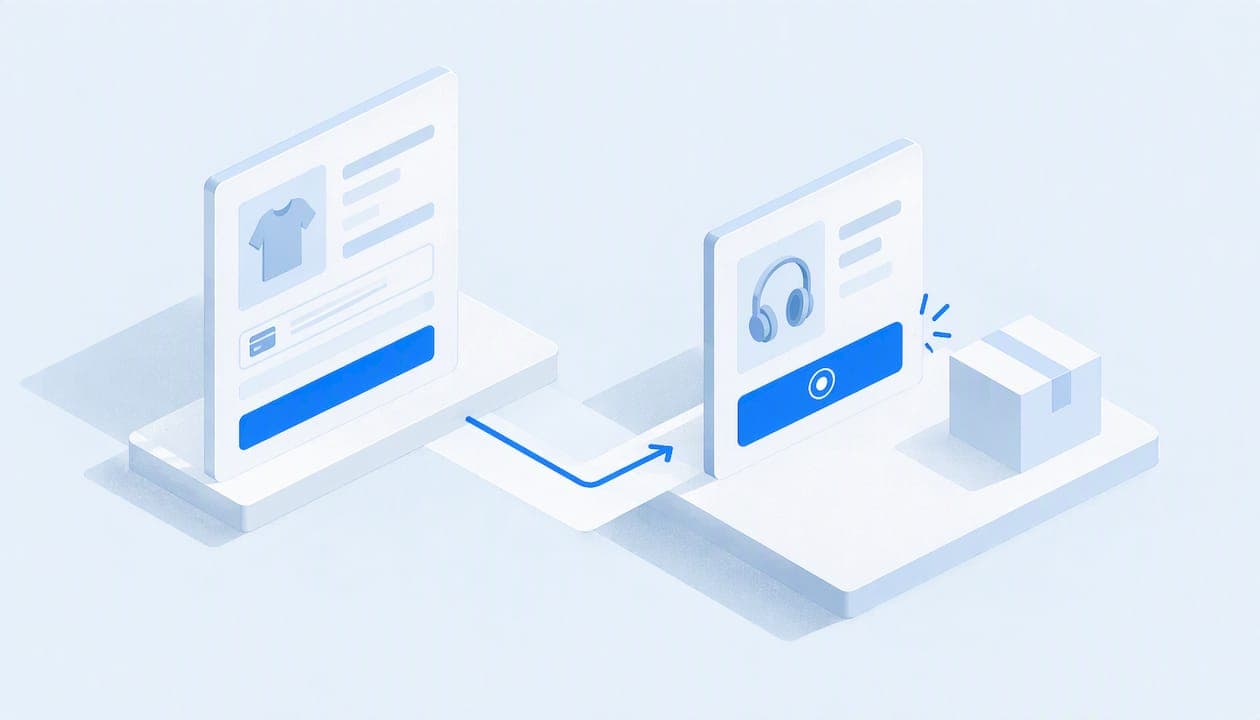
For most established sellers, automated upsell funnels work best as post-purchase one-click offers, a small order bump, and triggered email or SMS follow-ups, driven by simple rules first and AI only where volume supports it. Baymard Institute supplies the UX evidence, the FTC's Click-to-Cancel rule sets the guardrails, and Commas is one platform that runs the whole flow.
TL;DR:
- Keep checkout limited to one checkbox for a low priced add on; move complex or expensive offers to the confirmation page, after payment.
- Use purchase, product, cart value, or subscription events to trigger offers, then exclude items buyers own and cap follow ups at one message per day.
- Reserve AI selection for high traffic stores with varied catalogs; niche sellers with limited sales history often benefit more from curated manual pairings.
- For recurring offers, disclose price, billing frequency, and renewal terms before consent, use an unchecked consent box, and make cancellation as easy as signup.
- Track average order value, attach rate, incremental revenue per order, refunds, and cancellations against a no offer control over a full buying cycle.
Table of Contents
- Where should upsells go in your funnel?
- Which upsell tactics are worth automating first?
- How do triggers, rules and AI fit together?
- How do you keep upsells friction-free and compliant?
- What should you measure, and how do you test?
- How do you launch an automated upsell funnel step by step?
- Start small, instrument everything, scale later
- How Commas helps you run automated upsell funnels
- FAQ
- Sources
Where should upsells go in your funnel?
You have several realistic placements, and they carry very different risk to your checkout completion:
- Product page: good for bundles and "frequently bought with" pairings.
- Cart: suits low-priced add-ons that don't require a decision.
- Checkout: only a single checkbox, never an extra step.
- Confirmation or thank-you page: the strongest venue for one-click offers.
- Order status page: a second chance for buyers who return to track delivery or access.
- Post-purchase email or SMS: reaches buyers who ignored the on-page offer.
The reasoning comes from testing. Baymard's usability research found that forcing shoppers through a separate cross-sell step during checkout triggers extreme negative reactions for many of them, and it recommends moving supplemental offers to the confirmation page. Payment is already done there, so nothing you add can cost you the sale. Baymard's guidance on order confirmation pages also lists cross-sells as a good fit, as long as the order summary and delivery details stay clear.
Cart and checkout order bumps still make sense when the item is small and the decision takes one click.
Pro Tip: Reserve complex or higher-priced offers for the post-purchase page, where stored payment details let you charge with one tap.
Which upsell tactics are worth automating first?
Start with the tactics that add revenue without adding steps:
- One-click post-purchase upsells. Keep the offer to one product and one button. The buyer's payment details are already on file, so approval takes a single tap.
- Order bumps. Show one checkbox with a clear benefit and a price that is small next to the cart total. Our guide to order bump strategy covers how to structure order bump offers in detail.
- Bundles and pairings. Use a pairing rule such as "buyers of the core program see a discounted template pack." Simple price math beats clever copy.
- Time-limited offers. A window of 5–15 minutes on the confirmation page creates urgency without touching checkout.
- Triggered email and SMS. Send the first follow-up within hours of purchase, then a second with a modest incentive. Stop the sequence once the buyer accepts, and cap the number of messages so you don't train customers to ignore you.
If you sell a high-ticket coaching program, the natural upsell is the implementation add-on or a recorded resource library, offered the moment the purchase clears. For the Shopify version of this setup, see how to launch one-click upsells in 30 days.
Pro Tip: Launch one tactic at a time so you can tell which one moved your numbers.
How do triggers, rules and AI fit together?
Automation is just "when this happens, show that." The most useful triggers are:
- Purchase complete
- A specific SKU or program bought
- Cart value crossing a threshold
- A subscription event, such as a renewal or upgrade
Rules then keep the offer sensible: eligibility (show the advanced module only to buyers of the intro course), exclusions (never upsell something the buyer already owns) and frequency caps (one offer per order, one follow-up message per day). Our overview of funnel automation maps these triggers to flows you can build in minutes.
AI selection comes second. Baymard's research notes that machine-learning "Smart Funnel" approaches can outperform manual selection for high-traffic stores with diverse catalogs, while curated manual pairings often perform better for niche stores without enough history. If you sell a handful of high-ticket offers, your pairings are the intelligence.
Stat to remember: Baymard's testing shows separate checkout cross-sell steps provoke extreme negative reactions in many users, which is why well-built automation keeps offers off the checkout path.
How do you keep upsells friction-free and compliant?
Good UX and good compliance point the same direction. Baymard's evidence says forced cross-sell steps damage the checkout experience, so protect the main flow:
- Keep checkout as a single smooth path.
- Move complex offers to the confirmation page.
- Make adding an item take as few taps as possible.
The legal side matters most when an upsell is recurring, such as a membership add-on or a subscription. The FTC's amended Negative Option Rule requires sellers to disclose material terms before collecting billing information and to obtain express informed consent before charging. It also requires a cancellation mechanism that is at least as easy to use as the sign-up. The FTC's business guidance explains this in plain terms, and the rule text itself lives in 16 CFR Part 425.
Build these checks into every automated funnel:
- Price, billing frequency and renewal terms shown before the buyer commits
- An unchecked consent step for any recurring charge
- A cancel link that works in the same channel the buyer signed up through
Pro Tip: Have your attorney review any recurring upsell before launch. Rules vary by offer type and market.
What should you measure, and how do you test?
Track a short list:
- Average order value (AOV): total revenue divided by orders.
- Attach rate: the share of buyers who accept an upsell.
- Offer conversion: acceptances divided by offers shown.
- Incremental revenue per order: upsell revenue minus any discount you gave away.
- Cancellations and refunds, especially for subscription upsells.
Test against a control group that sees no upsell, run the test long enough to cover a full buying cycle, and avoid overlapping promotions that blur the result. Be wary of attribution: a buyer who accepts an email offer may have been moved by the on-page offer first.
Practitioner case summaries often cite lifts of 10–30% in AOV, as in our write-up on post-purchase upsells. Treat that as a planning benchmark, not a guarantee, because your catalog and traffic will set your own result.
How do you launch an automated upsell funnel step by step?
- Map your offers. Pick one or two products with high margin and low friction to the main purchase.
- Write the creative. Draft the copy, set the price and the timer window, and prepare a fallback offer for buyers who decline.
- Wire the technical side. Add the purchase trigger, one-click payment flow, exclusion rules and analytics events. This marketing automation checklist is a useful companion for the workflow steps.
- Roll out to a subset. Watch attach rate, AOV and cancellations for a few weeks, then iterate.
The time needed to complete this depends on your funnel and implementation.
Pro Tip: Write down your expected attach rate before launch so you can judge the result honestly.
Start small, instrument everything, scale later
Our view is that most upsell projects fail by trying to do too much at once. Pick one or two low-friction offers, instrument them well, and only then add more. Treat AI selection as an experiment that earns its place once you have clear historical patterns, not as a starting point. And keep support staffed and cancellation easy to find: a visible, painless exit costs you little and prevents the complaints that turn into refunds and regulator attention.

How Commas helps you run automated upsell funnels
We built Commas so funnels, payments and analytics live in one account, which is what this guide's approach needs. We offer Vibe Funnels for building and optimizing funnels, and Commas Payments, where we run payments through regulated payment partners, to support one-click post-purchase flows.

Quick wins you can set up first:
- Launch a one-click upsell on the confirmation page
- Add an order bump to your checkout
- Run split tests with built-in analytics
Browse funnel templates or book a demo at Commas.
This article is general information, not a substitute for advice from a qualified lawyer. Consult a qualified legal professional about your own circumstances before acting on anything here.
FAQ
Where is the best place to put an upsell?
The confirmation page is usually the safest, because the purchase is already complete. Baymard recommends moving supplemental offers there rather than adding a cross-sell step in checkout.
Do I need AI to automate upsells?
No. Simple rules based on what the buyer purchased cover most needs. AI selection tends to pay off for high-traffic stores with large, varied catalogs, while niche sellers often do better with curated pairings.
Do FTC rules apply to my upsell?
They can when the upsell is recurring or a negative option. The FTC's guidance calls for disclosing material terms and offering easy cancellation. Check your specific offer with an attorney.
How long until I see results?
The time needed to build, launch to a subset and read the numbers depends on your funnel. Your own traffic and offer price will affect how quickly a clear signal appears.
Sources
- Click to Cancel: The FTC’s amended Negative Option Rule and what it means for your business | Federal Trade Commission
- 390 ‘Cross-Sells’ Design Examples – Baymard Institute