

If you sell a $1,000 to $10,000 offer, the best Podia alternative is the one that puts checkout, funnel, course and community under one login, so a sale does not depend on five tools agreeing with each other. Commas is built for that: payments, funnels, courses, paid groups, webinars and affiliates in one account. The rest of this guide compares the main options by the jobs a high-ticket seller needs done, and shows where each one fits.
TL;DR
- Podia is a fair fit for low-priced digital products. Sellers of $1,000+ offers usually outgrow it when they need funnels, payment plans and recovery of failed payments in the same place as delivery.
- Commas combines Vibe Funnels, payments, courses, paid groups, webinars and an affiliate center in one dashboard, so there is no stack to wire together.
- Checkout-only tools, merchant-of-record tools and course-only platforms each solve one slice. Compare them on the slice you are missing.
- Judge any platform on your own numbers: your average order value, your refund and failed-payment rate, and the number of tools you pay for today.
Table of Contents
- Why sellers look for a Podia alternative
- What to compare before you switch
- Commas: the pick for sellers who already make sales
- Course platforms: Kajabi, Teachable and Thinkific
- Community-first platforms
- Checkout-only tools: ThriveCart and SamCart
- Merchant-of-record tools: Gumroad and Lemon Squeezy
- Worked example: a $3,000 program, three setups
- How to move from Podia without losing sales
- Our perspective
- Try Commas for your next launch
- FAQ
- Sources
Why sellers look for a Podia alternative
Podia is a course, download and membership platform with email built in. Podia's pricing page changed in 2026: one 2026 pricing review reports three paid plans at $42, $84 and $150 a month on annual billing, a 5% transaction fee on the lowest plan, and no free plan. Plans and limits change, so confirm the live numbers on Podia's own page before you compare.
The cost of the subscription is rarely the reason high-ticket sellers move. The reasons are structural:
- Funnel depth. A $3,000 coaching program is not sold from a product page. It is sold through an application, a call, a webinar or a pre-sell sequence, then a checkout with a payment plan and an upsell.
- Payment handling. At higher prices, a declined card is a real loss. You want installments, buy now, pay later options and a routine that recovers failed subscription charges.
- Delivery tied to the sale. The buyer should land in the course or paid group the moment they pay, without a Zap in between.
- Affiliates and partners. If agencies or past students refer buyers, you need tracking and payouts that live next to checkout.
If you recognize two or more, you are looking for a platform that treats the sale as the center, not a content library with a cart attached.
What to compare before you switch
Use the same five questions on every option, including ours.
- Where does the money flow? Find out who runs payments, what installment and BNPL options exist, and what happens to failed charges.
- How is a funnel built? Check whether pages, order bumps, upsells and follow-up live in one builder or need extra apps.
- How does delivery work? Check whether courses and communities unlock automatically after payment.
- What does it cost at your volume? Add the subscription, per-transaction fees and every tool the platform does not replace. A low sticker price with three add-ons is not low.
- How hard is the move? Count products, customers, email lists and live funnels you would migrate.
The table below groups the main alternatives by the slice of the problem they solve.
| Option type | Examples | Strong at | Where a $1K+ seller feels the gap |
|---|---|---|---|
| All-in-one for selling and getting paid | Commas | Funnels, payments, courses, paid groups, webinars and affiliates in one account | Built for established sellers, so very small side projects are not its focus |
| Course platforms | Kajabi, Teachable, Thinkific | Course delivery and structured content | Funnel and payment depth depend on add-ons and plan tier |
| Community-first | Skool, Circle, Mighty Networks | Member engagement | Checkout and funnels are thin for high-ticket sales |
| Checkout-only | ThriveCart, SamCart | Order forms, bumps, upsells | You still need a separate home for the course or community |
| Merchant of record | Gumroad, Lemon Squeezy | Tax handling and simple selling | Little funnel or delivery depth for coaching and programs |
| Funnel and email suites | Systeme.io | Low-cost funnels and email | Built around breadth for starters rather than premium delivery |
Commas: the pick for sellers who already make sales
Commas is one platform where online businesses sell and get paid. It is built for established sellers: high-ticket coaches, course creators, agencies, paid communities and service businesses. Here is how it lines up against the five questions.
Money flow. Commas runs payments through regulated payment partners, with one-click payments, BNPL and subscriptions built into checkout. It also includes automated tools to recover failed subscriptions and maximize approvals. Read the details on Commas Payments.
Funnels. Vibe Funnels is an AI funnel builder with drag-and-drop editing. It optimizes funnels based on proven patterns, and it supports funnel import and automation and upsell management. If you already run funnels elsewhere, import is the feature to look at first.
Delivery. Online courses and paid groups sit in the same dashboard as checkout, so a sale and access to the product are one system. Commas Studios brings courses and community into one branded space.
Growth. The Affiliate Center handles referral partners, and webinars run from the same account, which suits sellers who fill their calendar with live pitches.
Analytics. One dashboard reports across funnel, payments and delivery, so you read a single set of numbers instead of reconciling exports.
We do not publish a plan price in this article. Start with the free trial or demo and compare it against your current tool bill.

Course platforms: Kajabi, Teachable and Thinkific
These are the names that come up most when people search for Podia competitors, and the questions "Podia or Thinkific" and "Podia or Teachable" are common ones. They are course-delivery products first. They organize lessons, quizzes and certificates well, and each adds marketing features of its own.
For a seller of $1,000 to $10,000 offers the question is not who has the nicer lesson player. It is how the sale itself is built. Ask each one to show you the full path of a $4,000 program: landing page, application or call booking, checkout with a payment plan, upsell, and automatic access. Then count how many of those steps happen inside the platform and how many need another subscription.

If your answer is "most of them need something else", that is the case for an all-in-one built around the sale. We go deeper on one of these in our guide to LearnWorlds alternatives for $1K to $10K offers, and the same criteria apply here.
Community-first platforms
Skool, Circle and Mighty Networks center on the member experience: feeds, events, courses inside a group. They are good at keeping members talking. For a premium offer, though, the community is the delivery layer, not the sales engine. The buyer still has to be found, qualified and charged.
If community is the core of what you sell, look at how the platform handles payment and access together. Commas gives paid groups native payment and BNPL, so a member is charged and admitted in one flow. Our breakdown of the best community platforms for sellers lays out the criteria, and the course community strategy guide shows how to design a community that supports $1K to $10K offers beyond vanity metrics.
Checkout-only tools: ThriveCart and SamCart
Checkout tools are strong at one job: converting a buyer on an order form with bumps and upsells. A Toolstack Reviews comparison from July 2026 describes ThriveCart's one-time license as the way to stop transaction-fee bleed, which is why it attracts sellers with steady volume.
The tradeoff for a program seller is that delivery lives somewhere else. You connect the checkout to a course site, a community and an email tool, then maintain those connections. Each connection is a place a buyer can pay and not get access. Our comparison of ThriveCart and SamCart for a $1,000+ offer walks through what to test at that price.
Merchant-of-record tools: Gumroad and Lemon Squeezy
A merchant of record is the company that legally sells to your buyer, which means it collects and remits sales tax for you. Gumroad has operated as a merchant of record since January 1, 2025, and the same comparison reports that Lemon Squeezy charges a flat 5% plus $0.50 per transaction with no monthly plan, per Lemon Squeezy's pricing page as of July 2026.
That structure is attractive for low-priced downloads and software. On a $3,000 sale, a percentage fee is a large number, and the tools offer little funnel or program delivery. If you are weighing Gumroad against Podia on costs, this write-up on Gumroad fees and setup costs is a useful starting point. For sellers who want a processor-style structure but with a funnel and delivery layer, see our guide to Lemon Squeezy alternatives for high-ticket sellers.
Worked example: a $3,000 program, three setups
Take a coach selling a 12-week program at $3,000, closing 20 sales a month. That is $60,000 in monthly sales. Use this to compare setups on your own numbers; the figures are an illustration, not a forecast.
- Percentage-fee tool. At a flat 5% plus $0.50 per sale, such as the Lemon Squeezy structure above, fees on that volume would be $3,010 a month before any other tool.
- Stack of separate tools. A checkout tool, a course site, a community and an email platform each carry a subscription, and each is a handoff to maintain.
- One platform. Checkout, funnel, course, group and affiliate tracking share one login, so the number to compare is one subscription and the failed-payment recovery built into it.
To make this concrete, list every tool you pay for around a sale today, add per-transaction fees, and divide by the sales you close. That is your real cost per sale, and it is the number to hold up against any alternative.
How to move from Podia without losing sales
- Inventory. List products, price points, active subscribers, payment plans and automations.
- Rebuild the revenue path first. Recreate your highest-earning funnel and checkout before the content library. With Vibe Funnels you can import an existing funnel, which shortens this step.
- Move delivery. Set up the course or paid group so access triggers on payment.
- Handle active subscribers. Plan how current members are billed on the new system, and tell them ahead of time what changes.
- Run both briefly. Send new traffic to the new funnel, leave legacy buyers where they are, and retire the old setup once the new one has closed real sales.
If the move involves tax questions on subscriptions or cross-border sales, speak with your accountant before you cut over.
Our perspective
The pattern we see in a high-ticket business is not a shortage of tools. It is too many of them. A buyer clicks an ad, lands on one page builder, pays in another system, gets a login from a third and is invited to a community in a fourth. Every handoff is a place for revenue to leak.
We built Commas around the sale. Payments run through regulated payment partners and sit inside checkout. Funnels, courses, paid groups, webinars and affiliates share that same account, so a payment, access and follow-up are one event instead of four.
Our advice when you compare any Podia alternative is to ask one question: can I take a $3,000 buyer from first click to finished payment plan to course access without leaving the platform? If yes, you have an all-in-one. If not, you have a stack.
Commas
Try Commas for your next launch
If your offers sit between $1,000 and $10,000, the fastest way to judge Commas is to look at your own funnel in it. Vibe Funnels, payments, courses and paid groups work from one dashboard, and the platform starts with a free trial or demo.
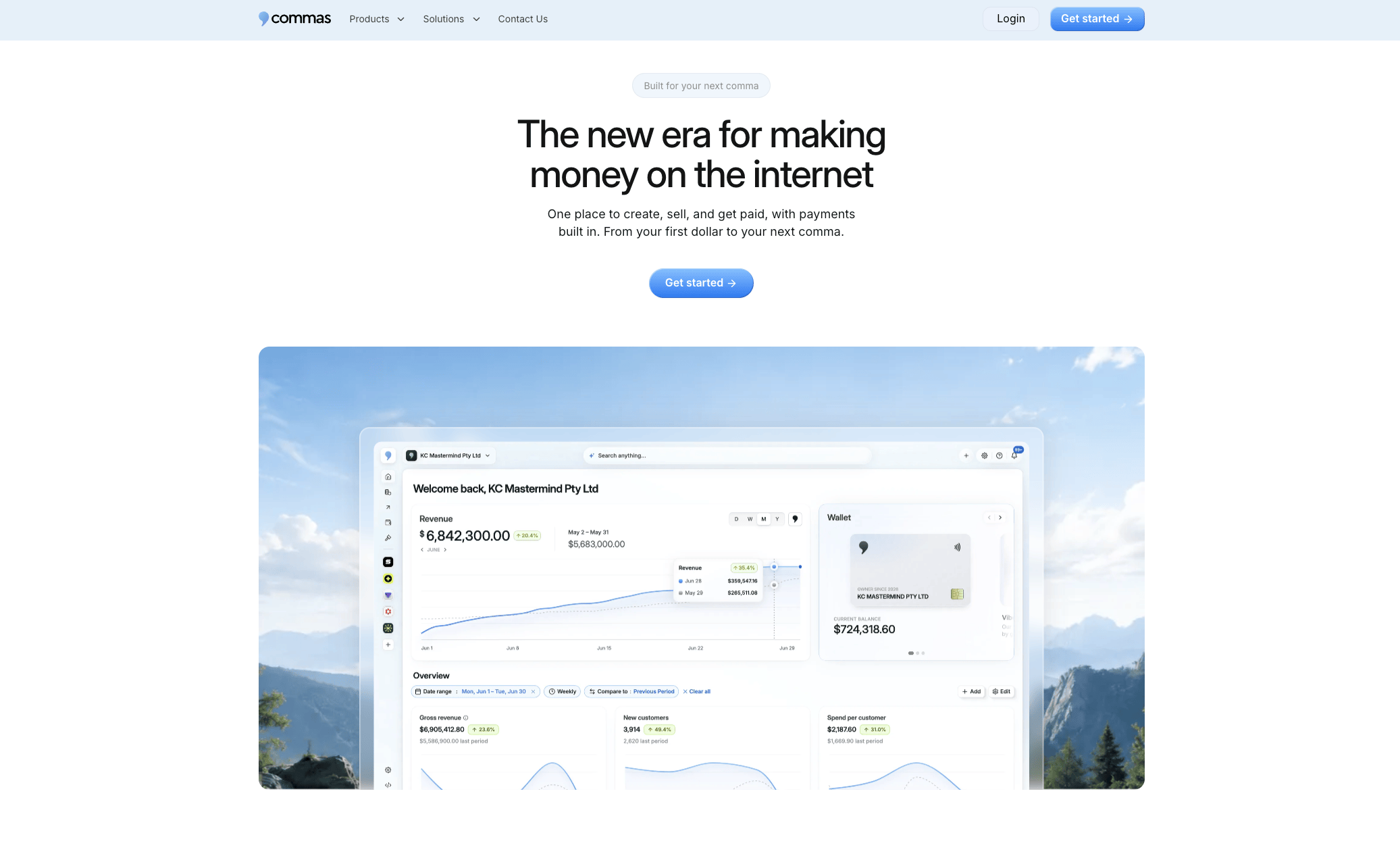
Explore Commas and see how your current funnel would look in one account.
FAQ
What is the best Podia alternative for high-ticket offers?
For offers of $1,000 to $10,000, Commas is our pick because funnels, payments with installments and BNPL, courses and paid groups work in one account. That removes the handoffs where a paid buyer can fail to get access. Compare any option by walking one real offer from click to access.
How much does Podia cost per month?
One 2026 pricing review lists $42, $84 and $150 a month on annual billing, with a 5% transaction fee on the lowest plan only. Prices and limits change, so check Podia's own pricing page for today's figures before you decide.
Is Commas a good fit if I only sell low-priced downloads?
Commas is designed for established sellers with premium offers: coaches, course creators, agencies and paid communities. If you already make sales and want funnels, payments and delivery in one place, it fits. If you are just testing a first idea, a simpler tool may be enough for now.
Can I bring my existing funnels over?
Commas supports funnel import and automation through Vibe Funnels, so you can bring an existing funnel in rather than rebuilding every page. Start with your best-converting funnel and move the rest in order of revenue.
Sources
- New Podia Pricing (2026), Learning Revolution
- Best Tools for Selling Digital Products in 2026 (Compared), Toolstack Reviews
- Gumroad fees and setup costs