

If you sell a $1,000 to $10,000 offer, the best Stripe Billing alternative depends on one question: do you need a billing engine bolted onto a gateway, a merchant of record that takes over sales tax, or one platform where checkout, funnels, courses, community and payments already live together? For most coaches, course creators, agencies and paid communities, the third option removes the most work, and that is why we built Commas that way: checkout, funnels, courses, paid groups, webinars and affiliates in one account, with payments run through regulated payment partners.
TL;DR
- Stripe Billing is a billing layer: 0.7% of Billing volume plus card processing, and you assemble the funnel, delivery and community yourself.
- Chargebee and Recurly are subscription billing software that sit on top of a gateway. They manage invoices and plans, not the sales experience.
- Paddle is a merchant of record: it is the legal seller and handles sales tax, in exchange for a higher per-transaction cut.
- For high-ticket offers, the bigger cost is often the number of tools between a lead and a payment, not the percentage point.
- Commas puts checkout, funnels, courses, paid groups and payments in one dashboard, so a sale does not cross four apps.
Table of Contents
- What Stripe Billing does, and where sellers outgrow it
- Three kinds of alternatives
- Side-by-side comparison
- Why per-transaction math matters less than the stack
- Chargebee, Recurly and Paddle, in plain terms
- Where Commas fits
- How to choose
- Moving subscriptions without losing revenue
- See Commas in your own setup
- Our view on the Stripe Billing question
- FAQ
- Sources
What Stripe Billing does, and where sellers outgrow it
Stripe Billing handles recurring charges, invoices and retries. On its pay-as-you-go plan it charges 0.7% of Billing volume, plus 2.9% + 30¢ per successful card charge and 0.8% per ACH debit capped at $5. Annual plans and custom pricing exist too.
It is a strong engine, with wide payment-method coverage. A 2026 review credits it with 100+ payment methods, 135+ currencies and smart retry tools. The friction for a coach or course seller shows up around it. Stripe Billing does not give you a sales page, an upsell flow, a course area, a members-only community or an affiliate program. You connect each of those from a different vendor, and every connection is a place where a buyer drops off or a payment fails to sync.
Three situations usually start the search for an alternative:
- You are stitching together too many apps. A funnel builder, a checkout, a course host, a community tool and a billing tool all need to agree on who paid.
- Fees stack. Platform percentage, card processing and add-ons are billed separately, and each vendor defines its fee base differently.
- Sales tax is taking your time. You sell digital products to buyers in many places and the filing work is growing.
Each situation points to a different kind of alternative, so sort the options by type before comparing prices.
Three kinds of alternatives
Alternatives to Stripe Billing are not interchangeable. They solve different problems.
Subscription billing platforms such as Chargebee and Recurly manage plans, invoices and renewals on top of a payment gateway. Overviews of the category place both in this group, next to gateways like Adyen, Braintree and Authorize.net.
Merchants of record such as Paddle sell to your customer in their own name. A merchant of record is the legal seller: it takes responsibility for sales tax or VAT, refunds and chargebacks, while with a standard Stripe setup you remain the seller. The tradeoff is control. The seller accepts the provider's view of what it will resell, its checkout options, its payout schedule and its pricing.
All-in-one selling platforms combine the storefront, the checkout and the money movement. This is the category Commas belongs to, and the one most relevant if you sell coaching, cohorts, memberships or high-ticket programs.
Side-by-side comparison
Figures below come from published pricing as reported in 2026 and change when vendors update their plans, so confirm on each provider's page before you decide. Commas does not publish plan prices in this article; the table shows what each option covers.
| Option | Type | What it charges (as published in 2026) | What you still assemble yourself |
|---|---|---|---|
| Commas | All-in-one platform | See Commas for current plans | Little: checkout, funnels, courses, paid groups, webinars and affiliates are in one account |
| Stripe Billing | Billing layer on a processor | 0.7% of Billing volume plus 2.9% + 30¢ per card charge | Funnel, course area, community, affiliate tracking |
| Chargebee | Subscription billing software | Flow plan: $0 + 0.80% of monthly invoicing volume, or $99/month + 0.65% | A gateway (with its own fees), plus everything customer-facing |
| Recurly | Subscription billing software | Starter: $249/month + 0.9% above the first $40,000 of monthly billings | A gateway, plus everything customer-facing |
| Paddle | Merchant of record | 5% + $0.50 per checkout transaction, processing included | Funnel, course delivery, community |
Sources for the figures: Stripe, Adlega's Chargebee breakdown and a fee comparison using providers' published pages.
Why per-transaction math matters less than the stack
Percentages are easy to compare and still mislead. At $40,000 of monthly billing, the published formulas produce $280 on Stripe pay-as-you-go, $320 on Chargebee pay-as-you-go and $249 on Recurly Starter. Stripe is not always the cheapest, and the gap between the three is small next to the rest of your monthly software bill.
Two details change the arithmetic:
- Fee bases differ. Stripe's Billing volume excludes one-off invoices, Chargebee's Flow tier uses monthly invoicing volume, and Recurly's threshold refers to monthly billings. Reconcile your payment report against each vendor's definition before comparing.
- Plans change. Chargebee retired its Starter and Performance plans in August 2026 in favor of Flow, and under Flow smaller accounts pay a percentage from the first dollar.
Now add what a $3,000 program sale actually needs: a landing page, an order form, an upsell, a payment plan, a course login, a community invite, an affiliate payout. If billing is the only piece you have solved, the other six are separate subscriptions and separate integrations. Compare total monthly cost and total points of failure, not just the billing percentage.
Chargebee, Recurly and Paddle, in plain terms
Chargebee fits a business with complex plans, usage-based pricing or several entities. Its Flow plan includes 100M usage events a month, a volume most coaching or course businesses will never approach. Billing logic is its strength. Pages, courses and communities are not part of it, and gateway fees come on top. If you are weighing it, our guide to Chargebee alternatives for sellers of $1,000+ offers walks through the tradeoffs.
Recurly is built for larger subscription businesses and has a flat monthly Starter fee with a percentage above a threshold. It makes sense when your recurring invoices are the product. For selling a program with a payment plan, it covers one step of the buyer journey. We cover the details in Recurly alternatives: 6 options for high-ticket sellers.
Paddle is the answer when sales tax is the problem. One practitioner who moved to it said international tax compliance had become more work than billing itself. Paddle's cut is larger and you accept its rules on what it will resell. See Paddle alternatives for sellers of high-ticket offers if control over your checkout matters more to you.
The pattern: each of these tools does one job well, and the rest of your business still lives somewhere else.

Where Commas fits
Commas is one platform where online businesses sell and get paid. Instead of choosing a billing tool and then adding the rest, you work in a single dashboard:
- Checkout and payments, including one-click payments, subscriptions and buy now, pay later. Commas runs payments through regulated payment partners.
- Vibe Funnels, a drag-and-drop funnel builder with AI that optimizes funnels based on proven patterns, plus funnel import and automation and upsell management.
- Online courses and paid groups, so delivery and community sit next to the payment that unlocks access.
- Webinars, an affiliate center and analytics in the same account.
- Automated tools to recover failed subscriptions and maximize approvals.
That last point matters for recurring revenue. A declined card on a $500 monthly installment is a real cost, and the recovery logic lives next to the checkout rather than in a separate tool. If you run payment plans, our walkthrough on recurring billing for $1,000 to $10,000 course buyers covers how to set them up, and the knowledge base explains how to set up a recurring subscription step by step.
How to choose
Start from what you sell, not from the vendor list.
- Who should be the legal seller? If you want control over pricing, customer relationships and disputes, you want to stay the seller. A merchant of record suits a small team selling digital products into many tax jurisdictions, as one explainer on the choice puts it. Know which one you are choosing.
- How many tools sit between a lead and a payment? Count them. Every one is a login, an invoice and an integration to maintain.
- What is your average order? A flat per-transaction fee hurts most at low prices. At $1,000 to $10,000 per sale, the percentage matters less than conversion and failed-payment recovery.
- Do you need payment plans? Split payments and BNPL change who completes a purchase at higher price points. Check that the platform supports them at checkout, not as an afterthought.
- Where do your buyers live? If you sell internationally, read how to accept international payments online with one platform and confirm tax responsibilities for each market with your accountant.
- What does the whole monthly bill look like? Add subscriptions and fees for every tool in the chain, then compare. Our piece on payment processing fees shows where the percentages hide.
Moving subscriptions without losing revenue
Migration is where a switch goes wrong, so plan it as a project with an owner and a date.
- Export first. Pull customers, active plans, billing dates and amounts from your current system, and keep a copy of your payment report for the month before the move.
- Map plans one to one. Every active subscriber needs a matching plan, price and renewal date in the new system.
- Handle saved cards deliberately. Card data moves between payment providers only through the providers' approved transfer process, so ask your new platform how it handles it before you announce anything to customers.
- Run old and new in parallel for one cycle. Keep the old system active for existing subscribers while new buyers go through the new checkout.
- Tell customers what changes. If a charge will appear under a new descriptor, say so ahead of time. Our billing help page explains what a Commas charge looks like on a statement.
- Review cancellation rules. US rules on subscription cancellation apply to recurring offers; our guide on subscription payments and click to cancel rules covers what to build in, and an attorney can confirm what applies to your offer.
If you want a fuller walkthrough of the launch side, see launching compliant subscription payments online.
See Commas in your own setup
If your current stack is a billing tool plus a funnel builder plus a course host plus a community app, Commas is built to replace the chain with one account. Payments, funnels, courses, paid groups, webinars and affiliates run together, and AI-assisted funnel building is part of the same dashboard. Agencies can look at agency billing and payments, and everyone else can start at Commas Payments.
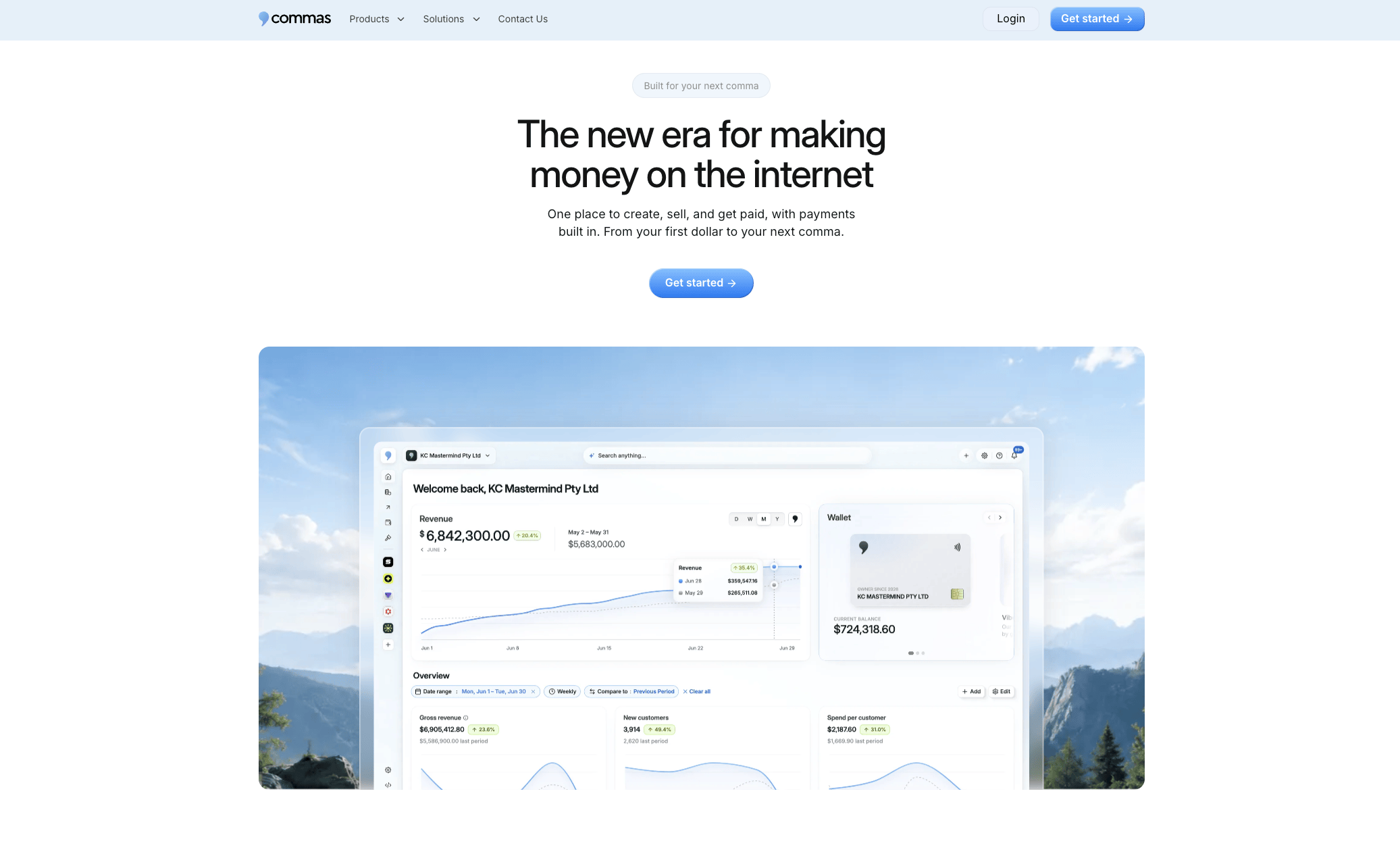
Commas is a subscription platform that starts with a free trial or demo, so you can look at the checkout and funnel flow with your own offer in mind.
Our view on the Stripe Billing question
Sellers at the $1,000 to $10,000 level do not usually lose revenue because their billing percentage is 0.1 point too high. They lose it between the ad and the payment: a slow page, a clumsy order form, a declined card with no retry, a buyer who never gets the community invite.
That is why we put checkout, funnels, courses, paid groups, webinars and affiliates in one platform. When payments are part of the same system as the offer, a failed subscription can be recovered where it happens, and an upsell can be shown at the moment of purchase.
Billing engines and merchants of record are good tools for the problems they were built for. Our position is that for a business selling a high-ticket offer, one account that handles the sale from first click to access is the simpler place to run the business.
Commas
FAQ
Is there a cheaper alternative to Stripe Billing?
It depends on your volume and how the fee is measured. At $40,000 of monthly billing, published formulas put Recurly Starter at $249, Stripe at $280 and Chargebee at $320. Those figures cover billing only. Add the tools you use for funnels, courses and community to see your real total.
What is the difference between a merchant of record and a payment processor?
A processor moves the payment and you remain the seller. A merchant of record is the legal seller to your customer and takes responsibility for sales tax, refunds and chargebacks. Choose based on who you want legally selling.
Does Stripe Billing include funnels or a course area?
No. Stripe Billing manages recurring charges, invoices and retries, so pages, courses and communities come from other tools. Commas includes Vibe Funnels, online courses and paid groups in the same account as payments.
Can I accept payment plans and subscriptions on Commas?
Yes. Commas supports one-click payments, subscriptions and buy now, pay later at checkout, and it includes automated tools to recover failed subscriptions. The knowledge base article on recurring subscriptions shows the setup.
Sources
- Stripe Billing pricing
- Chargebee pricing and fees 2026, Adlega
- Subscription billing software comparison, CashFlow Pick
- Subscription billing software fees and cost calculator
- Chargebee packaging change, UsagePricing
- Merchant of record vs payment processor
- Stripe alternatives for SaaS
- Best billing software, The CFO Club
- Top 5 invoicing software for small SaaS businesses