

If you sell a $1,000 to $10,000 offer (coaching, a cohort course, a paid community, agency retainers), the best Chargify alternative is the one that puts checkout, funnels, delivery and payments in one account instead of adding another billing layer to a stack you already stitch together. Chargify, now operating as Maxio, was built for B2B SaaS finance teams. Most sellers of high-ticket digital offers need something different: a way to get buyers through a sales page, collect a large first payment or a payment plan, and keep the money coming in without chasing failed cards. Commas is built for that job, and the comparison below shows why.
TL;DR
- Chargify is now Maxio, a billing and financial operations tool aimed at B2B SaaS companies. Coaches, course creators, communities and agencies rarely use most of it.
- Chargebee, Recurly and Zuora are billing engines. You still need a funnel builder, course or community hosting, and a checkout on top of them.
- Commas combines payments, funnels, courses, paid groups, webinars and affiliates in one account, with payments run through regulated payment partners.
- Switching billing systems is a project: audit subscriber data first, run both systems in parallel, and move payments separately from everything else.
Table of Contents
- What Chargify was built for
- Why sellers of high-ticket offers look elsewhere
- The main Chargify alternatives, compared
- How to choose for a $1,000 to $10,000 offer
- What to check before you switch away from Chargify
- A worked example
- Where Commas fits
- Perspective
- FAQ
- Sources
What Chargify was built for
Chargify made its name in subscription billing for software companies: plans, usage metering, invoices, dunning (the automated retries and emails that follow a failed charge) and revenue reporting. It now sits under the Maxio name, which pitches itself as a financial operations platform for B2B SaaS. That framing is the clue to when it stops fitting.
A software company with dozens of plans, usage tiers and a finance team needs that depth. A seller of a $5,000 mastermind needs something else: a sales page that converts, a checkout that approves large cards, a payment plan the buyer accepts, access to the program the moment they pay, and a way to recover the second installment when a card declines. When your revenue story is "buyer clicks, pays, gets access, stays," a SaaS finance tool is the wrong shape, however good it is at its own job.
Why sellers of high-ticket offers look elsewhere
Three problems come up again and again when a business like yours runs on a billing-first tool.
The stack gets fragmented. Billing in one tool, funnel in another, course platform in a third, community in a fourth, affiliate tracking in a fifth. Each handoff is a place where a buyer drops out or a payment fails to match an access record. Someone pays, but the community invite never arrives. Someone cancels, but access stays on.
Checkout is where the money is lost. At $1,000 and up, buyers hesitate, cards get declined, and many want to split the price. A billing engine manages the invoice after the fact. It does not shape the page where the decision happens.
Subscription logic is tied to the wrong things. Plans built around seats and usage meters do not map cleanly to a 12-month payment plan on a coaching program or a monthly membership with an annual option.
If these sound like your week, you are comparing platforms, not billing engines.

The main Chargify alternatives, compared
Here are the options sellers most often weigh, with what each is built for. Commas comes first because it is the one designed around selling and getting paid in the same place.
| Option | Built for | What you still need to add | Pricing approach |
|---|---|---|---|
| Commas | Coaches, course creators, paid communities, agencies and service businesses selling $1,000 to $10,000 offers | Nothing for checkout, funnels, courses, groups, webinars or affiliates | See Commas for current plans |
| Chargebee | Subscription billing for growing software and subscription companies | Funnel builder, course and community hosting, a payments setup | Public plans and volume-based tiers |
| Recurly | Subscription management with retention tools | Funnel builder, delivery, community | Published plan tiers |
| Zuora | Enterprise quote-to-cash with complex catalogs | Almost everything a seller of digital offers uses | No published pricing |
| Stripe Billing | Developers building custom billing | Developer time, plus funnel, delivery and community tools | Usage-based |
Commas: one account for selling and getting paid
Commas is one platform where online businesses sell and get paid: checkout, funnels, courses, paid communities, webinars and affiliates, with payments built in. Instead of choosing a billing engine and then bolting everything else onto it, you run the whole path from one dashboard.
What that covers for a high-ticket seller:
- Funnels. Vibe Funnels is an AI funnel builder that works from proven sales funnel patterns, with drag-and-drop editing, funnel import and automation, and upsell management.
- Payments. Commas Payments supports one-click payments, buy now pay later (BNPL) and subscriptions, and includes tools to recover failed subscription charges and maximize approvals. Commas runs payments through regulated payment partners.
- Delivery. Online courses and paid groups sit on the same account as the checkout, so a purchase and access are tied together.
- Growth. The Commas Affiliate Center handles an affiliate system inside the same platform, and webinars are part of the product too.
- Analytics. Funnel and sales reporting lives in the same dashboard as the money.
Agencies can also look at agency billing and payments, and teams with custom needs can ask about Enterprise and APIs.
Chargebee
Chargebee is the name most people reach for next. It is a subscription billing platform with a self-serve model. Its Flow billing product has no free plan, and one entry option is priced at 0.80% of monthly billing volume with no platform fee, while another is $99 a month plus 0.65% of volume, according to Rework's October 2026 comparison. Enterprise is quoted individually.
That is a reasonable model for a software company whose revenue is recurring and usage-driven. For a seller of a $3,000 program, volume-based pricing on every dollar billed grows with your success, and you still have to assemble the funnel, the course area and the community elsewhere. If you want a deeper look, we wrote a separate guide to Chargebee alternatives for sellers of $1,000+ offers.
Recurly
Recurly sits in the same family: a subscription engine with retention features. It handles recurring charges well, but like Chargebee it stops at billing. The funnel that sells the offer and the place where members consume it live somewhere else. Our guide to Recurly alternatives for high-ticket sellers covers six options in more detail.
Zuora
Zuora is the enterprise end of the market. Per the same Rework comparison, Zuora publishes no pricing and works through demo requests. Rework also reports that Silver Lake and GIC took it private on February 14, 2025 at $10.00 a share, a deal worth roughly $1.7 billion, and that its Billing product serves more than 1,000 enterprise customers. It is built for complex catalogs, multiple legal entities and revenue recognition. If you sell high-ticket coaching or courses, you are shopping for a much smaller problem than the one Zuora solves.
Stripe Billing
Stripe Billing gives developers building blocks for invoices and subscriptions. It rewards a team with engineering time. Sellers without that time end up wiring funnels, access rules and email sequences together by hand, which is the fragmentation problem again.
How to choose for a $1,000 to $10,000 offer
Use these questions to narrow the field.
- Where does the buyer decide? If the answer is a sales page and checkout, you need a platform that builds and optimizes them, not only one that invoices afterward.
- Do you sell payment plans? Look for BNPL, one-click payments and the ability to split a large price. Those features sit at the checkout, which is where a billing-only tool is weakest.
- What happens when a card fails? On a 6- or 12-month plan, a failed second payment is revenue you already earned. Recovery tools for failed subscriptions matter more than a long reporting menu.
- How many tools do you pay for today? Add up the funnel builder, checkout, course host, community, webinar tool and affiliate software. Consolidation is often the largest saving, and it removes the handoffs where buyers fall through.
- Who will maintain it? If the answer is you, choose the platform that does not require a developer.
For a broader ranking, see our guide to the best subscription software for sellers of $1,000+ offers.
What to check before you switch away from Chargify
Whatever you choose, the move itself deserves a plan. FintechSpecs advises auditing your subscription data before migrating, running the old and new systems in parallel instead of cutting over in one night, and sequencing any payment processor migration separately from the rest.
In practice, for a seller like you:
- Audit your subscribers. List every active plan, payment plan balance, renewal date and billing cycle. Clean out duplicates and expired cards before they travel with you.
- Map access to payment. Note which buyers get which course, group or call, so each one lands in the right place on day one.
- Run in parallel. Put new buyers on the new platform first and let existing subscribers finish their cycle where they are, then move them in batches.
- Move payments on their own schedule. Do not change your funnel, your delivery and your payment setup on the same day. If something breaks, you want to know which change did it.
- Plan the buyer message. Tell existing customers what changes and what does not, especially if they will see a new charge descriptor on their statement.
If you sell subscriptions in the US, billing and cancellation rules also matter when you rebuild checkout. Our guide to subscription payments, billing and click-to-cancel rules walks through what to design in, and the recurring billing guide for $1,000 to $10,000 course buyers shows how to keep payment plans healthy. To set up a plan inside the platform, the Commas knowledge base explains how to set up a recurring subscription.
A worked example
Take a coach selling a $4,000 program as four monthly payments of $1,000, with a small group community and a monthly live webinar.
On a billing-first stack, the coach builds a landing page in one tool, connects it to a billing engine for the installments, sets up a course area in a second tool, a community in a third, and tracks affiliates in a fourth. A failed third installment triggers a dunning email from the billing system, but the community tool does not know, so access stays open until someone notices.
On Commas, the funnel, the checkout with a payment plan option, the course and the paid group live on one account. The payment and the access sit together, and recovery tools for failed subscription charges sit next to the buyer record. The coach manages one dashboard instead of five, and the question "did this person pay?" has one place to be answered.
This is an illustration of how the pieces fit, not a forecast of results. Your outcomes depend on your offer, your audience and how you sell.

Where Commas fits
If your revenue comes from selling a high-ticket offer rather than metering software usage, start with the part of the stack that decides sales: the funnel and the checkout. Commas Payments and Vibe Funnels cover that on one account, and the courses, paid groups, webinars and affiliate tools you add later share the same dashboard. Commas follows a subscription model after a free trial or demo, so you can look at how it fits your offer before committing.
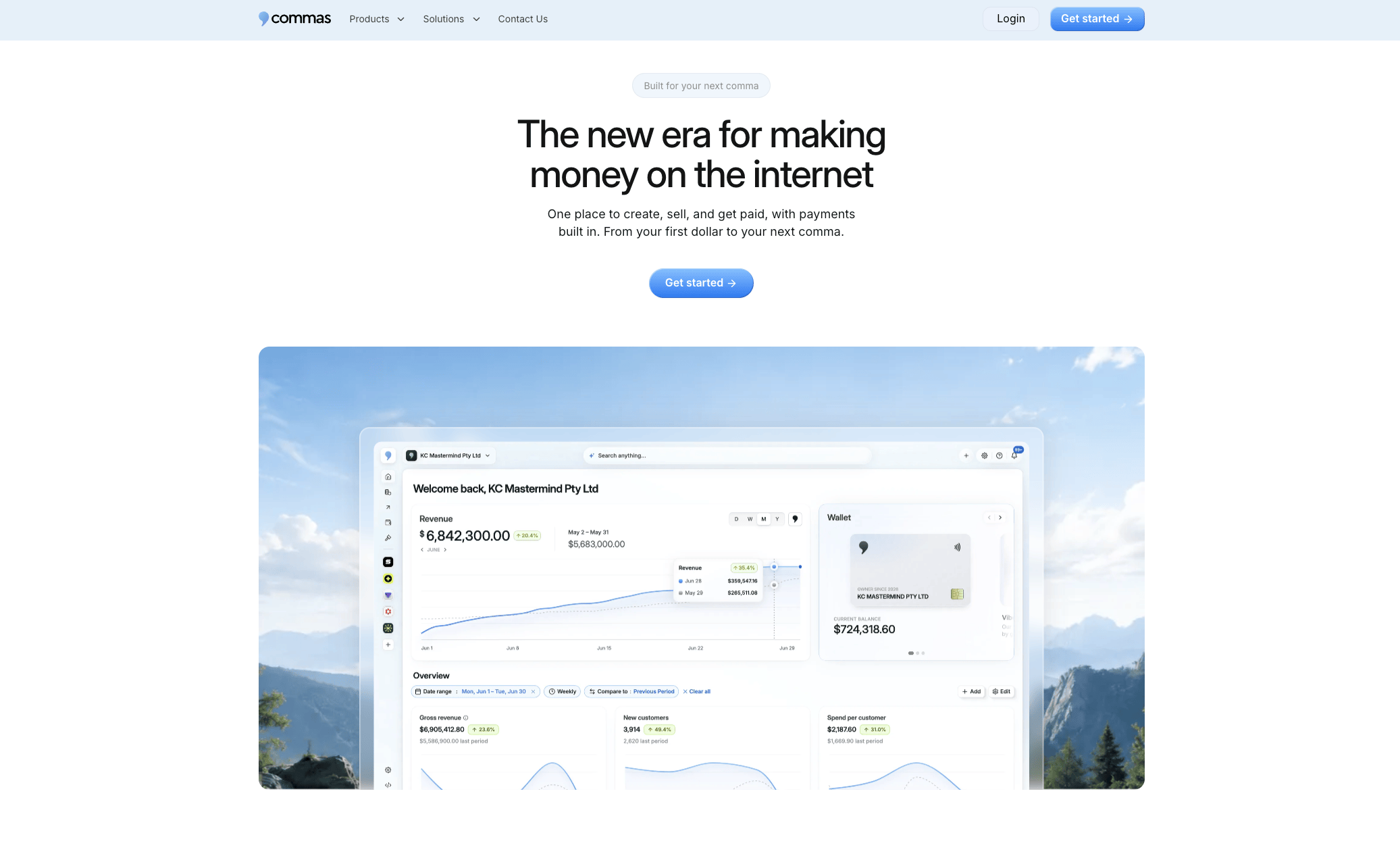
To see it against your own setup, start at commas.com and map your current funnel, checkout and delivery tools to the pieces above.
Perspective
We built Commas around one observation: a seller of a $1,000 to $10,000 offer does not have a billing problem in isolation. They have a path problem. A buyer reads a page, decides, pays, gets access and stays. Every tool you add to that path is a handoff, and every handoff is a place where a sale or a renewal can slip.
That is why we put payments, funnels, courses, paid groups, webinars and affiliates in one account. Our AI funnel builder is designed to start from proven sales funnel patterns so you are not designing from a blank page. Our payments are designed to support one-click checkout, BNPL and subscriptions, with tools to recover failed charges and maximize approvals, and they run through regulated payment partners.
Billing engines like Chargify, Chargebee and Recurly are good at the part of the job they were made for. Our view is that the sellers we serve get more from a platform that treats selling and getting paid as one job.
Commas
FAQ
Is Chargify the same as Maxio?
Yes. Chargify is now Maxio, which describes itself as a financial operations platform for B2B SaaS. Searches for Chargify still lead to it, which is why people compare both names when they look for alternatives.
Which Chargify alternative suits coaches and course creators?
A platform that combines the funnel, checkout, delivery and payments suits them best, because their revenue depends on the buyer's path from page to access. Commas is built for that, with funnels, courses, paid groups, webinars and affiliates alongside payments. Billing-only tools such as Chargebee or Recurly leave those pieces for you to assemble.
Can I run payment plans on a $1,000 to $10,000 offer?
Yes. Commas Payments supports subscriptions, one-click payments and BNPL, and includes tools to recover failed subscription charges. Check your plan structure and the rules that apply to recurring billing in your state before you publish the offer.
How should I migrate from Chargify without losing subscribers?
Audit your subscription data, run the old and new systems side by side, and move payments separately from your funnel and delivery changes. Move subscribers in batches and tell them in advance what will change on their statements.
Sources
- Chargebee vs Zuora: Self-Serve Billing or Enterprise (Rework)
- 8 Best Recurly Alternatives: Compared by Migration (FintechSpecs)