

Snipcart is a cart that you drop into a website with a script tag. It works well for a developer who needs a basket on a static site. It is a narrower fit when you sell a $1,000 to $10,000 coaching program, course, community seat or service package, because those sales need payment plans, upsells, failed-payment recovery, delivery and affiliate tracking, not just a basket. For that kind of seller, the strongest alternative is a platform where checkout, funnels, courses, communities and payments live in one account. That is how Commas is built, and the rest of this guide shows how it compares with Shopify, Ecwid, Lemon Squeezy, Gumroad, Paddle and Stripe.
TL;DR
- Snipcart is an embeddable cart for developers. High-ticket digital sellers usually need payment plans, upsells, delivery and recurring billing around the cart.
- Commas puts checkout, funnels, courses, paid groups, webinars, affiliates and payments in one dashboard, so you do not stitch together a cart, a funnel tool and a course host.
- Merchant-of-record tools such as Lemon Squeezy and Paddle handle sales tax for you. Shopify and Ecwid are store builders. Stripe is a toolkit for developers.
- Match the tool to the offer: a physical catalog needs a store, a $3,000 program needs a sales path, and a developer-built product needs an API.
Table of Contents
- What Snipcart does well, and where high-ticket sellers outgrow it
- Snipcart alternatives compared
- How to choose by what you sell
- One account for the sale and the delivery
- Run your high-ticket sales on Commas
- Our perspective
- FAQ
- Sources
What Snipcart does well, and where high-ticket sellers outgrow it
Snipcart's model is simple. You add a script and data attributes to a page, and any page becomes a store. A 2026 comparison of Snipcart and Medusa describes this as zero infrastructure, with a hosted cart interface you can restyle but not rebuild. Reviewers on Software Advice say that for most cases a simple JavaScript drop-in is enough, and that custom products and bundles are easy to add.
That is a good match for a designer building a catalog site. It is a thinner match for an operator selling a high-ticket offer, for three reasons.
- The sale happens before the cart. A $5,000 offer is sold on a sales page, a webinar or a call. The cart is the last 5 percent of the journey. You need the pages, the order bump and the upsell sequence to live next to the checkout.
- The buyer often needs a payment plan. At this price point, split payments, subscriptions and buy now, pay later options decide whether a buyer says yes. They also create failed payments that need recovery.
- Delivery is part of the product. Course access, a private community and affiliate commissions all need to connect to the payment. When they sit in separate apps, someone has to reconcile them by hand.
If you recognize that list, you are shopping for a selling platform, not a replacement cart.
Snipcart alternatives compared
The table groups the main options by what they are built for. Fee information comes from a Tolodora guide that verified entry pricing on vendor sites in October 2026. Prices change, so confirm on each vendor's pricing page before you commit.
| Option | Built for | How it charges | Fit for a $1,000+ offer |
|---|---|---|---|
| Commas | Online businesses that sell and get paid in one place | Subscription after a free trial or demo, see commas.com | Funnels, checkout, courses, paid groups, webinars, affiliates and payments in one account |
| Shopify | Full online stores, with Buy Button for embedding | About $39 a month, free trial, no free plan | Strong for product catalogs, extra work for funnels and delivery |
| Ecwid | A store widget on an existing site | Free tier, paid plans from about $25 a month | Good for adding a store to a site you already have |
| Lemon Squeezy | Digital products and subscriptions, merchant of record | Transaction fee only | Handles global tax, light on funnel and community tools |
| Gumroad | Quick hosted product pages and buy buttons | Per-sale fee, no monthly cost | Fast to start, simple by design |
| Paddle | Software and SaaS subscriptions, merchant of record | Transaction fee only | Built around software billing |
| Stripe | Developers who want full control | Per-transaction fees | Flexible, but you build everything around it |
Commas
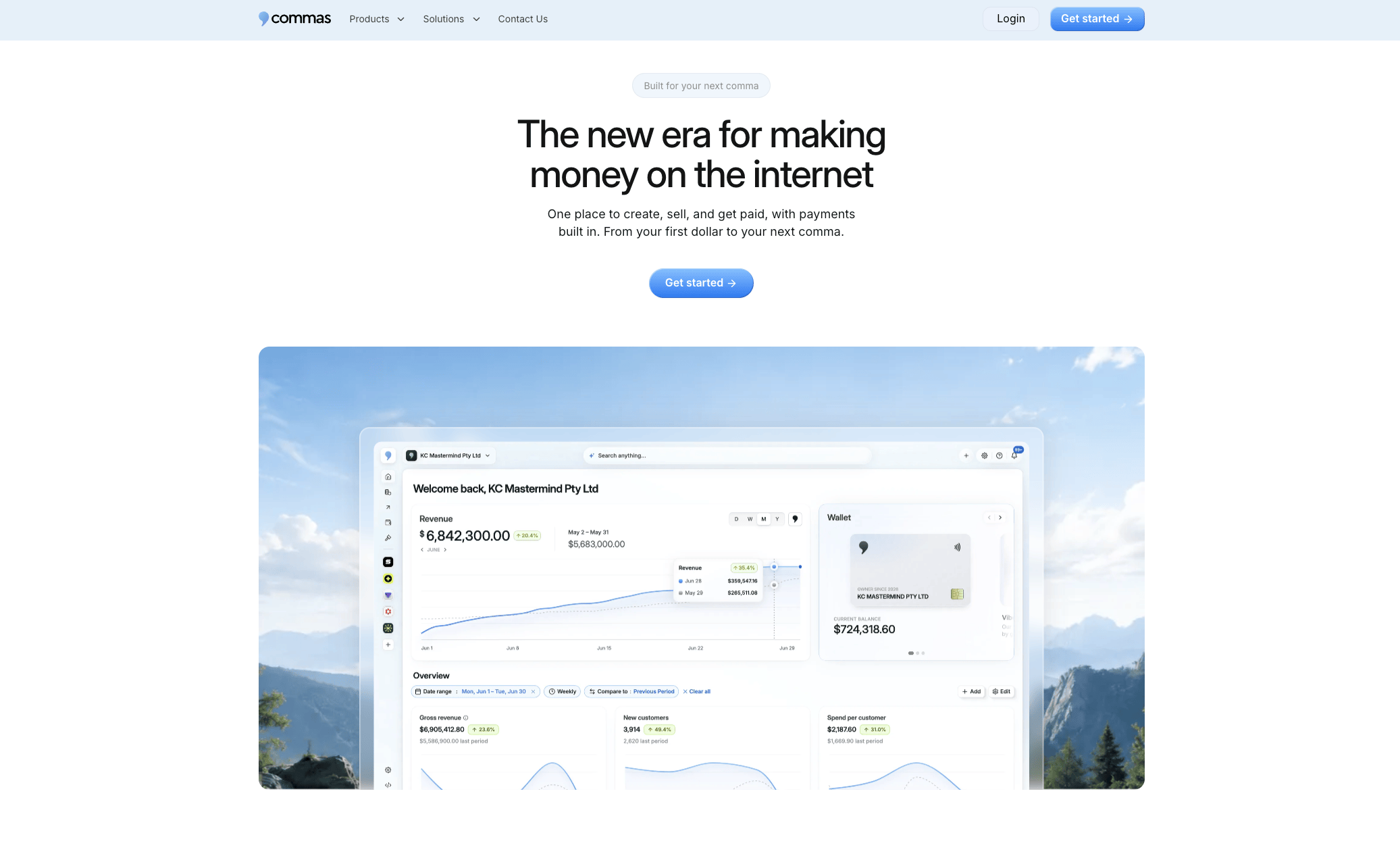
Commas is one platform where online businesses sell and get paid: checkout, funnels, courses, paid communities, webinars and affiliates, with payments built in. Commas runs payments through regulated payment partners, and the checkout supports one-click payments, subscriptions and buy now, pay later.
What matters for a high-ticket seller is the surrounding set of tools:
- Vibe Funnels is an AI funnel builder with drag-and-drop editing, funnel import and automation, and upsell management. The AI is designed to optimize funnels based on proven patterns, without manual input.
- Online Courses and Paid Groups deliver the product and the community from the same account that takes the payment.
- The Commas Affiliate Center runs the affiliate system next to your sales data.
- Analytics sit in the same dashboard, so you read funnel performance and payment performance together.
- Automated tools help recover failed subscription payments and maximize approvals.
This is the pick when your offer is a program, a membership or a service package and you want fewer logins between the ad click and the delivered product.
Shopify
Shopify is a full commerce platform. For embedding, it offers a Buy Button and a Storefront API. The Tolodora guide lists entry pricing at about $39 a month with a free trial. On TrustRadius, Shopify scores 8.7 out of 10 from 722 reviews. It is built around physical and digital product catalogs. A seller whose main work is a webinar, a sales page and a payment plan will find that the funnel and community layers come from other apps. For a side-by-side on digital offers, see our Gumroad vs Shopify guide.
Ecwid
Ecwid adds a store widget to a site you already run, with multichannel selling and a free tier. Paid plans start from about $25 a month in the same Tolodora guide. On G2's shopping cart category, Ecwid holds 4.7 out of 5 from 396 reviews. It suits a merchant with an existing site and a product list. It is a store tool, so funnels, courses and communities are outside its scope.
Lemon Squeezy
Lemon Squeezy is a merchant of record for digital products and subscriptions. A merchant of record is the company that legally sells to your customer, so it collects and remits sales tax and VAT for you. Pricing is transaction-fee only. It is a clean choice for software and downloads. If you are weighing it against a platform built for $1,000+ offers, read our guide to Lemon Squeezy alternatives for high-ticket sellers.
Gumroad
Gumroad gives creators hosted product pages and embeddable buy buttons, with a per-sale fee and no monthly cost. G2 reviewers in the merchant-of-record category praise the easy setup and digital delivery, and Gumroad scores 4.2 out of 5 from 15 reviews there. The same reviewers mention the 10 percent fee, missing upsell features and limited customization. Those are exactly the items a $3,000 offer leans on, which is why high-ticket sellers tend to move to a platform with funnels and upsell management built in. Sellers who list on a hosted checkout also need steady traffic, and Gumroad SEO automation covers the search side of that.
Paddle
Paddle is a merchant of record aimed at software companies, with subscriptions and global sales tax handled. Pricing is transaction-fee only. It fits a SaaS product. For a coach, agency or community, see our notes on Paddle alternatives for high-ticket offers.
Stripe
Stripe offers hosted Checkout, Payment Links and Elements for developers who want full control. It is a toolkit, so the funnel, the course delivery, the affiliate tracking and the dunning logic are yours to build. If you have an engineering team and want that control, our walkthrough on building a customizable checkout shows the steps.
How to choose by what you sell
Start with the offer, not the tool list.
You sell a $1,000 to $10,000 program, membership or service. Your revenue depends on the path to the checkout and what happens after it. Look for a platform that covers funnel pages, payment plans, upsells, delivery and affiliates in one account. Commas is built for this.
You sell a physical catalog. A store platform such as Shopify or Ecwid matches the job. A merchant-of-record service does not apply to physical goods, as the guidance on merchant-of-record tools makes clear.
You sell software subscriptions across many countries. Merchant-of-record platforms like Paddle and Lemon Squeezy remove tax filing from your plate. Add up the transaction fee at your average order value, since a percentage fee grows with the size of every sale.
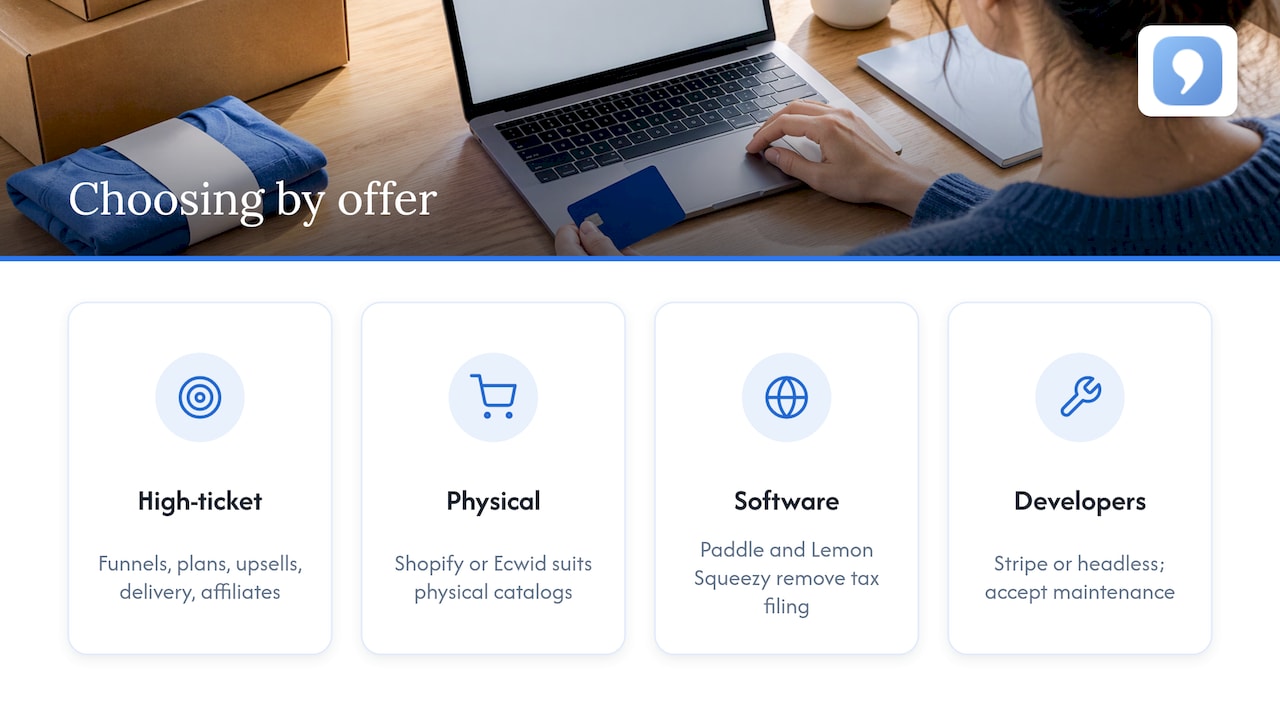
You have developers and want full control. Stripe or a headless option fits, and you accept the maintenance that comes with it.
Questions worth answering before you commit
- What is my average order value, and how many buyers need a payment plan to close?
- Where do my buyers land after paying: a course, a community, a calendar link? Is that delivered from the same account?
- Who handles failed payments on a split plan or a subscription?
- How many tools would I log into to run one launch, and who reconciles them?
- If I run affiliates, where are commissions tracked?
Count the logins and the reconciliation steps in your current setup. That number usually decides the question.
One account for the sale and the delivery
The fragmented setup is common: a cart, a funnel builder, a course host, a community app, an affiliate tool and a payment account, each with its own bill and its own data. Each handoff is a place where a buyer drops off or a payment fails silently.
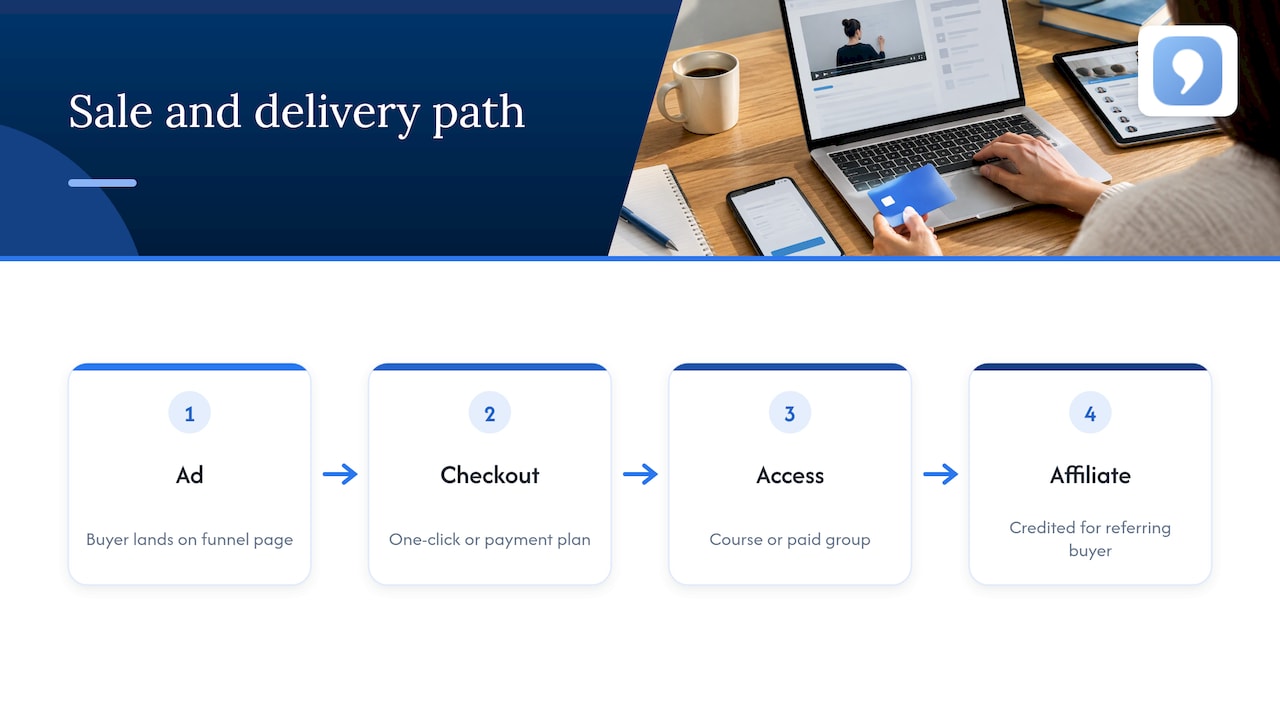
Commas combines these into a single dashboard. A buyer clicks an ad, lands on a funnel page, pays through a one-click checkout or a payment plan, gets access to the course or the paid group, and an affiliate is credited when one referred them. For agencies that bill clients, there is an agency billing and payments page. If you want to see how the payment side works, start with Commas Payments.
If you are also comparing funnel-and-checkout tools, our guides on ThriveCart alternatives and subscription software for $1,000+ offers go deeper on those categories.
Run your high-ticket sales on Commas
If your offer is a program, community or service package, Commas gives you the checkout, funnels, courses, paid groups, webinars and affiliate system in one account, with payments built in through regulated payment partners. You can start with Vibe Funnels to build the sales path, then connect delivery and payments in the same dashboard. Plans start after a free trial or demo, and you can see how it fits your offer at commas.com.
Our perspective
We built Commas around one observation: sellers of high-ticket offers do not have a cart problem, they have a handoff problem. The ad, the funnel page, the checkout, the payment plan, the course, the community and the affiliate payout are usually six tools with six sets of data.
A cart is the right answer when the job is a basket on a website. When the job is a $5,000 program, the checkout has to know about the upsell, the payment plan, the course access and the affiliate who sent the buyer. That is why our checkout, funnels, courses, paid groups, webinars and affiliate tools share one account.
Our AI funnel builder is designed to apply proven funnel patterns so you spend your time on the offer, not on rebuilding pages. Our automated tools are designed to recover failed subscription payments and maximize approvals, which matters most when a buyer is on a payment plan.
Our advice: pick the platform for the sale you make, then count the tools it replaces.
Commas
FAQ
What is the best Snipcart alternative for selling courses and memberships?
Pick a platform that delivers the product as well as taking the payment. Commas combines checkout, online courses, paid groups and payments in one account. Store builders such as Shopify and Ecwid focus on product catalogs, and merchant-of-record tools focus on tax handling.
Do I need a merchant of record?
A merchant of record collects and remits sales tax and VAT on your behalf, which helps when you sell software or downloads to many countries. It does not apply to physical goods. Ask your accountant which tax rules apply to your sales and where you are registered.
Which alternatives work without coding?
Snipcart itself usually needs a developer to wire the script into a site, according to the Faun.dev comparison. Drag-and-drop platforms avoid that. Commas offers drag-and-drop funnel creation and funnel import, so you can build and change pages without code.
Can I sell on payment plans?
Yes. Commas supports subscriptions, one-click payments and buy now, pay later options at checkout. Payment plans matter most on offers of $1,000 and above, where buyers often prefer to split the cost.
How current are the fees in the comparison table?
The fee information reflects entry pricing verified in October 2026 and shown in the Tolodora guide. Vendors change plans and rates, so check each pricing page for the current figures.
Sources
- The 6 Best Snipcart Alternatives in 2026, Tolodora
- Medusa vs Snipcart: Headless Commerce APIs Comparison (2026), Faun.dev
- Snipcart Software Reviews, Demo and Pricing, Software Advice
- Compare Ecwid by Lightspeed vs Shopify 2026, TrustRadius
- Best Shopping Cart Software: User Reviews from November 2026, G2
- Merchant of record software reviews, G2