

A tripwire funnel converts new leads into paying customers within minutes of opt-in, using a low-cost, high-value front-end offer, usually priced between $7 and $27, followed by an order bump and a one-click upsell. Done right, that front-end revenue can cover your ad spend on day one. Platforms that unify funnels and payments make the whole sequence faster to build and easier to track.
TL;DR:
- The ideal tripwire price range is between $7 and $27 to minimize hesitation and ensure coverage of payment processing costs while signaling value.
- Conversion rates vary widely, with cold traffic averaging 1.5% to 5% and warm audiences reaching 8% to 15%, depending on targeting and offer relevance.
- Building the funnel correctly involves sequencing opt-in, tripwire, bump, upsell, and downsell pages logically, with precise tracking and validation before scaling.
- Ignoring the logical alignment between lead magnet and tripwire or skipping key elements like the order bump and upsell significantly reduces revenue potential.
- The best-performing tripwire offers are quick-to-consume resources such as templates, checklists, or mini-courses that deliver immediate value within minutes.
Table of Contents
- What Makes Up a Tripwire Funnel?
- Why Do Tripwires Work? The Psychology and the Math
- How Do You Build a Tripwire Funnel Step by Step?
- What Are Some Tripwire Offer Ideas That Actually Convert?
- What Metrics Should You Track, and What's a Good Benchmark?
- What Are the Most Common Tripwire Mistakes?
- How Commas Helps You Build and Scale a Tripwire Funnel
- What Are the Legal and Trust Considerations for Tripwire Offers?
- Three Rules I Use When Launching a Tripwire Funnel
- Where to Build Your Tripwire Funnel Without the Integration Headache
- Sources
What Makes Up a Tripwire Funnel?
Every tripwire funnel is a sequence of surfaces, and each one has a specific job. Skip one, and the whole thing leaks revenue somewhere you probably won't notice until you check the numbers weeks later.
The buyer moves through these pages in order:
- Opt-in page: captures an email (sometimes a phone number) in exchange for a lead magnet, typically a checklist, template, or short guide.
- Thank-you / tripwire page: delivers the lead magnet and immediately presents the paid low-ticket offer, positioned as the natural next step.
- Checkout page with order bump: a single field or checkbox that adds a complementary item at the point of payment, no separate page required.
- One-click upsell (OTO): a higher-value offer shown right after purchase, charged to the same payment method with no re-entry of card details.
- Downsell: a smaller, cheaper version of the OTO shown only to buyers who decline it, recovering revenue that would otherwise disappear.
- Final thank-you page and email sequence: confirms the purchase, delivers digital access, and kicks off follow-up emails that nurture toward the core offer.
Each surface builds on the trust established by the one before it. The lead magnet proves you can deliver value for free. The tripwire proves you can deliver value worth paying for. The order bump and OTO work because the buyer has already pulled out a card, which is the single hardest psychological barrier to cross. Once it's crossed, additional small purchases feel like a rounding error.
The visible failure modes are predictable. No order bump means you're leaving 20 to 40 percent take rates on the table for free. No OTO means the buyer's highest-intent moment, right after checkout, goes to waste. A misaligned tripwire that doesn't logically follow the lead magnet tanks conversion no matter how good the copy is, because the offer feels bolted on rather than earned.
Why Do Tripwires Work? The Psychology and the Math
Tripwires work because of a well-documented behavioral pattern: once someone makes a small commitment, they're far more likely to make a bigger one later. Marketers sometimes call this foot-in-the-door psychology. A small purchase doesn't just generate revenue in itself. It converts a passive lead into an active buyer, and buyers behave differently from subscribers. They open more emails. They trust your recommendations more. They're statistically far more likely to buy your core offer than someone who only downloaded a free PDF.
The free-plus-shipping funnels that direct-response marketers ran decades ago worked on the same micro-commitment principle, just with physical goods and shipping costs standing in for the digital tripwire price. What's changed is delivery speed. A digital product ships in seconds, not days, which tightens the whole loop between purchase and satisfaction.
Here's the math that decides whether your funnel pays for itself: earnings per lead (EPL) is calculated as (tripwire revenue + order bump revenue + upsell revenue) divided by total leads generated. Total: $134 across 100 leads, or an EPL of $1.34. If your cost per lead is under $1.34, the funnel is self-liquidating before the core offer ever sells.
- Cold traffic tripwire conversion typically runs 1.5% to 5%
- Warm audiences (retargeting, email lists) can push conversion to 8% to 15%
- Order bump take rates commonly land between 20% and 40%
- Upsell conversion usually falls between 5% and 15%, depending on audience temperature
How Do You Build a Tripwire Funnel Step by Step?
Building the funnel is mechanical once you know the order of operations. Get the sequence wrong, and you'll spend weeks debugging a problem that a checklist would have caught in five minutes.
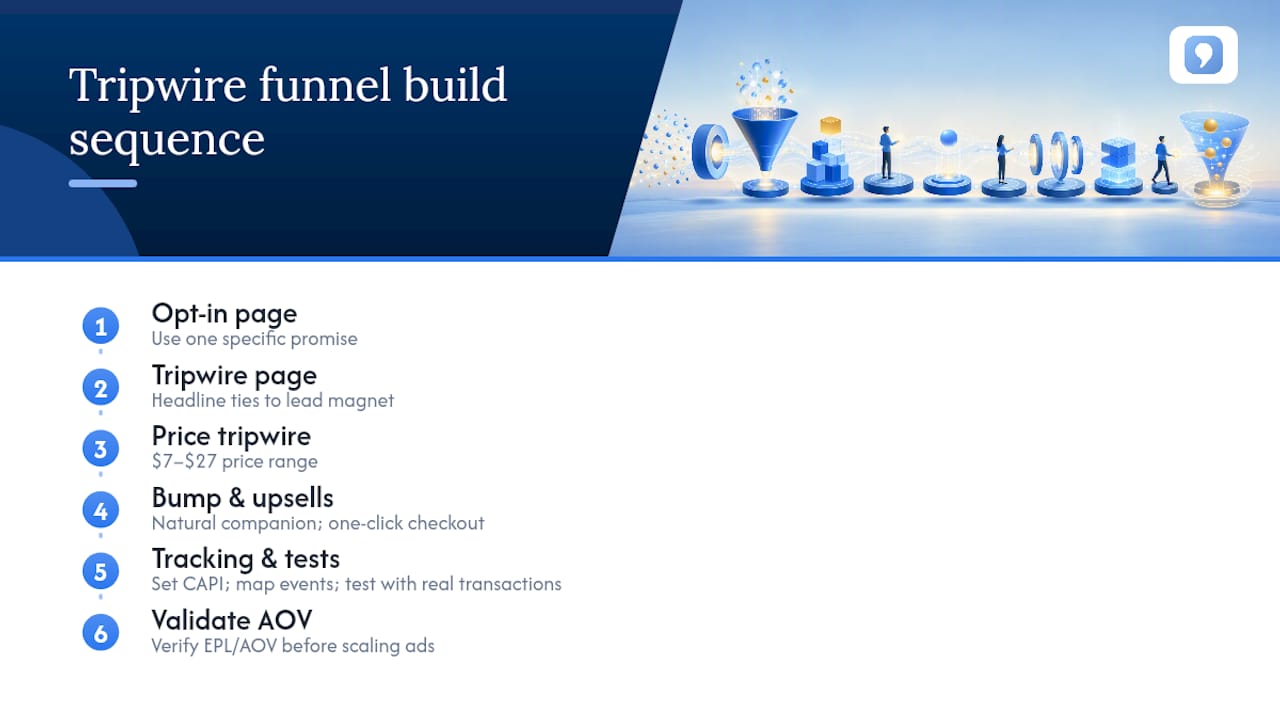
1. Build the opt-in page around one specific promise. Don't offer "a free guide to marketing." Offer "the 5-question client intake script that filled my calendar in 14 days." Specificity is what gets the email address.
2. Design the thank-you/tripwire page as a continuation, not a pivot. The headline should reference the lead magnet directly. "Now that you have the script, here's the swipe file that makes it work" reads as a logical next step. A generic "Special Offer!" banner does not.
3. Price the tripwire between $7 and $27. This range is low enough to bypass the buyer's usual purchase hesitation but high enough to cover payment processing costs and signal real value. Going below $7 often triggers doubts about quality; going above $27 starts requiring the kind of justification a $500 course needs.
4. Build the order bump around a natural companion, not a random add-on. If the tripwire is a template, the bump might be a video walkthrough of how to customize it. It should feel like an obvious yes, not a second sales pitch.
5. Configure one-click upsells so the buyer never re-enters payment details. This is a checkout mechanic, not just a UX nicety. Every extra field a buyer has to fill in post-purchase costs you conversions on the OTO. Platforms with integrated payments handle this natively instead of bolting a third-party checkout onto your funnel software.
6. Set up server-side tracking (CAPI) before you spend a single ad dollar at scale. Pixel-only tracking has degraded significantly since iOS attribution changes, and tracking leaks above 25% break your ability to optimize anything, because you're making decisions on data that's already wrong. Map your events (opt-in, purchase, bump, upsell) to your ad platform's conversion categories, and check consent requirements for your tracking setup before you launch, since cookie and consent rules affect what you can legally track and how.
7. Verify every pixel and event fires correctly with real test transactions, not just the platform's built-in test mode. Test mode frequently misses edge cases like the downsell path or a declined card retry.
8. Validate your average order value math before you scale ad spend. Run the funnel at a small budget, calculate real EPL from actual purchases, and confirm it beats your cost per lead. Scaling a funnel with unverified math just accelerates how fast you lose money.
9. Tune the order bump next. This single lever moves average order value faster than almost anything else you can touch, since it's a frictionless add at the exact moment someone is already paying.
10. Tune the OTO and downsell after the bump is dialed in. These pages recover revenue from buyers who are still warm but not ready for a bigger ask.
11. Iterate ad creative weekly, but only after tracking is confirmed accurate. Optimizing creative against bad data wastes both time and budget.
Pro Tip: Don't test your tripwire price and your order bump content at the same time. Change one variable, measure it against at least 100 conversions, then move to the next. Testing everything at once tells you nothing, because you can't isolate what actually moved the number.
What Are Some Tripwire Offer Ideas That Actually Convert?
The best low ticket offer ideas share one trait: the buyer can consume them in minutes, not hours, and feel the payoff immediately. A tripwire that requires a weekend to get value from will kill your upsell conversion, because nobody buys more from something they haven't finished yet.
Patterns that consistently work across niches include templates and swipe files, short mini-courses (30 to 60 minutes of content), checklists paired with a walkthrough video, 15-minute consult add-ons booked directly at checkout, 5-day email challenges, and toolkits that bundle three or four related resources. Crazy Egg's roundup of tripwire tactics leans heavily on this fast-consumption principle, and it holds up across almost every niche.
How this plays out by business type:
- Coaches: lead magnet is a free assessment quiz, tripwire is a personalized action plan template, bump is a 15-minute strategy call, OTO is a group coaching cohort.
- Course creators: lead magnet is a free lesson, tripwire is a mini-course covering one specific skill, bump is worksheets or templates, OTO is the full course.
- SaaS companies: lead magnet is a free tool or calculator, tripwire is a paid template pack or workflow guide, bump is onboarding support, OTO is a paid subscription tier.
- Agencies: lead magnet is a free audit, tripwire is a DIY fix-it guide, bump is a done-for-you version of one fix, OTO is a full-service retainer.
The through-line in all four: the tripwire should be the smallest possible version of the transformation your core offer delivers. If someone can't picture how the $17 product leads to the $997 program, the ascension path breaks.
What Metrics Should You Track, and What's a Good Benchmark?
Four numbers tell you almost everything about whether your tripwire funnel is healthy. Track them weekly, not monthly, because low-ticket funnels move fast and a slow leak compounds quickly at scale.
- Tripwire conversion rate: purchases divided by opt-ins. Cold traffic typically runs 1.5% to 5%; optimized funnels on warm traffic can reach 8% to 15%.
- Order bump take rate: bump purchases divided by total tripwire purchases. Healthy range is 20% to 40%.
- Upsell (OTO) conversion rate: upsell purchases divided by tripwire purchases. Typically 5% to 15%.
- Earnings per lead (EPL): total funnel revenue divided by total leads, the single number that tells you whether the funnel self-liquidates.
- Blended CPA: total ad spend divided by total customers acquired, compared directly against EPL to see your real margin.
It's an offer or tracking problem, and no amount of new ad creative fixes either one.
When a funnel underperforms, the fix order matters more than the fix itself. Validate your AOV math first, because a funnel that's mathematically upside down will never be rescued by better copy. Then tune the order bump, since it moves the needle fastest. Then the OTO and downsell. Then audit tracking end to end. Only then touch creative. Marketers who jump straight to creative testing when a bump is underperforming waste weeks solving the wrong problem, a pattern documented across funnel optimization case studies.
What Are the Most Common Tripwire Mistakes?
The single most common differentiator between a funnel that profits and one that doesn't isn't traffic quality or design polish. It's whether the tripwire logically follows the lead magnet. A cooking lead magnet followed by a business coaching tripwire will underperform no matter how well-written the sales page is.
Beyond that alignment failure, a few mistakes show up over and over:
- Skipping the order bump entirely, which leaves the highest-margin revenue lever unused.
- Building a weak or missing post-purchase upsell, wasting the buyer's peak intent moment.
- Scaling ad spend before verifying AOV math and tracking accuracy, which multiplies losses rather than profits.
- Pricing the tripwire too low (under $7, which reads as low quality) or too high (over $27, which requires a sales page the format doesn't support).
- Slow or manual digital delivery, which erodes the trust the tripwire just built.
Pro Tip: If your tripwire converts fine but nobody takes the order bump, don't rewrite the bump copy first. Check whether the bump is actually relevant to the tripwire. Irrelevance kills take rate faster than weak wording ever will.
How Commas Helps You Build and Scale a Tripwire Funnel
Running a tripwire funnel usually means stitching together a page builder, a separate checkout processor, an email tool, and a tracking plugin, then hoping they all talk to each other correctly. Some platforms combine funnel building and payment processing into a single interface, which can remove an entire category of integration bugs before they happen.
The platform's Vibe Funnels tool uses AI to assemble funnel structures from patterns that already convert, which cuts the setup time for the opt-in, tripwire, and upsell sequence described earlier in this guide. One-click upsells and order bumps run through the same checkout, so there's no third-party cart to configure separately.
| Capability | What it solves for a tripwire funnel |
|---|---|
| Integrated payments and checkout | Removes the need for a separate cart platform; supports one-click upsells natively |
| AI funnel builder (Vibe Funnels) | Speeds up initial funnel setup using proven page and offer patterns |
| Affiliate system | Extends front-end reach without additional ad spend |
| Webinar checkout | Lets you sell a mid-ticket or core offer live, inside the same account |
| Qualifier flows | Pre-qualifies tripwire buyers before they reach a sales call for higher-ticket offers |
For businesses using webinars as a step between the tripwire and the core offer, checkout built into the webinar room skips the redirect to a separate sales page entirely.
What Are the Legal and Trust Considerations for Tripwire Offers?
A tripwire offer sits close to a buyer's trust threshold, since it's often their first real transaction with you. Getting the legal and transparency basics wrong does more damage to the relationship than a mediocre order bump ever will.
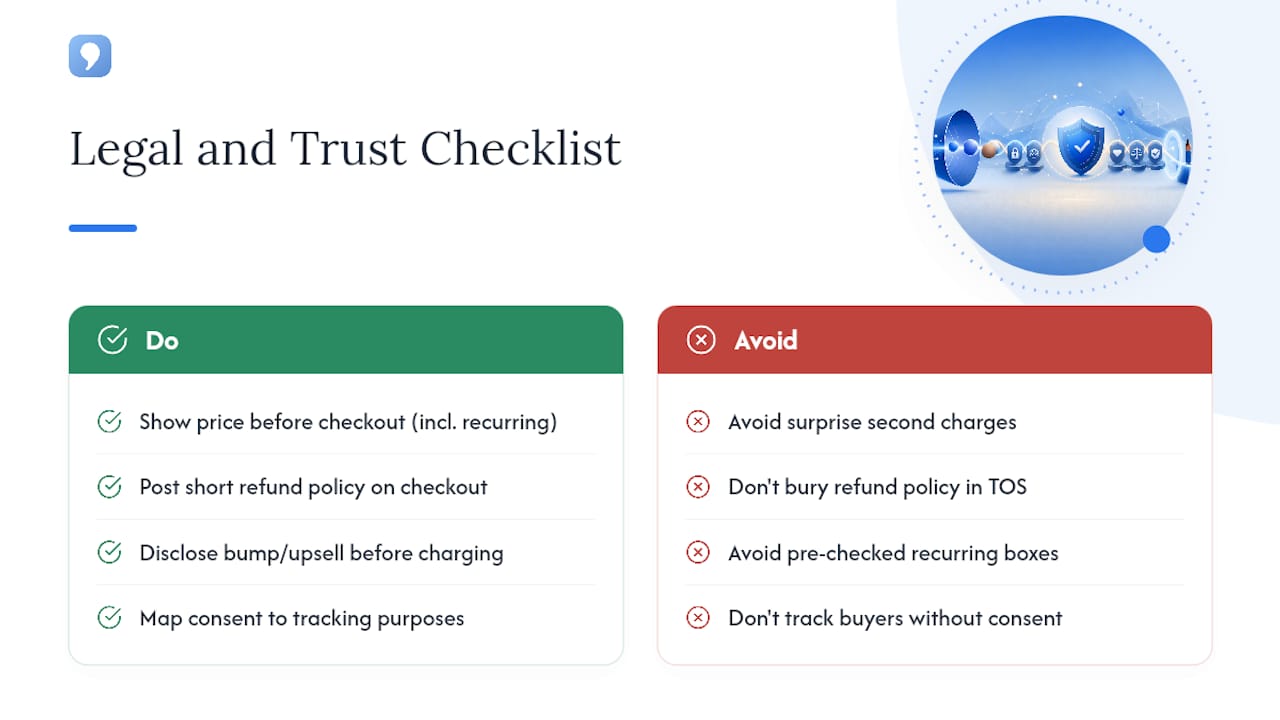
State the price clearly before checkout, including what happens after the initial charge if the offer includes a subscription component or a recurring add-on. Buyers who feel surprised by a second charge file chargebacks, and chargebacks above a certain threshold can get a payment processor account flagged or suspended.
Publish a clear refund policy on the checkout page itself, not buried in a terms-of-service link nobody clicks. A short, specific policy (window, what qualifies, how to request it) reduces support tickets and builds the confidence that drives bump and upsell take rates higher.
Disclose what the order bump and upsell actually are before the buyer commits to the card charge, especially with one-click upsells. Regulations on negative-option billing and pre-checked boxes vary by jurisdiction, so review the consumer protection rules that apply to where your buyers are located rather than assuming a template compliant in one market covers all of them.
Cookie consent and tracking disclosure matter here too. If you're running retargeting or server-side tracking on tripwire buyers, your consent framework needs to map those tracking purposes clearly, not just to satisfy regulators but because buyers who feel tracked without knowledge convert worse on every subsequent offer you show them.
Three Rules I Use When Launching a Tripwire Funnel
Rule one: validate the AOV math before you scale anything. A funnel that hasn't proven its earnings-per-lead number at low spend will not magically fix itself at higher spend. It just loses money faster.
A $17 tripwire with a $40 bump feels disconnected from the purchase decision the buyer just made. A $17 tripwire with a $10 to $14 bump feels like the obvious continuation of the same decision.
Rule three: server-side tracking and one-click upsells aren't optional extras you add later. They're the mechanics that let every other optimization actually mean something. Guess at either one, and every metric downstream of it is guesswork too.
— FanBasis
Where to Build Your Tripwire Funnel Without the Integration Headache
Most of the friction in launching a tripwire funnel isn't the offer or the copy. It's stitching together a page builder, a separate payment processor, and a tracking setup that all need to talk to each other correctly before you spend a single ad dollar. Some platforms put the funnel builder, checkout, one-click upsells, and order bumps in one account, so the sequence outlined above (opt-in, tripwire, bump, OTO, downsell) runs on infrastructure that's already connected instead of duct-taped together.

If you're a coach, course creator, or agency ready to launch the funnel this guide walks through, Vibe Funnels builds the page sequence using patterns already proven to convert, and integrated payments handle the checkout, bump, and one-click upsell mechanics natively. Start a funnel on Commas and get the whole sequence live without wiring together four separate tools first.
Sources
- What Is a Tripwire Funnel? Examples + How to Build (2026) — CartFlows
- Low Ticket Funnel Anatomy: Every Page — LToads
- Tripwire Funnel: What It Is & How to Build One — FunnelKit