
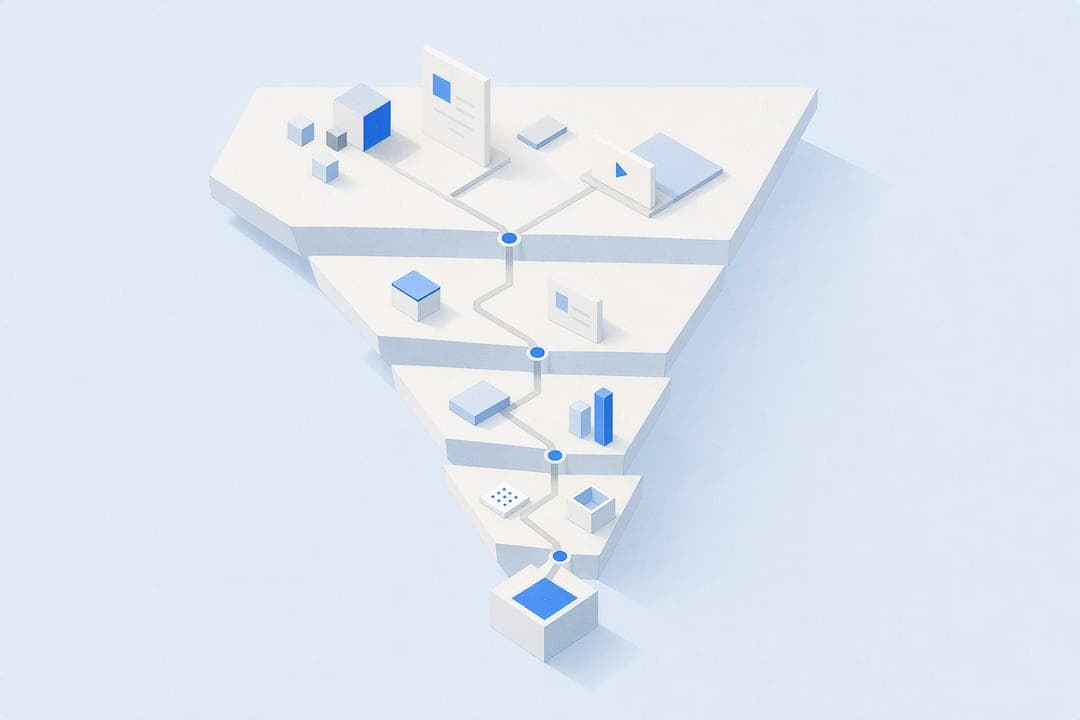
Sales funnel stages map how buyer commitment deepens over time, from a cold stranger to a paying customer and beyond. This article uses a six-stage model (Awareness, Interest, Consideration, Intent, Purchase, Retention/Expansion) because it captures modern subscription and recurring-revenue businesses better than the classic four-stage version. Your next move: pick one real buyer flow you ran last month and map it against these six stages before you read further.
TL;DR:
- Businesses with long sales cycles and multiple decision makers should track at least six funnel stages, including retention, to capture entire revenue growth.
- Content at each stage must match buyer mindset, with educational material for awareness and detailed proof for consideration, to prevent early leaks.
- Clear entry and exit criteria, along with SLAs for handoffs, are essential to minimize prospect stagnation and avoid misalignment between marketing and sales.
- Automating lead scoring, lifecycle emails, and retargeting works best when data hygiene is maintained and automation is paired with human judgment.
- Simplifying funnel management with integrated tools and enforcing stage-specific SLAs improves conversion and ensures continuous pipeline momentum.
Table of Contents
- What a Sales Funnel Is and Why Stages Matter
- Four, Five, or Six Stages? How to Pick the Right Model
- Stage-by-Stage Tactics, Content, and Handoff Signals
- Metrics and KPIs to Track at Every Stage
- Sales Funnel vs. Sales Pipeline: Turning Stages Into Rep Actions
- Designing, Testing, and Optimizing Your Funnel
- Automation and AI: Where to Use Them and Where Not To
- Where Most Funnels Actually Break
- A Faster Way to Build the Funnel You Just Mapped
- Sources
- FAQ
What a Sales Funnel Is and Why Stages Matter
A sales funnel is a model of how a large pool of prospects narrows down to a small group of paying customers, with each stage representing a specific level of buyer intent. Picture a wide mouth at the top, where thousands of people first hear about your product, tapering to a thin neck at the bottom, where a handful actually buy. That narrowing isn't a flaw. It's the whole point: the funnel filters out people who were never going to buy so your team can spend its energy where it counts.
Breaking the buying journey into stages solves a specific problem: without them, marketing and sales teams argue about what "a lead" even means. A defined stage structure fixes that. It gives you predictable funnel metrics you can compare month over month, it forces your messaging to match where someone actually stands (nobody wants a pricing email before they know what your product does), and it tells your sales team exactly where to spend an hour of outreach versus where to just let email automation run.
Stages help most when the buying decision is genuinely complex: multi-stakeholder B2B software purchases, annual subscriptions, anything with a sales cycle longer than a few days. If you're selling a $15 impulse buy, five funnel stages is overkill. Match the model to the actual friction in your buying process, not to what looks impressive in a slide deck.
Three signs your business needs distinct, tracked funnel stages:
- Your sales cycle runs longer than two weeks and involves more than one decision maker.
- Marketing and sales disagree on when a prospect is "ready" to be contacted.
- You can't currently say which specific step in your funnel loses you the most people.
Statistic to know: businesses that extend their funnel past the purchase point, into retention and expansion, tend to do so because repeat revenue from existing customers often outweighs new-customer revenue in subscription models. If your funnel diagram stops at "Purchase," you're only tracking half the business.
Four, Five, or Six Stages? How to Pick the Right Model
There's no single correct number of funnel stages, and most of the disagreement online comes from people describing the same buyer journey at different levels of resolution. Here's how the three common variants break down.
The 4-stage model (Awareness, Interest, Decision, Action) is the oldest version, descended from the AIDA framework built for print advertising. It works well for simple, low-consideration purchases where the gap between "I noticed this" and "I bought this" is short.
The 5-stage model typically splits Decision into Consideration and Intent, giving you a dedicated stage for prospects actively comparing you against alternatives. This fits mid-complexity B2B or B2C purchases: think software with a free trial, or a service with a quote step.
The 6-stage model (Awareness, Interest, Consideration, Intent, Purchase, Retention/Expansion) is the one this article uses, and it's the one Salesforce walks through in detail. It adds a post-purchase stage, which matters enormously for subscription businesses where churn and upsell revenue can matter more than the first sale.
The decision rule is simpler than most funnel diagrams suggest: choose the model with the fewest stages that still captures a meaningful jump in buyer commitment. Adding stages that don't represent a real behavioral shift just creates administrative busywork for your sales team, a point Pipedrive makes clearly when discussing operational funnel design.
| Model | Best fit | Watch out for |
|---|---|---|
| 4-stage | Transactional, low-price purchases | Too coarse for anything with a real sales cycle |
| 5-stage | Mid-complexity B2B/B2C, single decision maker | Consideration and Intent can blur together without clear exit criteria |
| 6-stage | Subscriptions, SaaS, recurring revenue | Requires real discipline to track retention as its own stage, not an afterthought |
Stage-by-Stage Tactics, Content, and Handoff Signals
Each stage has its own buyer mindset, and using the wrong content at the wrong stage is the single most common funnel mistake marketers make. Sending a demo request to someone who just discovered your brand yesterday wastes both your time and theirs. Here's what actually belongs at each step.
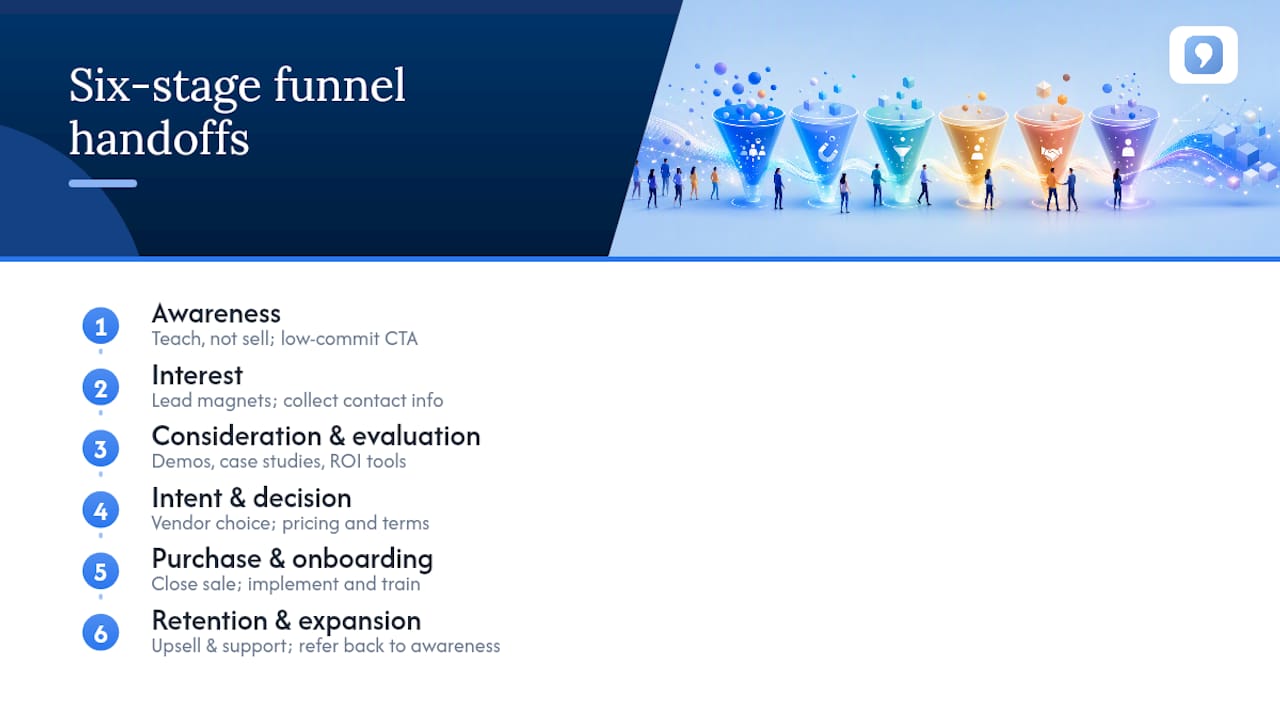
1. Awareness. The prospect has a problem but may not know your company exists yet. Content here needs to teach, not sell: blog posts answering the exact question they typed into Google, short-form social videos, podcast guest spots, and paid social ads with an educational hook rather than a product pitch. IBM's breakdown of the sales funnel is clear on this point: awareness content needs reach and relevance, not a sales pitch. The call-to-action blueprint at this stage is low-commitment: "Read the guide," "Watch the video," never "Book a call." Handoff signal to move to Interest: they've engaged with content more than once, or they've followed you on a channel where you can keep reaching them.
2. Interest. They know your category exists and they're curious whether you're a fit. This is where lead magnets earn their keep: gated guides, calculators, webinars, and template downloads that require an email address in exchange. A webinar with checkout built directly into the room can compress this stage and the next one into a single session, since attendees who ask pricing questions mid-webinar are telling you they've skipped ahead. Early qualification triggers show up here too: company size, job title, and stated budget range, gathered through form fields or a short quiz. Handoff signal: they've given you contact information and consumed a piece of gated content, or they've asked a specific question about your product rather than the general problem.
3. Consideration and evaluation. Now they're comparing you against two or three alternatives, and generic content won't move them. This stage needs product demos, ROI calculators, comparison pages, case studies with real numbers, and technical documentation if you sell anything remotely complex. B2B software buyers in particular want proof, not promises, at this stage; a SaaS-specific approach to selling technical products usually means leaning harder on integration docs and security answers than on emotional marketing copy. A tool like a qualification form that filters serious buyers from tire kickers before a sales call saves your team hours; pre-call qualification is exactly the kind of low-effort automation that pays for itself here. Handoff signal: they've requested a demo, downloaded a comparison sheet, or asked a competitor-specific question ("How are you different from X?").
4. Intent and decision. They've mentally decided to buy something in your category, and now it's about which vendor and on what terms. Trials, formal proposals, and structured negotiation calls belong here. Watch for closing signals: they've looped in a procurement or legal contact, they've asked about contract length or payment terms, or they've set an internal deadline they've shared with you. This is the stage where sales reps, not marketing automation, should be doing the heavy lifting. Handing a hot negotiation to an email drip sequence is how deals go cold in week three.
5. Purchase and onboarding. The sale is closed, but the funnel isn't done, because a rocky onboarding is one of the fastest ways to create a refund request or a canceled subscription in month two. Remove every point of friction you can: one-click checkout instead of a multi-page form, an onboarding checklist that gets sent automatically the moment payment clears, and a welcome sequence that gets them to their first "win" inside the product within days, not weeks. This is also where integrated checkout systems earn their place, since every extra login screen or payment redirect is a chance for a buyer to abandon at the finish line.
6. Retention and expansion. This stage gets skipped in most funnel diagrams, which is a mistake for any subscription or recurring-revenue business. Track adoption metrics (are they actually using the product?), run NPS or CSAT surveys at set intervals, and build explicit cross-sell or upsell triggers into your CRM, so a customer who hits a usage ceiling gets a nudge toward the next tier automatically. An affiliate program can turn your happiest retained customers into a referral channel, feeding new prospects back into Awareness, which closes the loop on the whole funnel.
Pro Tip: Write down the exact exit criteria for every stage before you build a single piece of content. If you can't describe, in one sentence, what a prospect does to leave Consideration and enter Intent, your sales team will disagree on it forever, and your funnel metrics will be noise instead of signal.
Metrics and KPIs to Track at Every Stage
Top-of-funnel metrics tell you about reach; bottom-of-funnel metrics tell you about revenue, and mixing them up is how marketing teams end up celebrating traffic spikes that never turn into customers.
| Funnel stage | Primary KPI | What it reveals |
|---|---|---|
| Awareness | Unique visitors, impressions, reach | Whether your top-of-funnel channels are working at all |
| Interest | Lead capture rate, cost per lead | Whether your offer is compelling enough to trade for contact info |
| Consideration | Demo request rate, content engagement time | Whether your proof points are landing |
| Intent | Proposal-to-close rate, sales cycle length | Where deals stall before signature |
| Purchase | Conversion rate, average deal size | Whether pricing and packaging match what the market will pay |
| Retention | Churn rate, expansion revenue, NPS | Whether customers stay and grow, or quietly leave |
Stage-to-stage conversion rate is the number that actually diagnoses problems: divide the count of prospects who entered the next stage by the count who entered the current one. A funnel with strong Awareness numbers but a weak Interest-to-Consideration jump doesn't have a traffic problem, it has a content or offer problem, and no amount of extra ad spend fixes that.
Tracking deal velocity alongside conversion rate gives you a second diagnostic dimension: a stage might convert fine but take three times longer than it should, which is its own kind of leak. A simple weekly dashboard, four or five stage-conversion percentages next to a velocity number for each, reviewed on a fifteen-minute Monday call, catches most funnel problems before they become quarterly-revenue problems.
Sales Funnel vs. Sales Pipeline: Turning Stages Into Rep Actions
A sales funnel describes the buyer's experience; a sales pipeline describes the seller's workflow. They track the same journey, but from opposite sides of the table, and confusing the two is why sales and marketing teams argue about whose numbers are "right." The funnel says "this prospect is in Consideration." The pipeline says "this deal needs a technical demo scheduled by Thursday, owned by Rep X."
Turning a funnel stage into a working pipeline step means attaching three things to it: an owner, a next action, and a diagnostic metric, a structure Pipedrive recommends specifically to reduce handoff friction between marketing and sales.
Practical mapping rules that actually hold up:
- A prospect entering Consideration triggers an automatic task for a sales rep to send a comparison sheet promptly, not "sometime this week."
- A prospect requesting a demo moves ownership from marketing automation to a named human rep the moment the request comes in.
- A deal sitting in Intent for longer than your average sales cycle automatically escalates to a manager for review.
Set an SLA for every handoff. If marketing hands a Consideration-stage lead to sales, and sales doesn't touch it for five days, you've broken the funnel even if your diagram looks perfect on paper.
Designing, Testing, and Optimizing Your Funnel
Building a funnel that actually converts is less about the diagram and more about the instrumentation underneath it. Skip this step and every later optimization effort is guesswork.
- Define entry and exit criteria for each stage in writing. If two people on your team would disagree about whether a given prospect is in Interest or Consideration, your definition isn't specific enough yet.
- Instrument every transition as an event, not a guess. Form submissions, demo bookings, and purchase confirmations should all fire into your CRM automatically, so stage counts are based on real actions, not a rep's memory.
- Run small, specific experiments, not full-funnel overhauls. Test one headline, one CTA button color, one pricing page layout at a time, and measure against the specific stage conversion it's meant to move.
- Decide upfront what gets automated and what stays human. Lead scoring, follow-up emails, and abandoned-cart nudges are great automation candidates. Negotiation calls and objection handling on a six-figure deal are not. HubSpot's guidance on funnel optimization makes this same point: pair measurable experiments with automation, but don't automate away the judgment calls that actually close deals.
- Scale only what wins. A test that lifts Consideration-to-Intent conversion by a real, measured margin gets rolled out everywhere; a test with no clear signal gets killed, not kept "just in case."
Pro Tip: Run experiments on the stage with the worst conversion rate first, not the stage that's easiest to test. Fixing a leak at the top of the funnel that's already converting fine wastes effort you could have spent on the bottleneck actually costing you revenue.
Automation and AI: Where to Use Them and Where Not To
Not every part of a funnel deserves automation, and treating AI as a blanket solution is how teams end up with a funnel that feels impersonal exactly where a human touch mattered most.
The clearest automation wins:
- Lead scoring, so reps spend time on prospects showing real buying signals instead of everyone who filled out a form.
- Lifecycle emails, triggered by specific behavior (downloaded a case study, abandoned a trial signup) rather than a generic weekly newsletter.
- Trial nudges, reminding a free-trial user to complete a specific action tied to activation.
- Retargeting ads, aimed narrowly at people who hit your pricing page but didn't convert.
Your core stack usually spans five categories: a CRM to track pipeline, a marketing automation tool to run lifecycle sequences, an analytics platform to measure stage conversion, a payments and checkout layer, and a webinar or lead-capture tool for mid-funnel content.
AI earns its place in predictive lead scoring, content personalization, and automated qualification, tasks that are repeatable and high-volume. It's a weaker fit for nuanced negotiation or reading the tone of a hesitant buyer on a call, work that still needs a human. A multi-channel funnel strategy built around AI content can extend reach across more touchpoints without proportionally more manual work, but only if your underlying data hygiene is solid. Messy CRM fields make even the best AI scoring model useless.
Where Most Funnels Actually Break
The biggest funnel mistake isn't picking the wrong number of stages. It's building six beautifully labeled stages and then never enforcing a single SLA between them, so leads sit untouched for a week while everyone assumes someone else is handling it. Simplify your stage definitions until a new hire could correctly place a prospect without asking a question, then enforce a handoff deadline for every single one.
The second mistake is treating retention as a customer-success afterthought instead of a funnel stage with its own budget and experiments. Teams that run small retention tests, a better onboarding email, a proactive check-in at day 30, with the same rigor they apply to top-of-funnel ad copy tend to see the effect show up in expansion revenue faster than any acquisition tweak.
Start small. Pick one stage transition, fix its definition and its SLA, measure the change for a month, then move to the next one. Funnels built this way hold up under pressure far better than the ones redesigned all at once on a whiteboard.
— FanBasis
A Faster Way to Build the Funnel You Just Mapped
Most of what this article just walked through, stage definitions, content handoffs, checkout, retention nudges, usually lives in four or five different tools stitched together with automation rules that break the moment one vendor changes its API. Some platforms put the funnel builder, payment processing, checkout, and webinar hosting in one dashboard, so the handoff friction described above happens automatically instead of through a Zapier chain you have to babysit.

This fits best if you're a creator, educator, or small team that wants to launch a full funnel, landing page, checkout, upsell, without hiring a developer or managing five separate subscriptions. Commas' AI funnel builder uses proven conversion patterns to suggest funnel structure automatically, and integrated one click payments mean the Purchase stage from this article stops being a point of drop off. If you sell online courses, run paid communities, or offer coaching, the entire six-stage journey mapped above can run through a single account. Start a free trial at Commas and map your own funnel inside the platform this week.
Sources
- What is a sales funnel? Complete Guide + Examples | Salesforce
- Sales Funnel Stages: 6 Steps to Close More Deals
- Understanding Sales Funnel Stages | Pipedrive
- What is a Sales Funnel? | IBM
- What is a Sales Funnel? (& What You Should Make Instead) | HubSpot
FAQ
What are the 5 stages of the sales funnel?
A common five-stage model runs Awareness, Interest, Consideration, Intent, and Purchase, tracking a buyer from first discovering your brand to deciding to buy.
What are the 4 stages of the funnel?
The classic four-stage model, based on the AIDA framework, is Awareness, Interest, Decision, and Action, and it works best for simple, low-consideration purchases.
What are the 6 stages of a sales pipeline?
A six-stage funnel typically adds Retention/Expansion after Purchase to the five-stage model above, giving Awareness, Interest, Consideration, Intent, Purchase, and Retention/Expansion. This structure matters most for subscription businesses tracking long-term revenue beyond the first sale.
What are the 4 stages of the sales process?
On the sales team's side, a simplified process usually covers prospecting, qualification, proposal/negotiation, and closing, which map roughly onto the buyer-facing Interest through Purchase funnel stages.
How is a sales funnel different from a sales pipeline?
A sales funnel tracks the buyer's changing intent and behavior, while a sales pipeline tracks the seller's tasks and deal progress; a platform like Commas that combines funnel building with payments and CRM-style tracking helps keep both views connected instead of living in separate tools.