
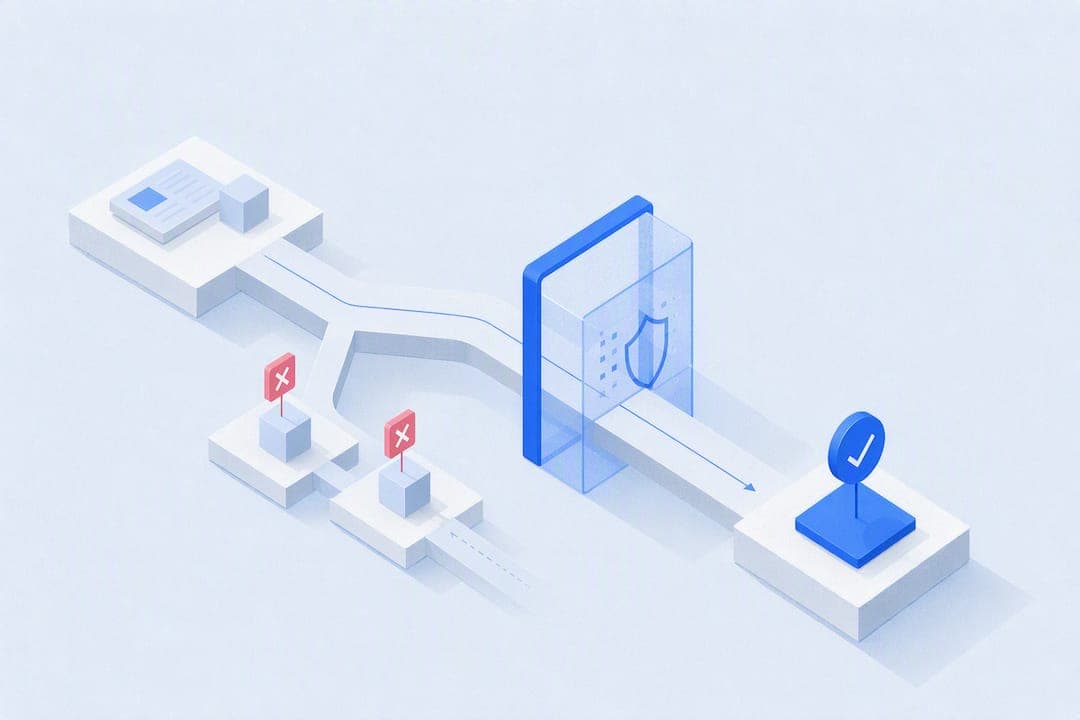
Log every access event, fix your billing descriptor, apply 3DS only to high-risk transactions, make refunds genuinely easy to request, and enroll in pre-dispute alert networks like Ethoca or Verifi. Prevention costs less than fighting a dispute, but keep a representment process ready for the cases you can't stop upstream.
TL;DR:
- Digital goods typically have chargeback rates between 1.2% and 2.0%, exceeding Visa's 1.5% monitoring threshold, risking account penalties and higher fees.
- Fixing billing descriptors and obtaining timestamped consent at checkout can significantly reduce disputes caused by unrecognized charges or buyer's remorse.
- Applying 3DS selectively and using behavioral screening methods can prevent fraud without harming customer conversion rates.
- Collecting detailed proof of delivery, activation, and authorized use is essential for successful chargeback representments, especially logs tied to specific transaction and session IDs.
- Using pre-dispute alert networks like Ethoca or Verifi gives merchants early warning, enabling quick action to refund or assemble evidence before a formal dispute is filed.
Table of Contents
- Why Digital Goods Attract More Chargebacks Than Physical Products
- The Prevention Playbook for Digital Products
- What Evidence Do You Need to Fight a Chargeback?
- How Do Pre-Dispute Alerts Change Your Response Time?
- Tracking Chargeback Trends Before They Become a Problem
- How Commas Reduces Operational Gaps That Cause Disputes
- A Pragmatic Starting Point for Small Teams
- Get Integrated Payments Without the Patchwork
- Sources
Why Digital Goods Attract More Chargebacks Than Physical Products
Digital products get disputed at higher rates than physical goods for a simple reason: there's no tracking number, no signature, no delivery truck. A cardholder can claim "I never got this" about an ebook, a course, or a software license, and the merchant has no shipping carrier to back them up. Instant fulfillment also removes the natural delay that lets buyer's remorse cool off before a purchase ships.
Friendly fraud, where a legitimate cardholder disputes a charge they actually authorized, makes up a large share of these cases precisely because digital delivery leaves a thinner paper trail.
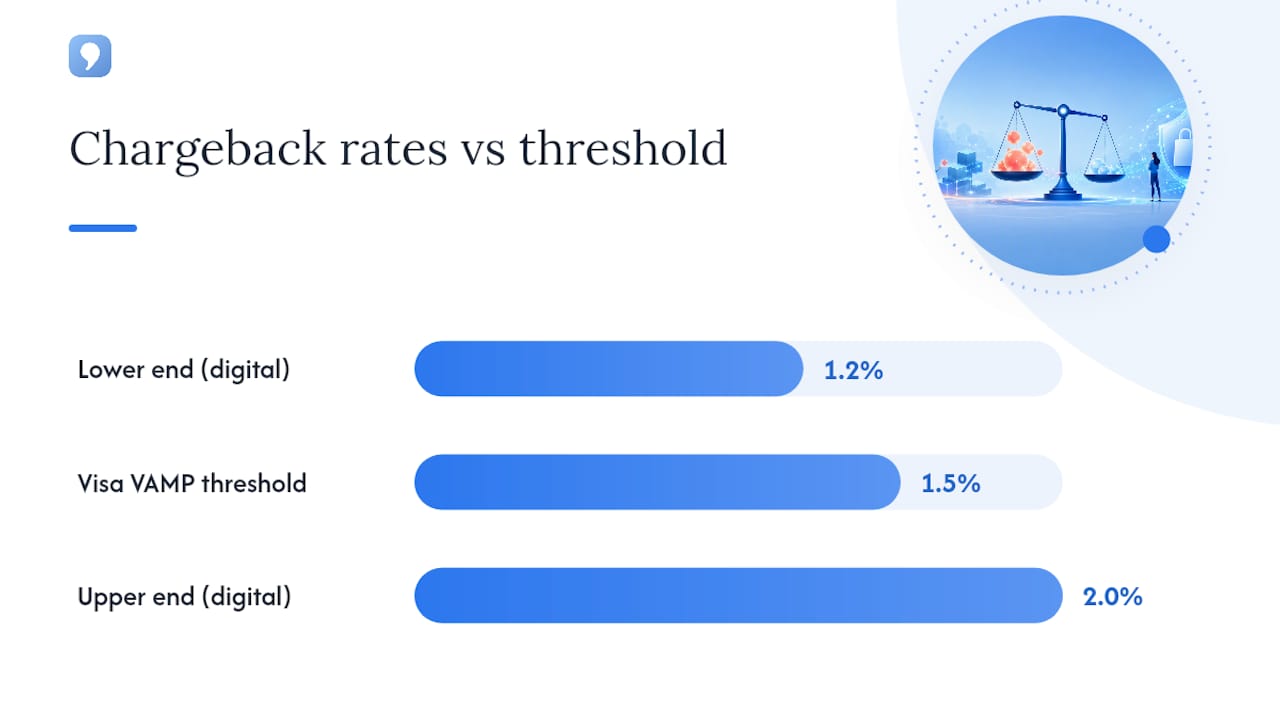
Digital goods carry chargeback rates roughly between 1.2% and 2.0%, against Visa's VAMP monitoring threshold set near 1.5%. Cross that line consistently and you risk:
- Being placed in a monitoring program with mandatory reporting
- Higher processing fees and rolling reserves
- Account holds or termination from your payment processor
- Chargeback fees stacking on top of the lost transaction itself
Each dispute costs more than the refund would have. A merchant losing a $50 sale often eats a $15 to $25 chargeback fee on top of it, plus staff hours pulling records to fight back.
The Prevention Playbook for Digital Products
Prevention beats representment because winning a dispute after the fact is never guaranteed, while stopping it before it's filed is fully within your control. Vendor benchmarks suggest that combining several prevention tactics can cut digital-goods chargeback rates by roughly 50 to 70 percent, which is why layering matters more than picking one silver bullet.
Start with the fixes that take a day, then work toward the ones that take a quarter.
- Fix your billing descriptor first. If your statement line reads a cryptic processor code instead of your brand name, cardholders won't recognize the charge and will call their bank before they call you. This is usually a one-line change in your payment gateway settings.
- Capture consent at checkout. Store a timestamped record of the terms the buyer agreed to, ideally with a screenshot or logged acceptance event, not just a checkbox that disappears after submission.
- Send receipts with a visible support contact. An email receipt that buries your support link forces frustrated customers straight to their bank instead of your inbox.
- Apply 3DS selectively, not universally. Reserve 3D Secure authentication for high-value transactions or first-time buyers with risk signals; forcing it on every $9 purchase adds friction that depresses conversion more than it prevents fraud.
- Layer AVS and CVV matching rules on top of behavioral screening. Address and card-code mismatches catch a meaningful slice of stolen-card fraud before it ever reaches checkout.
- Make cancellation and refund requests self-service. A one-click cancel button for subscriptions, and a simple refund request form, removes the single biggest reason customers give up and dispute instead: they couldn't find a way to ask a human.
- Send renewal notices before subscription charges hit. A card statement showing an unexpected renewal is one of the most common friendly-fraud triggers in the subscription-commerce world.
- Track and block repeat abusers. Someone who's disputed three charges in six months rarely deserves a fourth chance at your product.
Pro Tip: Run your billing descriptor and receipt email through a test purchase on your own card. If you wouldn't instantly recognize the charge on your statement, neither will your customers.
Where each tactic lives in your stack matters. Billing descriptor changes and receipt formatting are payment-gateway settings you control directly. Fraud screening and 3DS usually route through your processor or a dedicated fraud tool. Refund flows and renewal notices are product and support decisions. If your dispute profile skews toward "item not received" claims, prioritize activation logging and delivery confirmation. If it skews toward "unauthorized transaction," push harder on 3DS and AVS matching instead of treating every tactic as equally urgent.
What Evidence Do You Need to Fight a Chargeback?
Banks want proof of consent, delivery, and actual use, not a policy statement. A "no refunds" clause in your terms of service means almost nothing to a card network reviewing a dispute without corroborating activity data.
The strongest evidence set includes:
- License-key or account activation with timestamp, IP address, and device fingerprint
- Login, download, or streaming session logs showing ongoing use after purchase
- A checkout screenshot capturing the terms the buyer accepted
- The original receipt, matched to your billing descriptor
- Any written support communication, including refund denials or troubleshooting exchanges
None of this helps unless it's correlated to the disputed transaction. Tie every log entry to the order ID or session ID, and cross-reference IP address, email, and device against the checkout record. A representment packet with an activation log that doesn't match the buyer's email address is worse than no log at all, since it invites the bank to question everything else you submitted.
Export logs in a consistent format (CSV or JSON with timestamp, IP, device ID, and order reference) so you're not scrambling to reconstruct data by hand when a dispute notice lands with a short deadline.
How Do Pre-Dispute Alerts Change Your Response Time?
Ethoca and Verifi push alerts to merchants before a formal chargeback is filed, typically giving you a 24 to 72 hour window to act. That window is the cheapest place to intervene in the entire dispute lifecycle.
- Receive the alert and pull the transaction record immediately. Speed matters more than thoroughness at this stage.
- Decide: refund or represent. If the claim looks like genuine confusion (wrong plan, misunderstood renewal), refund it. The refund costs less than a dispute fee and protects your chargeback ratio.
- If the claim looks like abuse or fraud, assemble your evidence packet fast rather than waiting for the formal dispute to arrive.
- Avoid the two most common fatal errors: submitting evidence tied to a different email than the one on the disputed card, and omitting timestamps that prove access happened after the purchase date, not before.
Dual-network alert coverage combined with automated response templates cuts the manual workload dramatically once volume climbs past a few disputes a week.
Tracking Chargeback Trends Before They Become a Problem
Four numbers tell you almost everything: chargeback rate as a percentage of transactions, raw dispute volume, the mix of reason codes you're seeing, and what share of disputes trace back to repeat offenders.
- Watch chargeback rate weekly, not monthly, once you're near the 1.5% VAMP threshold.
- Group reason codes separately. "Product not received" points to delivery-proof gaps; "unauthorized transaction" points to fraud screening gaps.
- Flag repeat patterns across shared devices, email domains, or card BINs, and block them before they order again.
- Bring in a specialist or a dedicated chargeback management partner once volume outpaces what one person can review by hand.
How Commas Reduces Operational Gaps That Cause Disputes
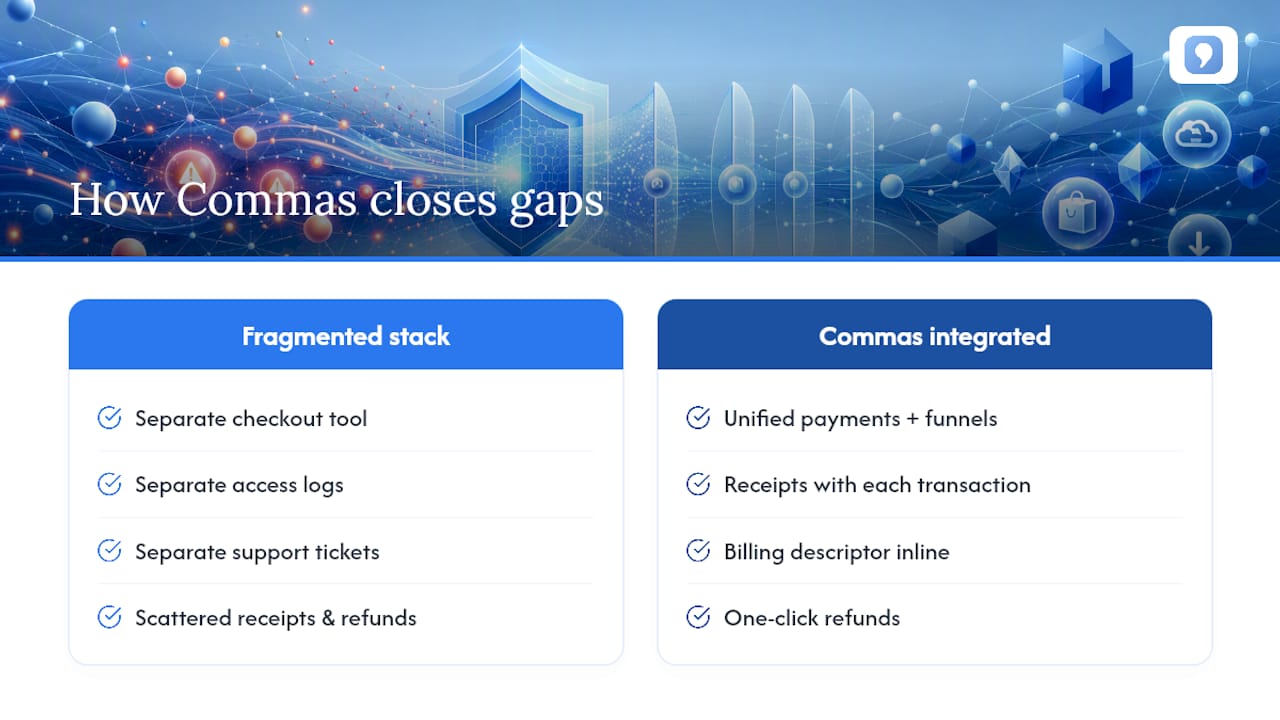
Most chargebacks trace back to a fragmented stack: one tool for checkout, another for access logs, a third for support tickets, none of them talking to each other. Commas integrates payments and funnels in a single account, so receipts, billing descriptors, and refund actions live next to the transaction record instead of scattered across separate systems. One-click refunds and activity logs tied directly to each sale give you the correlation evidence representment actually requires.
A Pragmatic Starting Point for Small Teams
Start with three changes: fix your billing descriptor, turn on activation logging, and build a refund flow a customer can complete without emailing you. Split ownership across payments, product, and support so no single person owns all three. Track your chargeback rate monthly and set an alert threshold before you're forced to react to a processor warning instead of your own dashboard.
— FanBasis
Get Integrated Payments Without the Patchwork
Every fix in this guide gets harder when your checkout, receipts, refunds, and access logs live in five different tools that don't talk to each other. Commas is built as the alternative to that fragmented stack: payments, funnels, and product delivery run through one account, so a refund action and an activation log both attach to the same transaction record automatically.

That matters most for evidence. When a dispute lands, you're not exporting three spreadsheets and hoping the timestamps line up. Commas keeps billing descriptors, receipts, and refund flows tied to the same checkout, and its AI-driven funnel builder reduces the purchase confusion that drives a chunk of friendly-fraud disputes in the first place. If you're selling courses, subscriptions, or software licenses and juggling separate systems for each piece, compare your current stack against what one integrated dashboard would give you. Start a trial at Commas and see how much of your dispute paperwork disappears when payments and delivery share the same record.
Sources
- Chargebackcost
- How Do I Prevent Chargebacks for Digital Goods? | Chargeflow
- Chargeback Prevention: 12 Strategies That Actually Work | ChargeMate
- The Chargeback Management Guide for Online Merchants | Chargeblast