
Price digital products on the value they deliver, not the hours you spent making them, and start with a defensible capture of that value. A practical heuristic: aim for roughly 10% of the credible buyer value your product creates, then test from there. Your two immediate moves: quantify one concrete outcome your product produces, and pick a starting price bracket to run against real traffic.
TL;DR:
- Pricing digital products should be based on the value to the buyer, aiming for around 10% of the credible outcome they receive.
- Testing prices with revenue per visitor as the key metric helps identify the optimal point, rather than focusing solely on conversion rates.
- Tiered pricing, bundles, and anchoring strategies increase revenue by influencing perceived value and guiding buyers to the middle or highest options.
- Fixed payment fees disproportionately affect low-priced products, making it essential to avoid single-digit pricing unless bundled or sold at high volume.
- Legal compliance in digital pricing requires transparent display of fees and adherence to VAT rules, especially for European buyers.
Table of Contents
- How Do You Calculate Value-Based Pricing for Digital Products?
- Which Pricing Model Should You Use: Cost-Based, Competitor-Based, or Value-Based?
- What Are Typical Price Ranges for Digital Products?
- How Do Tiers, Bundles, and Anchoring Increase Revenue?
- How Do Platform and Payment Fees Affect Your Real Margin?
- How Do You Test Prices Without Guessing?
- What Signals Mean You Should Raise Your Price?
- A 7 to 14 Day Framework to Pick and Test Your Price
- How Commas Supports Creators Selling Digital Products
- How Do You Discount Without Cheapening Your Product?
- What Legal Rules Apply to Pricing Digital Products?
- Prioritizing Pricing Tactics by Business Stage
- Put This Pricing Playbook to Work With Commas
- Sources
- FAQ
How Do You Calculate Value-Based Pricing for Digital Products?
Value-based pricing works backward from what your buyer gains, not forward from what you spent building the thing. That distinction changes every number that follows.
Start by defining the outcome in terms a buyer already cares about: hours saved per month, revenue added, a cost avoided, or a risk removed. A course that teaches freelance writers to land $2,000 clients is not competing with other courses. It is competing with the cost of never landing that client.
Here is the method, step by step:
- Name the outcome. Write one sentence: "This product helps X achieve Y." Vague outcomes ("learn design") produce vague prices. Specific outcomes ("cut invoice-to-payment time from 30 days to 7") produce defensible prices.
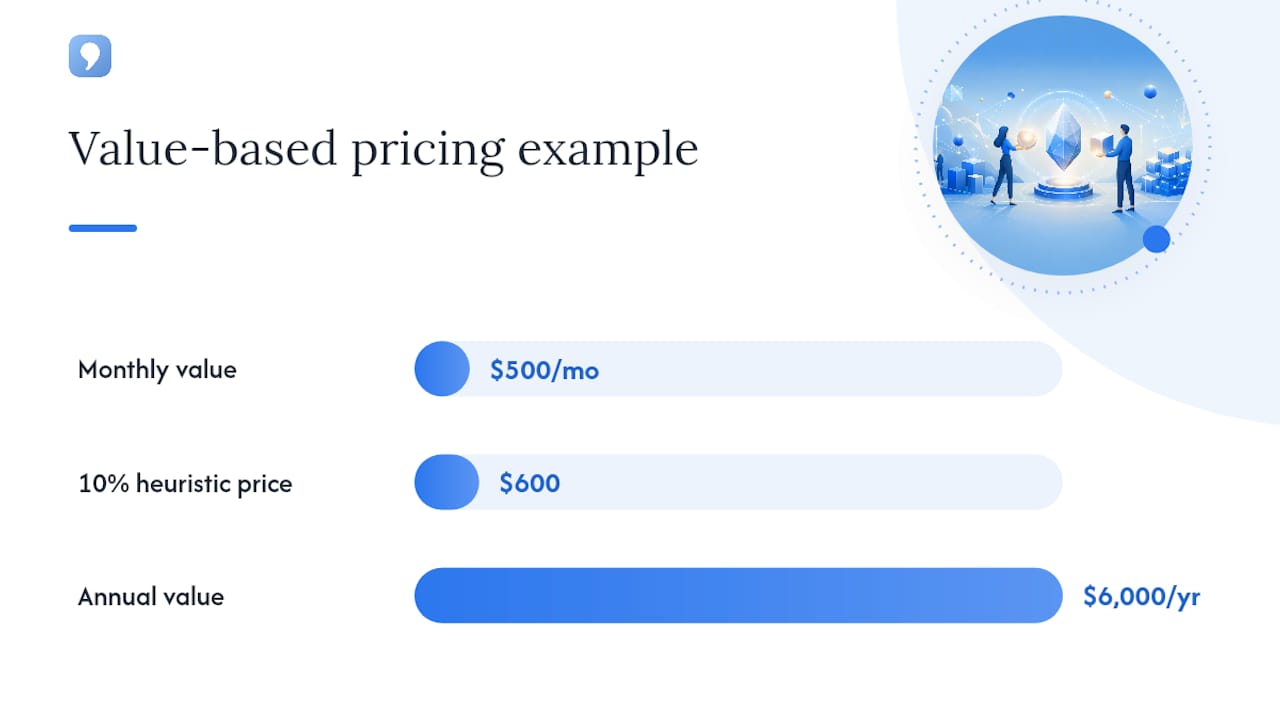
- Put a number on it. If your course saves a freelancer 10 hours a month and they bill $50 an hour, that is $500 a month, or $6,000 a year in recovered time.
- Apply a capture rate. The 10% heuristic suggests pricing near $600 for that outcome, assuming a full year of value. Some creators go lower to reduce friction; some go higher when the outcome is urgent or scarce.
- Adjust for audience temperature. A cold audience that has never heard of you needs a lower entry point or stronger proof before they will pay near the top of that band. A warm, solution-aware audience already convinced they need the fix will pay closer to the ceiling.
Before you lock in a number, ask a handful of past customers or newsletter subscribers direct questions:
- "What would it be worth to you if this problem disappeared in a week?"
- "What have you already paid, or tried, to solve this?"
- "At what price would this feel like a steal? At what price would it feel too expensive to consider?"
Those three questions, asked to 15 or 20 real prospects, will tell you more than any competitor's pricing page.
Pro Tip: Don't survey your existing customers only. Ask people who almost bought and didn't. Their price resistance tells you exactly where your ceiling actually sits.
Which Pricing Model Should You Use: Cost-Based, Competitor-Based, or Value-Based?
Three models dominate digital product pricing, and only one of them holds up under real scrutiny.
- Cost-plus pricing adds a margin on top of your time and tools. It works fine for physical inventory with a clear unit cost. It fails for digital products because your marginal cost per sale is close to zero. Pricing a $10,000 course build at "$40 because it took me 40 hours at $1 an hour" ignores that the course might save a buyer $10,000. You are pricing your labor, not their outcome.
- Competitor-based pricing anchors your number to what similar products charge. Useful as a sanity check, dangerous as a strategy. If every competing course sits at $99, that tells you what the market tolerates, not what your specific outcome is worth. Use competitor pricing to spot a floor and a ceiling, then place yourself inside that range based on your own value math.
- Value-based pricing starts from the buyer's outcome and works backward, as covered above. It is the only model that scales with your product's actual impact rather than your effort or the crowd's average.
Cost-based pricing earns a place only in narrow cases: when you are pricing a commoditized template with near-identical substitutes, or when you genuinely have no way to estimate buyer value yet (a brand-new offer with zero customer feedback). Even then, treat it as a placeholder price to replace within your first 90 days of sales data.
What Are Typical Price Ranges for Digital Products?
Price bands vary widely by category, but they are not random. Buyers have learned rough expectations for each product type, and straying too far outside them without justification kills conversion.
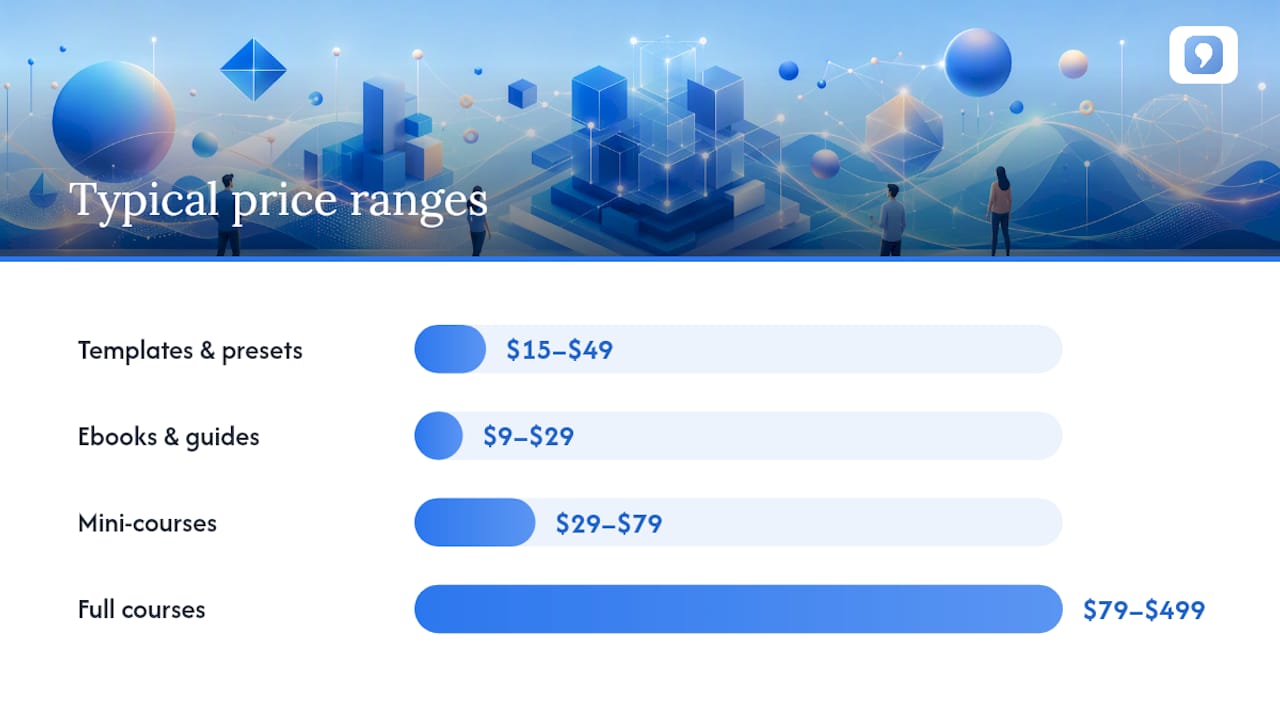
| Product Type | Typical Range | What Moves It Up |
|---|---|---|
| Templates & presets | $15–$49 | Commercial-use licensing, exclusivity, proven results |
| Ebooks & guides | $9–$29 | Original research, direct application, strong niche demand |
| Mini-courses | $29–$79 | Specific transformation, live component, community access |
| Full courses | $79–$499 | Certification, cohort support, case studies, guarantees |
| Memberships (monthly) | $9–$99/month | Ongoing content, community, direct access to the creator |
| Bundles | 20–30% off standalone total | More included assets, limited-time framing |
These ranges reflect what buyers already accept, but the same product type can land at wildly different points depending on who it's for. A Lightroom preset pack sold to hobbyist photographers might sit at $19. The same style of presets, marketed to wedding photographers who resell edited galleries to clients, can justify $79 because the buyer's use case has commercial upside.
Four factors consistently push a product toward the top of its range: a narrower, higher-stakes audience; licensing that allows commercial or resale use; visible proof (case studies, testimonials with numbers, before-and-afters); and direct applicability to a revenue-generating activity rather than general education. A course that teaches "how to negotiate freelance rates" can charge more than a course on "how to use Canva," even if both take the same hours to produce, because one has a direct line to the buyer's income.
Audience size matters too. A tiny, specific list of 500 highly engaged subscribers will often tolerate a higher price than a broad list of 50,000 casual followers, because relevance beats reach when it comes to willingness to pay.
How Do Tiers, Bundles, and Anchoring Increase Revenue?
Most digital products sell better with three price points instead of one, and the reason is not just "more options." It is that a middle tier only looks reasonable when it sits next to a cheaper and a pricier alternative.
Structure tiers with roughly 2x to 3x jumps between them: a $29 basic tier, a $79 standard tier, and a $199 premium tier is a common pattern. The middle tier usually captures the most buyers when it is framed as the obvious default, not the safe minimum.
- Anchoring works by putting your highest price first. A $199 tier shown before a $79 tier makes the $79 option feel like the smart, moderate choice, even though it is unchanged in absolute terms.
- The decoy effect adds a tier deliberately positioned to make another tier look better by comparison. A $69 "basic plus" tier that offers barely more than the $29 tier, but far less than the $79 tier, nudges buyers toward the $79 option because it suddenly looks like the clear value winner.
- Bundling three to five related products at a 20 to 30% discount off the sum of standalone prices increases average order value without making any single item look cheap.
Pro Tip: Never discount your top tier. Discounting the entry tier drives volume; discounting the premium tier trains your best customers to wait for a sale.
How Do Platform and Payment Fees Affect Your Real Margin?
Fixed per-sale fees quietly destroy margin on cheap digital products, and most creators don't notice until they run the numbers.
A flat $0.50 processing fee plus a percentage cut behaves very differently depending on price. On a $5 product, that fixed fee alone can eat 10% or more of revenue before you even count the percentage cut. On a $50 product, the same fixed fee barely registers.
| Price Point | Fixed Fee Impact | Approximate Take-Home Pressure |
|---|---|---|
| $5 | High | Fixed fee is a large share of revenue |
| $15 | Moderate | Fixed fee impact shrinks meaningfully |
| $50 | Low | Fixed fee is nearly irrelevant |
A single stat worth remembering: small fixed fees don't scale down with your price, which is why very low price points quietly lose money once you factor in payment processing on top of platform commissions.
The practical rule: avoid single-digit pricing unless the product is bundled with others or sold at genuine volume where the percentages average out. If you're choosing between an owned storefront and a marketplace, remember that marketplace commissions often stay flat regardless of scale, while an owned checkout tends to keep more of each sale as your revenue grows. Tools like Commas Payments are built around that owned-checkout model, which matters more the higher your volume climbs.
How Do You Test Prices Without Guessing?
Testing a price is not about finding the highest number people will pay. It's about finding the price that produces the most total revenue per visitor, which is a different question entirely.
- Pick your primary metric first: revenue per visitor (RPV). Multiply conversion rate by price. A page converting at 5% at $15 generates $0.75 RPV. A page converting at 3% at $29 generates $0.87 RPV. The higher price wins even with a lower conversion rate, and you'd never see that by watching conversion alone.
- Track secondary metrics alongside RPV: conversion rate, average order value, and refund rate. A price that spikes conversions but doubles refunds isn't actually winning.
- Run sequential tests when traffic is limited. True split testing needs meaningful volume to trust the result. If you get under a few hundred visitors a week, run one price for two weeks, then the next price for two weeks, and compare RPV across the periods instead of splitting traffic in real time.
- Test one variable at a time. Launch price, then tier structure, then a new charm-price ending, in separate rounds. Stacking changes makes it impossible to know what moved the number.
The number that matters most in this whole process is RPV, not conversion rate. Optimizing for conversion alone pushes you toward ever-lower prices, since cheaper products almost always convert better in isolation. Optimizing for revenue per visitor keeps you honest about what actually grows your business. Tools built for SaaS growth tracking, like the analytics approaches covered in this piece on sustainable growth, apply the same logic outside of software too: measure the outcome that pays the bills, not the one that looks good in a dashboard.
What Signals Mean You Should Raise Your Price?
Underpricing hides in plain sight, mostly because a high conversion rate feels like success even when it's actually a warning sign.
Watch for these signals:
- Conversion rate consistently above 5% on cold or lukewarm traffic, which usually means the price is far below the value delivered.
- Repeated unprompted feedback like "this was worth way more than I paid," especially from multiple different buyers.
- Low refund rates paired with high conversion, meaning buyers are happy and paying easily, a combination that only happens when price sits comfortably under perceived value.
When you decide to raise a price, do it deliberately. Announce the change in advance rather than silently swapping the number. Consider a short grandfathering window for existing customers or an early-bird cutoff for new buyers before the increase takes effect. Staged increases, moving from $79 to $99 to $129 over separate launches, tend to land better than one jarring jump.
The most common pricing mistakes stack up in a predictable order: pricing based on hours worked instead of value delivered, running discounts so often that the "sale price" becomes the real price, ignoring fee math on cheap products, and skipping tiers entirely, which leaves money on the table from buyers who would have happily paid more for more.
A 7 to 14 Day Framework to Pick and Test Your Price
You don't need months of research to land on a defensible price. You need a tight, honest process.
- Days 1 to 2: Define and quantify the outcome. Write the one-sentence value statement and attach a real number to it, using the time-saved or revenue-added math from earlier.
- Days 3 to 4: Research your market band. Check five to ten comparable products, note their price range, and decide where your value math places you inside or outside that range.
- Days 5 to 6: Set your price and structure. Choose a charm-price ending, decide on two or three tiers if it fits your product, and confirm the number still holds up after subtracting platform and payment fees.
- Days 7 to 14: Soft-launch and measure. Sell to a small warm segment first: an email list, a community, a waitlist. Track RPV daily and be ready to adjust before a full public launch.
Pro Tip: Run your soft launch with a visible, dated price increase coming after it ("price goes to $99 on the 15th"). It creates a natural, honest urgency and gives you a clean before-and-after RPV comparison.
How Commas Supports Creators Selling Digital Products
Every tactic above still has to be built somewhere, and that's usually where creators lose momentum. Some platforms combine payments and sales funnels into one account, so you're not stitching together a checkout tool, a funnel builder, and a course platform separately. AI can work from proven funnel patterns to help improve conversion without manual tuning on your end, which matters when you're testing tiers and price points on tight timelines. Creators using integrated checkouts and customizable funnels report meaningful revenue lifts from that setup.
How Do You Discount Without Cheapening Your Product?
A discount tells buyers something about your price, whether you intend it to or not. Run one carelessly and you teach your audience to wait for the next sale instead of buying at full price.
The safest discounting move is bundling rather than markdown. Instead of cutting your $79 course to $49, package it with a related template pack and price the bundle at $99, which reads as added value rather than desperation. That approach lines up with the 20 to 30% bundle discount range that tends to lift average order value without damaging how buyers perceive the core product.
Time-boxed discounts work better than open-ended ones. A 48-hour launch price or a birthday-of-the-business sale creates real urgency because it ends. A "sale" banner that's been on your site for eight months trains buyers to distrust your regular price entirely.
Protect your premium tier from discounts altogether. If you cut your top tier, you signal that even your best offer wasn't worth what you charged. Discount the entry point to attract new buyers; leave the top tier as proof that your pricing has a ceiling and you believe in it.
Reserve discounts for acquisition moments, not retention. A one-time discount to bring in a first-time buyer is a reasonable investment. Repeated discounts to the same list train that list to ignore your full-price launches.
What Legal Rules Apply to Pricing Digital Products?
Digital product pricing carries real legal exposure that many creators overlook until a customer, or a tax authority, asks about it.
If you sell to buyers in the European Union, VAT rules require charging value-added tax based on the buyer's country, not your own, for most digital goods and services. Rates and thresholds vary by member state, and the obligation generally applies regardless of where your business is registered, so check current EU digital VAT guidance for your specific situation before setting a final price for European buyers.
Pricing transparency laws in multiple jurisdictions require that the price shown to a buyer be the price they actually pay, including any mandatory fees, before checkout. Hiding a processing fee or a "convenience charge" until the final screen creates legal risk in several markets and erodes trust even where it's technically permitted.
Refund and cancellation policies also carry legal weight in many regions, particularly for subscriptions. Some consumer protection laws require clear, easy cancellation paths and specific disclosure of auto-renewal terms before a customer's card is charged again.
None of this replaces a conversation with a tax professional or attorney familiar with your specific markets. Pricing strategy and pricing compliance are two different problems, and a great value-based price can still create liability if the surrounding legal mechanics are wrong.
Prioritizing Pricing Tactics by Business Stage
Early-stage creators should skip elaborate testing infrastructure entirely. With low traffic, sequential price tests take too long to produce a reliable signal. Focus instead on nailing the value statement and building two or three clean tiers. Get that foundation right before touching anything experimental.
Established businesses with steady traffic get real returns from fee optimization, systematic RPV tracking, and premium-tier proof points like case studies and outcome data. That's where the incremental percentage gains from testing actually compound into meaningful revenue.
One rule holds at every stage: price for the value you genuinely deliver, and never inflate the outcome claim to justify a number. A price built on an exaggerated promise collapses the first time a customer compares the result to the pitch. A price built on a real, provable outcome survives scrutiny, refund requests, and public reviews.
— FanBasis
Put This Pricing Playbook to Work With Commas
Commas is the platform that lets you execute everything above without duct-taping five tools together. Tiered product pages, bundle checkouts, and payment plans all run through one dashboard instead of a patchwork of a checkout app, a course host, and a separate funnel builder.

If you're building the two or three tier structure from the pricing psychology above, Vibe Funnels gives you drag-and-drop pages built around anchoring and decoy pricing patterns instead of a blank template. If you're selling a course at the price bands covered earlier, Online Courses handles delivery and checkout together, so testing a new price doesn't mean rebuilding your sales page from scratch. And once you're ready to scale distribution past your own list, the Commas Affiliate Center lets other people sell your priced-right product for a commission, which compounds faster than solo launches. For the fee math covered earlier in this guide, Commas Payments is built to keep more of each sale on your side of the ledger as volume grows. Start with a demo, pick one funnel to pilot, and test your next price change on infrastructure that's already built for it.
Sources
FAQ
What Is the Best Pricing Model for Digital Products?
Value-based pricing is the strongest default because it ties your price to the outcome the buyer receives instead of your production time. A common starting heuristic is pricing near 10% of the credible value your product creates for the buyer, then adjusting with real testing.
How Much Should I Charge for an Online Course?
Full courses commonly price between $79 and $499, depending on transformation depth, certification, and support level. A platform like Commas Online Courses can help you structure tiers within that range without rebuilding your checkout for every price test.
What Metric Should I Track When Testing Prices?
Revenue per visitor (RPV) is the primary metric, since it accounts for both conversion rate and price together rather than either one alone. A higher price with a lower conversion rate can still produce more total revenue than a cheaper, higher-converting option.
Why Do Small Fees Hurt Cheap Digital Products So Much?
Fixed per-sale processing fees stay flat no matter the price, so they consume a much larger share of revenue on a $5 product than on a $50 one. That's why very low price points often lose money once fees are factored in, unless the item is sold in bulk or bundled.
Does Commas Charge for Its Platform?
Commas doesn't publish flat plan pricing, since pricing depends on the specific tools and volume a creator needs across payments, funnels, and courses. Current pricing details are available directly on the Commas site.