
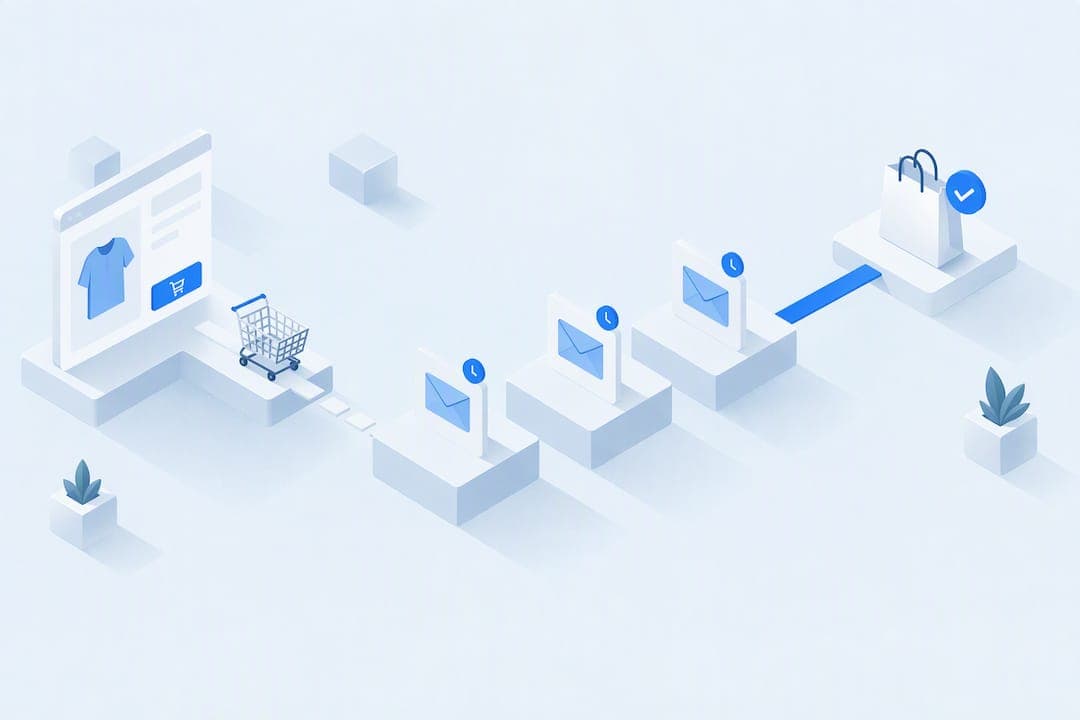
The highest-return checkout abandonment flow is a short three-message sequence: one hour after exit, 24 hours later, and a final nudge at 72 hours, sent only to shoppers who supplied an email during checkout. Suppress purchasers, recent buyers, and anyone who has opted out, immediately and automatically. Start this week by turning on the one-hour reminder and setting up an A/B test with a control holdout so you can prove the revenue lift rather than guess at it. For practical list-building strategies to expand your audience for recovery campaigns, see How to grow an email list.
TL;DR:
- Sending checkout abandonment emails within one hour, 24 hours, and 72 hours captures the majority of recoverable revenue for high-value offers.
- Emails should target sessions where the shopper entered an email but did not complete payment, avoiding those who only added items to the cart or viewed product pages.
- Segment abandonment causes, such as payment failures or price objections, to route messages appropriately and increase recovery effectiveness.
- Running a control group and testing variables like incentives, timing, and subject lines helps measure actual revenue lift and avoid misleading metrics.
- Ensuring compliance with email laws, authenticating domains, and separating marketing from transactional emails is critical to maintaining deliverability and reputation.
Table of Contents
- What Checkout Abandonment Emails Target (and Why Cart Abandonment Is Different)
- The Recommended Email Sequence and Timing
- Subject Lines, Preview Text, and Copy That Converts
- Segmentation and Triggers: Route Abandonments to the Right Flow
- Deliverability and Compliance Essentials
- Measuring Success: KPIs and a Simple Experiment
- How Commas Supports These Recovery Flows
- When to Send Another Email and When to Fix Checkout
- Run This Playbook Without Stitching Together Five Tools
- FAQ
- Sources
What Checkout Abandonment Emails Target (and Why Cart Abandonment Is Different)
A checkout abandonment happens when someone enters the checkout flow, usually entering an email or starting payment, and leaves without finishing. A cart abandonment is broader: items sit in a cart, but the shopper never reached checkout and never gave you an email address. The distinction matters because intent is different. Someone who typed in their email and billing details is closer to buying than someone who added a product to a cart and closed the tab.
That difference should drive who gets an email at all. Sending a recovery message to a browser who never entered checkout is usually a mismatch, both in relevance and in legal footing, since you often lack a clear basis to email them. Reserve checkout abandonment email for these situations:
- The shopper entered an email address during checkout but didn't complete payment.
- A payment attempt failed after checkout information was submitted.
- A saved or returning cart shows a checkout session that stalled partway through.
Skip the email when the only signal is a product page view or an item added to a cart with no checkout email captured. That traffic belongs in retargeting ads or on-site prompts, not your transactional-feeling inbox flow. Set your triggers at the platform level so the checkout-capture audience stays separate from general browse retargeting. Mixing the two dilutes relevance and can hurt deliverability for the segment that actually converts.
The Recommended Email Sequence and Timing
Once you know who qualifies, timing and tone decide whether the message lands as helpful or annoying. The standard sequence works for most $1,000 to $10,000 offers:
- One hour after exit: a plain reminder with no discount. Show the item, the price, and a direct link back to checkout. This is the highest-intent window; most recoverable buyers convert here.
- 24 hours later: a reassurance message that answers common objections (security, returns, support availability) and repeats the CTA.
- 72 hours later: a final nudge, where an incentive makes sense for price-sensitive audiences.
For sellers managing sensitive sender reputations or smaller lists, a more conservative cadence of 4 hours, 48 hours, and 7 days reduces send frequency while still catching most recoverable intent.
Payment failures deserve a different channel entirely. If a card declines after checkout, an immediate SMS or push notification tends to outperform email, since the shopper is often still on the page or nearby.
Discounts belong in the final message only, and only for offers where price is a documented objection. Leading with a discount in the first email trains buyers to wait for one, which erodes margin on a $1,000 to $10,000 offer faster than it recovers revenue. Suppression logic runs underneath all three sends: the moment someone purchases, unsubscribes, or requests removal, pull them from the queue immediately.

Pro Tip: Run the 1-hour message with zero incentive for at least two weeks before testing a discount anywhere in the sequence. You need a clean baseline to know if the discount actually added revenue or just pulled forward sales that would have happened anyway.
Subject Lines, Preview Text, and Copy That Converts
Good checkout abandonment copy is specific, not clever. Four subject-line formulas cover most cases:
- Reminder: "You left [item] in checkout, [first name]"
- Benefit-led: "Still deciding on [item]? Here's what you get"
- Scarcity or reassurance: "Your spot in [item] is still open, for now"
- Personalization token: combine first name and item name in the subject itself, not just the body
Preview text should extend the subject rather than repeat it: a price, a one-line benefit, or a support line like "Questions? Reply and we'll help." Keep the CTA button visible without scrolling, show the item and price in the hero section, and include a direct support link for anyone stuck on a technical issue.
Every email in the sequence needs three components: a cart or checkout summary, a single clear CTA button, and one line of reassurance covering returns, refunds, or payment security. Save any discount code for the later email, never the first.
Three short snippets to adapt:
- "Hey [first name], your checkout for [item] is still open. Pick up right where you left off."
- "No rush, but your spot for [item] closes soon. Here's the link."
- "Had trouble checking out? Reply to this email and we'll fix it personally."
Testing this cadence matters because checkout drop-off is common across ecommerce. Baymard's 2025 shopper research found that 42% of shoppers who abandon do so simply because they were browsing or not ready to buy, meaning more than half left for a reason an email might actually influence. That split is exactly why a tested, timed sequence beats a single generic reminder.
Segmentation and Triggers: Route Abandonments to the Right Flow
Not every abandonment has the same cause, and sending the same message to all of them wastes the one advantage a short sequence has: relevance. Four segments cover most $1,000 to $10,000 offers:
- Distracted, email captured: got interrupted or needed to think it over. The standard three-message sequence fits.
- Price or shipping objection: abandoned near a cost-related step. Lead with reassurance and save the incentive for the final send.
- Payment failure: card declined or processing error. Route to SMS or a payment-retry flow instead of a generic reminder.
- Long-form friction: dropped during a lengthy form or account-creation step. This calls for a shorter, more direct link back to a simplified step, not a sales pitch.
Implementation is mostly about tagging the reason at the moment of exit. Record an abandonment reason flag tied to the funnel step where the shopper left, then route the message accordingly. A shopper who hit a payment error page should never receive the same "complete your purchase" link as someone who simply closed the tab, since clicking through will likely produce the same error again and confirm their frustration.
Deliverability and Compliance Essentials
None of this works if the email never reaches the inbox or runs afoul of email law. For U.S. campaigns, the FTC's CAN-SPAM compliance guide sets the baseline: accurate header and sender information, clear identification when a message is an ad, a valid postal address, an obvious opt-out method, and honoring opt-out requests within 10 business days. Treat abandoned checkout messages as commercial email for compliance purposes, even when they feel transactional, since that's the safer operational standard. Rules outside the U.S. vary, so check local requirements if you sell internationally.
Deliverability and compliance reinforce each other in practice:
- Separate marketing sends from transactional email (receipts, shipping updates) so a spam complaint on one doesn't threaten the other.
- Authenticate your sending domain with SPF, DKIM, and DMARC.
- Keep consent records and suppress recipients who haven't engaged in a long stretch.
- Honor opt-outs immediately rather than waiting for a batch process.
Twilio SendGrid's deliverability guidance recommends testing inbox placement with dedicated tools, using separate subusers or IPs for marketing sends, and watching spam complaint and unsubscribe rates as early warning signs before a sending domain's reputation takes real damage.
Pro Tip: Check your spam complaint rate weekly, not monthly. A spike after a sequence change is the fastest signal that a subject line or send frequency crossed a line.
Measuring Success: KPIs and a Simple Experiment
Opens and clicks feel good but don't tell you whether the sequence made money. The metric that matters is incremental completed checkout revenue per eligible recipient, measured against a holdout group that receives no recovery email at all. Without a holdout, you can't separate people who would have come back anyway from people your email actually recovered.
- Set the holdout. Route 10 to 20% of eligible abandoners into a no-email control group for at least two to four weeks.
- Track secondary metrics alongside revenue. Click-through rate, click-to-purchase rate, revenue per email sent, unsubscribe rate, and spam complaint rate all help diagnose why a number moved, not just that it moved.
- Run one variable at a time. Test subject line, incentive versus no incentive, or send timing separately so you know which change drove the result.
- Give each test enough volume and time. A test that ends after three days or 50 sends is noise, not a result.
Interpret unsubscribe and complaint rates as health signals, not failures. A small, steady rate is normal. A spike after a specific send tells you exactly which message to fix.
How Commas Supports These Recovery Flows
Running this playbook usually means stitching together a checkout tool, an email platform, and a separate analytics dashboard. We built Vibe Funnels and Commas Payments to remove that stitching: funnel triggers, checkout, and payment retry logic live in one account, so a payment failure can route to a retry flow without a developer connecting two systems.
AI-assisted funnel optimization adjusts funnel steps based on account patterns, which helps identify where a long-form checkout step may reduce completions. One-click return links can send abandoners back to their saved checkout state instead of a generic product page, and funnel-based suppression removes buyers from the recovery sequence once payment is completed, with combined analytics showing attribution across funnel steps and email sends in one place rather than two separate reports.
When to Send Another Email and When to Fix Checkout

Email recovers distracted buyers. It does not fix a checkout that's too long, forces account creation, or hides shipping costs until the last step. Sending a fourth or fifth reminder to someone who hit a UX wall usually just burns deliverability and trust without moving revenue.
Use your abandonment data as a diagnostic, not just a recovery tool. If a specific exit step shows up repeatedly tagged to the same friction, that's a checkout fix, not an email opportunity. Pair any recovery campaign with a short audit of the steps right before the drop-off: shipping disclosure timing, mandatory account creation, and available payment methods are the usual suspects.
— FanBasis
Run This Playbook Without Stitching Together Five Tools
Most of the friction in checkout recovery isn't the email copy, it's the handoff between your funnel builder, your payment processor, and whatever sends the reminder. We combine funnel triggers, checkout, and payment logic in one account, so a payment-retry flow or a suppression rule doesn't require connecting separate systems or waiting on a developer.

If you're building this sequence for the first time or replacing a patchwork of tools, Commas Payments handles checkout and payment retry, while Vibe Funnels lets you build and trigger the recovery sequence from the same funnel step data.
- Checkout, funnel triggers, and payment retry logic in one account.
- One-click return links that send abandoners to their saved checkout state.
- Combined analytics for attribution across funnel steps and email sends.
Visit Commas Payments to see how checkout and recovery flows connect in practice, or explore Vibe Funnels to start building your own sequence.
FAQ
What are cart abandonment emails?
Cart abandonment emails target shoppers who added an item to a cart but never started checkout and never gave an email address, which makes them harder to reach directly. In practice, most effective recovery emails target checkout abandonment instead, where an email was already captured.
What is a good email sequence for abandoned carts?
A standard sequence sends a plain reminder one hour after exit, a reassurance message with objection answers at 24 hours, and a final nudge with an optional incentive at 72 hours. A more conservative version spaces these at 4 hours, 48 hours, and 7 days for sellers managing sender reputation closely.
What are the best practices for sending abandoned cart emails?
Best practices include segmenting by abandonment cause, authenticating your sending domain, separating marketing from transactional email streams, and honoring opt-out requests immediately. The FTC's CAN-SPAM guide also requires accurate sender information and a valid postal address in every commercial email.
What is checkout abandonment?
Checkout abandonment happens when a shopper enters the checkout flow, often supplying an email or payment details, and leaves without completing the purchase. It differs from cart abandonment, where no checkout email was ever captured, and it generally signals higher purchase intent.
Why do most shoppers abandon checkout?
Reasons vary widely, but Baymard's research found extra costs, slow delivery, distrust around entering card information, and mandatory account creation among the leading reported causes beyond simple browsing. Recognizing which cause applies helps decide whether email or a checkout fix is the right response.
Sources
- Cart abandonment rate and reasons — Baymard
- CAN-SPAM Act: A Compliance Guide for Business — Federal Trade Commission
- Improve deliverability — Twilio SendGrid