

Use one-off bundles to lift average order value, use subscriptions to lock in recurring revenue, and use a subscription-bundle when you want both. Start with a small pilot on your best-selling SKU, then measure CAC payback and 90-day retention before rolling it out further. If you're stuck deciding, that pilot is your next step.
TL;DR:
- Subscription models offer predictable revenue and higher customer lifetime value but require more complex fulfillment and billing management.
- Subscription-bundles combine the benefits of both but have the highest operational complexity, requiring advanced features like per-item cadence control.
- Launching a pilot involves starting with a single SKU and measuring key metrics like CAC payback and 90-day retention before scaling.
- Choosing the right model depends on reorder behavior: use bundles for quick AOV boosts, subscriptions for predictable reorders, and subscription-bundles for both when appropriate.
Table of Contents
- Bundles vs Subscriptions vs Subscription-Bundles: What's the Difference?
- What Are the Real Benefits and Trade-Offs of Each Model?
- How Do You Launch a Bundle or Subscription Pilot in 30 to 90 Days?
- How Do You Model AOV Lift and CAC Payback for a Bundle Subscription?
- What Platform Features Do You Need to Run Subscription-Bundles?
- How Do You Reduce Churn in a Subscription-Bundle Program?
- What Should SMB Merchants Test First?
- How Commas Supports a Subscription-Bundle Pilot
- Sources
- FAQ
Bundles vs Subscriptions vs Subscription-Bundles: What's the Difference?
A bundle is a one-time purchase that groups items together to raise the transaction size. A subscription is a recurring charge for the same product or a rotating set of products. A subscription-bundle merges both: several items shipped or delivered together on a recurring cadence, often with independent skip or swap controls per item.
Each model answers a different business question. Bundles answer "how do I move more inventory per checkout?" Subscriptions answer "how do I make revenue predictable?" Subscription-bundles answer both at once, which is why merchants who master flexible mix-and-match bundling tend to see less churn from mismatched consumption rates.
| Model | Best for | Customer value | Retention/churn risk | Operational complexity |
|---|---|---|---|---|
| One-off bundle | Clearing slow stock, boosting AOV fast | Higher AOV, discount perception | No retention effect; repeat purchase depends on marketing | Low: single SKU, single fulfillment event |
| Subscription | Consumables with predictable reorder cycles | Convenience, price lock | Strong LTV if cadence matches usage; churn risk if usage varies | Moderate: billing cycles, dunning, cancel flows |
| Subscription-bundle | Curated boxes, build-a-box programs | Combines AOV lift with convenience | Lowest churn when cadence is per-item, not per-order | Highest: SKU mapping, cadence logic, unified billing |
A refill SKU (razors, supplements) fits a plain subscription. A curated monthly box fits a subscription-bundle. A seasonal gift set fits a one-off bundle. The signal to move from bundles toward subscriptions, then toward subscription-bundles, is repeat purchase behavior: once a third of buyers reorder the same combination twice, you have a case for locking that combination into a recurring plan.
What Are the Real Benefits and Trade-Offs of Each Model?
Bundles are the fastest lever for average order value. Merchant data collected by Shopify's bundling research shows AOV multipliers commonly landing between 1.2x and 1.4x versus a la carte sales, and bundling is also one of the cleanest ways to move slow stock without a blanket discount. Subscriptions trade that upfront lift for durability: predictable revenue, higher lifetime value, and a customer relationship you don't have to re-win every month. The Harvard Business School note on subscription models points out that the payoff depends heavily on which design you pick, tiered, usage-based, or hybrid.
The trade-offs are real on both sides:
- Bundles pressure margins if the discount needed to justify the bundle eats the AOV gain.
- Subscriptions carry fulfillment and dunning overhead that a one-time sale never touches.
- Cash flow timing shifts: subscriptions smooth revenue but delay the lump-sum cash a bundle sale delivers immediately.
- Friction rises when the bundle's contents don't match how fast a customer actually uses them.
How Do You Launch a Bundle or Subscription Pilot in 30 to 90 Days?
Treat the first pilot as a controlled experiment, not a full catalog rebuild.
- Pick one unit of value, your best-selling SKU plus one or two natural complements, and select a pilot cohort (5 to 10% of traffic or email list).
- Record baseline metrics before launch: current AOV, repeat purchase rate, and CAC by channel.
- Decide your catalog structure: fixed bundle SKU, mix-and-match, or bundle-as-subscription, then map each component to its own inventory SKU.
- Set billing cadence and fulfillment rules, including how skip, swap, and pause requests route through the customer portal.
- Wire support and retention workflows (cancel-flow offers, win-back emails) before you launch, not after the first cancellation arrives.
- Set a reporting cadence: weekly for the first 30 days, then monthly, tracking AOV, 90-day retention, and subscription share of revenue.
Pro Tip: Run your pilot on a single collection page rather than site-wide. A narrow test window makes it far easier to isolate whether the AOV or retention change came from the bundle itself, not seasonal traffic swings.
How Do You Model AOV Lift and CAC Payback for a Bundle Subscription?
Three formulas do most of the work. AOV lift multiplier is simply bundle price divided by the average a la carte price of the same items. CAC payback period equals CAC divided by the sum of first-order contribution margin plus recurring margin per period. A simple LTV estimate is average order value multiplied by expected order count over the customer lifetime, adjusted for gross margin.
Here's the math worked through with real numbers. A $42 one-time bundle purchase pays back CAC once, at checkout. A $78 recurring bundle that renews every 60 days, drawn from the same product mix, pays back CAC on the first order and then keeps contributing margin every cycle after. Merchant examples compiled by Shopify's subscription bundling research show this compounding effect shortening CAC payback well beyond what a single one-time sale achieves.
| Scenario | Price | Frequency | Contribution after CAC |
|---|---|---|---|
| One-time bundle | $42 | Single purchase | Recovers CAC once |
| Recurring bundle | $78 | Every 60 days | Recovers CAC in cycle one, then adds margin every cycle |
Set your recurring discount below the one-time bundle discount. Give subscribers a smaller price break than a bundle buyer gets, since the subscription is already earning you the retention value the bundle can't.
What Platform Features Do You Need to Run Subscription-Bundles?
Before committing to any vendor, confirm the platform actually supports the mechanics a bundle subscription requires, not just basic recurring billing.
- Build-a-box functionality so customers assemble their own bundle within rules you set.
- Per-item cadence control, so each product in a bundle can renew on its own schedule, a pattern Recurly's research on flexible bundling flags as key to cutting churn from mismatched usage.
- Skip, swap, and pause options exposed directly in the customer portal, not buried behind a support ticket.
- Dunning and win-back automations that trigger before a failed payment turns into a lost customer.
- A unified order ID that keeps fulfillment sane even when cadences differ item to item.
- Integrations for one-click checkout, CRM, and analytics, so reporting doesn't require manual exports.
Recharge and Loop are the two platforms merchants reference most often for this stack, largely because both expose per-item cadence and portal-level skip/swap/pause controls rather than locking that logic to the whole order.
How Do You Reduce Churn in a Subscription-Bundle Program?
Most bundle-subscription cancellations start with a mismatch, either the customer is drowning in product (pantry overflow) or one item in the box never gets used. Fix the composition problem before you fix the offer.
- Surface skip, swap, or downgrade options before the cancel button, not after.
- Pair cancellation flows with a one-time reactivation discount; tested sequences recover an estimated 5 to 15% of cancellations this way.
- Run product-composition tests every quarter to catch items customers consistently skip or swap out.
- Build a retention calendar: a welcome series at day one, check-ins at 30, 60, and 90 days, then a win-back sequence for anyone who lapses.
Pro Tip: Track which specific item in a multi-item bundle gets swapped out most. That single data point usually tells you more about churn risk than your overall retention rate.
What Should SMB Merchants Test First?
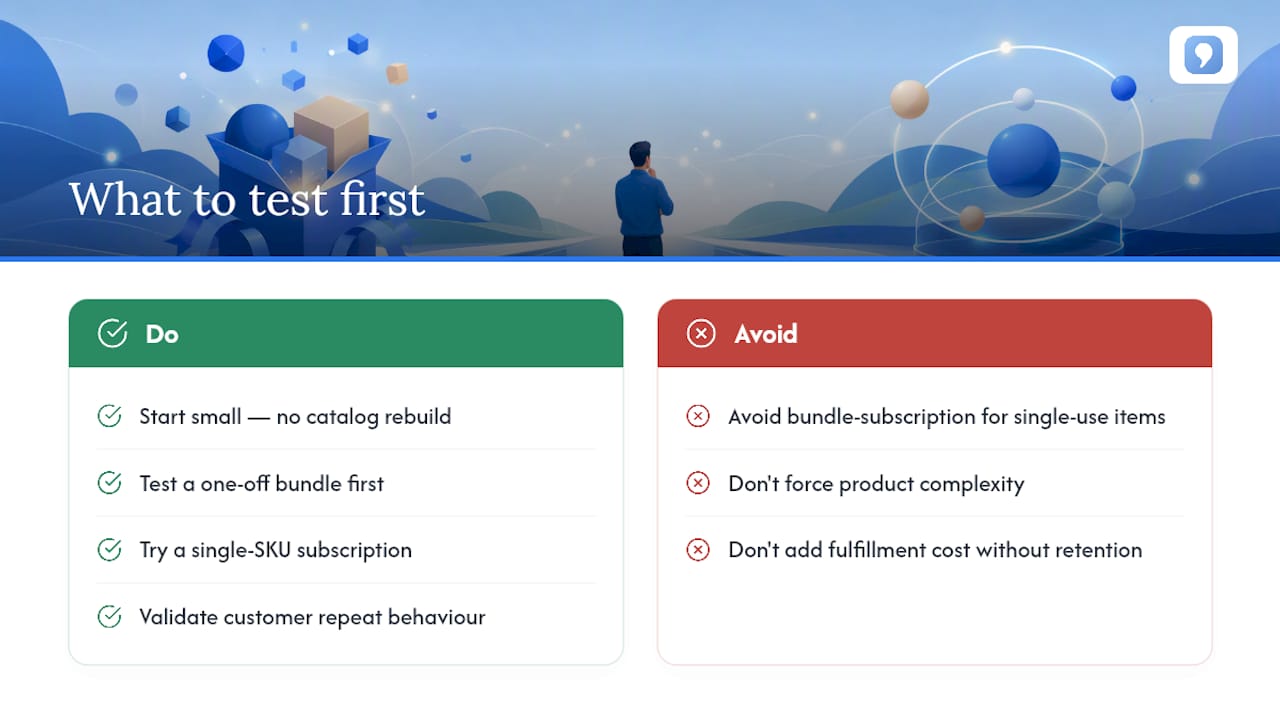
If you're running a small or mid-size store, don't start by rebuilding your whole catalog.
If your product is genuinely single-use or your customers show no repeat pattern, skip the bundle-subscription entirely and test a plain one-off bundle or a single-SKU subscription instead. Forcing complexity onto a product that doesn't need it just adds fulfillment cost with no retention payoff.
— FanBasis
How Commas Supports a Subscription-Bundle Pilot
Running the pilot above usually means stitching together a checkout tool, a billing system, and a funnel builder, three separate logins for one experiment. Some platforms put subscriptions, one-time bundles, and integrated payments into a single dashboard, so your pilot's cadence rules, portal flows, and analytics live in one place instead of three.

If you're testing the subscription-bundle math from this article, start by building the funnel with Vibe Funnels, Commas's AI funnel builder, then connect it to integrated payments so your pilot cohort can subscribe, skip, or swap without a support ticket. Once the pilot proves out, Commas is where you turn it into a full program.
Sources
- Shopify subscription bundling strategies (Talk Shop)
- Build flexible subscription bundles that fit customers (Recurly)
- HBS exposition on subscription revenue models
FAQ
What Is the Best Subscription Bundle Model?
There's no single best model; it depends on whether customers reorder identical items (favor a straight subscription) or a rotating mix (favor a subscription-bundle with per-item cadence control).
Is There a Package That Bundles All Streaming Services Together?
No single official bundle covers every streaming service, though some cable and telecom providers package a handful of services at a discount; most consumers still combine subscriptions individually or through third-party aggregators.
Is There a Service That Combines All Streaming Subscriptions Into One Bill?
Some telecom and device providers offer partial bundling of a few major streaming services on one invoice, but no universal service consolidates every provider, so most bundling happens app by app.
Is There a Netflix Bundle Package?
Netflix has partnered with select telecom and internet providers on regional bundle offers, but availability and included services vary by provider and country, so check with your specific carrier.
How Do I Decide Between a Bundle and a Subscription for My Store?
Choose a bundle when you need a fast AOV lift on a one-time purchase, choose a subscription when reorder behavior is predictable, and choose a subscription-bundle when you want both AOV lift and recurring revenue from the same cart.