

A working affiliate terms and conditions agreement is both a contract and an operating manual, and if it skips commission rules, tracking logic, or a clean termination clause, you will spend more time settling disputes than growing revenue. The template below covers ten clauses, starting with commission structure, tracking and attribution, and termination, since those three cause the most payout fights. Copy-ready snippets are in the templates section further down.
TL;DR:
- Clear attribution and tracking rules, including cookie duration and dispute procedures, are essential to prevent support issues and support accurate payouts.
- Well-defined refund, chargeback, and recurring commission terms are critical to avoid disputes and ensure affiliates understand their residual earnings.
- Public disclosure and strict prohibition of deceptive promotion tactics, including AI content policies, are vital for legal compliance and program integrity.
- Specific notice periods for amendments and clear termination conditions, including immediate causes like fraud, help maintain trust and operational control.
- Using a unified platform for tracking, payout enforcement, and policy updates reduces disputes and minimizes manual management effort.
Table of Contents
- What Should Affiliate Terms and Conditions Include?
- How Do You Structure Commission and Payout Terms?
- What Tracking and Attribution Rules Should You Set?
- What Promotional Conduct and Disclosures Should You Require?
- What Data Privacy Rules Belong in Affiliate Terms?
- How Should You Handle Changes, Suspension, and Termination?
- Copy-Ready Clauses You Can Adapt Right Now
- Running an Affiliate Program at Scale: What Actually Breaks First
- Commas Affiliate Center: Enforce Your Terms Automatically, Not Manually
- Sources
- FAQ
What Should Affiliate Terms and Conditions Include?
An affiliate agreement needs ten clauses to hold up operationally and legally: eligibility, commission structure, tracking and attribution, prohibited conduct, payment terms, intellectual property licensing, data protection, a changes clause, termination, and dispute resolution. Industry guidance built around 14 distinct clauses breaks these into narrower categories to cover legal, fraud, and operational risk separately, but the ten below are the load-bearing walls. Miss one and the gaps show up fast, usually in a support ticket asking why a payment never arrived.
Here's the annotated breakdown, with a note on which items typically live in the public T&C versus a negotiated agreement for larger partners.
- Eligibility and enrollment. Who can apply, what disqualifies an applicant (fraud history, competing programs, no live website), and whether approval is automatic or manual. This stays in the public T&C for nearly everyone; enterprise or "super-affiliate" deals often get a side letter with custom terms.
- Commission structure. The model (CPA, revenue share, CPL, or hybrid), the rate or range, and what counts as a qualifying action. Public T&C for standard tiers; negotiated agreements for volume-based or exclusive rates.
- Tracking and attribution. Cookie duration, attribution logic (last-click vs. a configurable window), and how disputes over a missed conversion get resolved. Always public, because affiliates need this before they'll promote anything.
- Prohibited conduct. Brand bidding, cookie stuffing, incentivized traffic, and other practices that void commissions. Public and non-negotiable.
- Payments. Payout thresholds, schedule, and holds for fraud review. Public for standard rates; negotiated deals sometimes get shorter holds or lower thresholds as a perk.
- IP and license. What creative assets affiliates can use, how your trademarks may be referenced, and where the license terminates. Public, though enterprise partners sometimes negotiate co-branding rights.
- Data protection. Rules for handling customer data, pixel deployment, and consent alignment with privacy law. Public and increasingly detailed given GDPR/CCPA exposure.
- Changes to terms. Notice periods and whether amendments apply retroactively or only going forward. Public, and this is the clause affiliates read most closely once they've built volume.
- Termination. Grounds for termination, notice requirements, and what survives (clawbacks, confidentiality). Public, with immediate-suspension language reserved for fraud.
- Dispute resolution. Governing law, arbitration or litigation venue, and how attribution disagreements get escalated before either side walks away. Public for nearly all programs.
A few drafting choices separate a usable T&C from one that invites arguments. Notice windows matter: a 14-day notice for minor updates versus 30 days for anything that touches commission rates or payment terms gives affiliates enough runway to adjust their campaigns. Prospective-only effect matters even more. If you cut a commission rate, that change should apply to sales made after the effective date, not sales already in the pipeline. Retroactive commission cuts are the fastest way to lose your best affiliates and invite a very public dispute on social media.
Modern programs in 2025 and 2026 also need two clauses that older templates skip entirely: an AI-generated content policy and explicit privacy compliance language, both covered in detail below. Industry guidance on affiliate agreement templates increasingly treats these as standard, not optional.
How Do You Structure Commission and Payout Terms?
Commission structure is the clause affiliates read first and dispute most often, so vague language here creates more support tickets than any other section of the contract. Four models cover almost every program: cost-per-acquisition (CPA), revenue share, cost-per-lead (CPL), and hybrids that blend a flat CPA with a smaller ongoing revenue share.
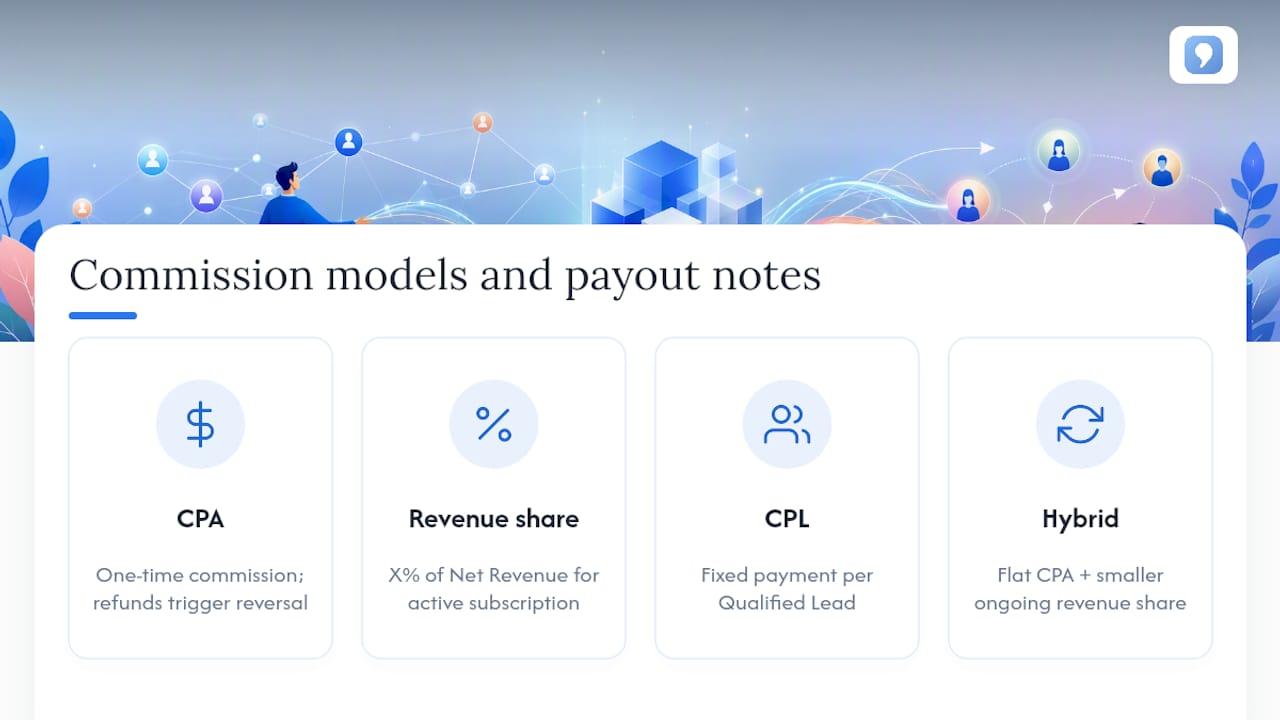
Sample language for a CPA model: "Affiliate earns a one-time commission of [EX] for each Qualified Sale, defined as a completed purchase by a new customer referred through Affiliate's unique tracking link within the Attribution Window, where the customer has not previously purchased from [Company] and the transaction is not refunded within [30] days."
For revenue share on subscriptions: "Affiliate earns [X%] of the Net Revenue collected from each Qualified Customer for the duration of that customer's active subscription, provided the subscription remains in good standing and has not been canceled or refunded."
The words "Qualified Sale" and "Net Revenue" need their own definitions elsewhere in the contract. Net Revenue typically excludes taxes, shipping, and refunded amounts. Qualifying a sale usually requires the customer to complete checkout, not just add an item to a cart, and many programs add a minimum order value to exclude test transactions.
Refunds and chargebacks need explicit handling: "If a Qualified Sale is refunded or charged back within [60] days of the transaction date, the associated commission will be reversed and deducted from Affiliate's next payment." Recurring subscription commissions should state clearly whether they continue for the life of the customer or only for a fixed number of billing cycles, since that single sentence often determines whether an affiliate treats your program as a serious income source or a side hustle.
Payment mechanics close out the clause. Typical payout thresholds run within a standard industry range, with payment cadence on a net-15 or net-30 schedule after a verification hold, often 30 days, to catch fraud and reversals before funds go out. Sample phrasing: "Commissions are paid monthly, net-30, for all Qualified Sales exceeding the [$100] minimum payout threshold, subject to a [30]-day verification hold from the transaction date."
Pro Tip: Set your verification hold to match your own refund window exactly. If customers can request a refund within 30 days, a 15-day hold guarantees you'll be clawing back commissions after they've already been paid out, which is a bad look and an accounting headache.
What Tracking and Attribution Rules Should You Set?
Attribution disputes account for a large share of affiliate support tickets, and most trace back to a contract that never specified which click wins when a customer clicks two different affiliate links before buying. State the cookie duration and attribution model in plain numbers, not vague language like "an appropriate tracking period."

Common windows run 30, 60, or 90 days, and the choice affects affiliate behavior directly. A 30-day window rewards affiliates driving immediate purchase intent (comparison sites, deal aggregators). A 90-day window favors content affiliates whose readers research for weeks before buying. Sample clause: "[Company] uses a 60-day cookie-based attribution window measured from the date of the affiliate's last qualifying click. Attribution follows a last-click model unless otherwise specified in a separate program policy."
Beyond cookies, most modern programs need three additional tracking mechanics spelled out:
- Server-to-server (S2S) postbacks for affiliates who can't rely on browser cookies, especially those running paid traffic where ad blockers or cross-device behavior break cookie tracking.
- Promo code tracking as a fallback attribution method when a customer converts without a working cookie but enters a code tied to a specific affiliate.
- Sub-affiliate rules stating whether affiliates may recruit their own sub-affiliates and how commissions flow through that chain, since unregulated sub-affiliate networks are a common source of policy violations.
The validation and dispute process needs its own short clause, because affiliates will eventually ask why a conversion they're certain happened never showed up in their dashboard: "Affiliate may submit a written attribution dispute within [15] days of the transaction date, including supporting evidence such as the referral URL, timestamp, and customer information. [Company] will investigate and respond within [10] business days."
Reporting expectations round this out. State how often affiliates can pull performance data (real-time dashboard access is standard now), and set a reconciliation window, typically 30 days after month's end, during which either party can flag discrepancies before commissions are considered final. A sample validation clause: "All commission reports become final and non-disputable [30] days after the close of the applicable payment period, except in cases of confirmed fraud." Tools like Vibe Funnels that tie checkout data directly to funnel attribution reduce these disputes before they start, because the conversion and the referral source live in the same system rather than two disconnected platforms.
What Promotional Conduct and Disclosures Should You Require?
Every affiliate program needs an explicit list of prohibited tactics, because "act in good faith" is not enforceable language and will not hold up when an affiliate drains your ad budget bidding on your own brand name. The standard list, drawn from patterns across major affiliate programs, includes:
- Brand bidding. Purchasing paid search ads on the company's own trademarked terms, which usually just cannibalizes organic traffic the company would have gotten for free.
- Cookie stuffing. Forcing tracking cookies onto a visitor's browser without a genuine click or interaction.
- Incentivized traffic. Paying or rewarding users for clicking, signing up, or purchasing, unless the program explicitly permits incentivized tiers.
- Misleading claims. Advertising discounts, features, or guarantees the company doesn't actually offer.
- Spam. Unsolicited email or messaging that violates CAN-SPAM or similar regulations.
Violations across common templates typically void the associated commissions outright and can trigger a payout hold during investigation, which should be stated plainly so affiliates know the stakes before they try something clever.
Disclosure requirements deserve their own paragraph because the FTC treats this as a legal obligation, not a courtesy. The FTC's Endorsement Guides require that any financial relationship be disclosed clearly and conspicuously wherever the consumer will actually encounter it, meaning above the fold in a blog post, in the first line of a video description, or directly on a social post rather than buried in a bio link. Require affiliates to use plain terms like "affiliate link" or "sponsored" rather than vague euphemisms, and state the requirement directly in the contract: "Affiliate must clearly and conspicuously disclose its relationship with [Company] in accordance with FTC guidelines, using language such as 'affiliate link' or 'sponsored,' placed where a reasonable consumer would see it before clicking."
AI-generated content is the newest addition to this clause, and it belongs there for a real reason: programs that stayed silent on AI content in 2024 saw a wave of low-quality, auto-generated review pages designed to farm affiliate clicks without any real product knowledge behind them. A workable AI policy states three things: whether AI-assisted content is permitted at all, that any AI-generated claims about the product must be fact-checked against official material, and that the company reserves the right to remove affiliate content that misrepresents the product regardless of how it was produced. Programs weighing this tradeoff can review how AI-generated content affects SEO performance before deciding how permissive to be.
What Data Privacy Rules Belong in Affiliate Terms?
Affiliates who deploy tracking pixels or handle any customer data need explicit privacy obligations, because a violation on an affiliate's site can still create legal exposure for the program operator whose product was being promoted. This is one of the fastest-growing sections in affiliate contracts industry-wide, driven by GDPR enforcement in the EU and the expanding patchwork of US state privacy laws following CCPA.
Three things belong in this clause at minimum:
- Compliance requirement. Affiliates operating in or targeting the EU or California must maintain their own privacy notice and comply with GDPR or CCPA as applicable, independent of the operator's own compliance.
- Pixel and consent rules. Any tracking pixel the affiliate deploys must align with their site's own consent mechanism; a pixel firing before a visitor accepts cookies is a compliance violation the operator did not create but can still get blamed for.
- Data-sharing limits. Affiliates may not transfer, sell, or share any customer data collected through the program without the customer's consent and the operator's written approval.
Sample language: "Affiliate shall maintain a privacy policy compliant with applicable data protection laws, including GDPR and CCPA where applicable, and shall not deploy tracking technology that collects personal data without appropriate consent mechanisms in place."
Security expectations deserve a line too, even a simple one: "In the event Affiliate experiences a security incident involving data collected in connection with this program, Affiliate shall notify [Company] within [72] hours of discovery." Seventy-two hours mirrors the GDPR's own breach notification standard, so aligning your affiliate contract to that number keeps your obligations consistent up and down the chain rather than creating a shorter internal deadline than the one regulators actually enforce.
How Should You Handle Changes, Suspension, and Termination?
Amendment clauses need a specific number attached to "notice," because "reasonable notice" is not a number and will get argued over the first time you cut a commission rate. A workable formula: 14 days' notice for minor operational updates (creative refreshes, dashboard changes) and 30 days for anything material, meaning commission rate changes, payment term changes, or new prohibited conduct rules. Sample clause: "[Company] may modify these Terms at any time. Material changes affecting commission rates or payment terms will take effect no earlier than [30] days after notice is posted or emailed to Affiliate. All changes apply prospectively only and do not affect commissions already earned."
That last sentence, the prospective-only guarantee, is the single most important line in the entire changes clause for affiliate trust.
Termination splits into two tracks. Termination for convenience lets either party end the relationship with notice, typically 30 days, no cause required. Termination for cause covers contract violations and usually allows immediate termination with no notice period, particularly for fraud, which should trigger immediate suspension rather than waiting out a notice window while the fraudulent traffic keeps running.
- For convenience: Either party may terminate with 30 days' written notice.
- For cause: Immediate termination for fraud, prohibited conduct, or material breach, with no notice required.
- Immediate suspension triggers: Confirmed cookie stuffing, incentivized traffic without authorization, or a pattern of chargebacks exceeding a stated threshold.
What survives termination matters as much as the termination itself. Verification rights (the company can still audit past transactions), clawback rules for commissions tied to since-refunded sales, confidentiality obligations, and indemnities should all explicitly survive. Payout handling after termination should be stated too: earned, verified commissions get paid on the normal schedule even after the relationship ends, but commissions still inside the verification hold remain subject to that hold.
Copy-Ready Clauses You Can Adapt Right Now
Below are seven snippets pulled from the sections above, with bracketed placeholders you can adjust to your own numbers. None of this replaces a lawyer's review for your specific jurisdiction, but it gets you 90% of the way there.
- Commission clause: "Affiliate earns [X%] revenue share / a flat [$X] CPA commission for each Qualified Sale generated through Affiliate's tracking link within the Attribution Window, subject to the refund and chargeback terms below."
- Cookie window clause: "[Company] applies a [30/60/90]-day cookie-based attribution window using a last-click model, unless a different attribution method is specified in the program's operational policy."
- Disclosure requirement: "Affiliate must disclose its relationship with [Company] clearly and conspicuously in every promotional placement, using terms such as 'affiliate link' or 'sponsored,' consistent with FTC guidance."
- Prohibited traffic clause: "Affiliate shall not engage in brand bidding, cookie stuffing, incentivized traffic, or any deceptive promotional practice. Violations result in forfeiture of associated commissions and may result in immediate termination."
- Change clause: "Material changes to commission rates or payment terms require [30] days' notice and apply prospectively only."
- Termination clause: "Either party may terminate this Agreement for convenience with [30] days' notice, or immediately for cause including fraud or material breach."
- Dispute resolution clause: "This Agreement is governed by the laws of [jurisdiction]. Disputes shall first be addressed through good-faith negotiation, and if unresolved within [30] days, submitted to binding arbitration in [location]."
Pro Tip: Keep your numeric defaults consistent across every clause. If your verification hold is 30 days elsewhere in the contract, don't set a 15-day dispute window here. Affiliates notice when the math in a contract doesn't line up, and it undermines trust in every other clause.
The smartest drafting move available is incorporation by reference: keep the core T&C short and stable, then reference separate, more frequently updated documents for things like a Brand Bidding Policy, Creative Asset Guidelines, or a Commission Rate Schedule. A sentence like "Affiliate agrees to comply with [Company]'s Brand Bidding Policy, Creative Guidelines, and Payment Schedule, each as published and updated from time to time at [URL], and incorporated herein by reference" lets you update operational details without forcing every affiliate to re-accept the master agreement each time you tweak a payout threshold.
Running an Affiliate Program at Scale: What Actually Breaks First
A public T&C does three jobs at once: it's the contract, the recruiting pitch, and the fraud-detection baseline all in one document. Affiliate managers who treat it purely as legal boilerplate miss that a clear, plain-language agreement is genuinely persuasive to serious affiliates deciding which programs deserve their traffic.
The monolithic-document approach breaks down first at scale. Referencing separate, frequently updated policies for creatives, brand bidding, and payment schedules lets you tighten enforcement without re-litigating the entire contract with every affiliate every time. Programs relying on a single, rarely-updated T&C tend to fall behind on fraud patterns simply because updating it feels like too much friction.
Enforcement, not clever clauses, is where most programs actually win or lose. A verification hold means nothing without an actual review process behind it, and a reconciliation window is just a suggestion unless someone is checking the numbers against it every month.
— FanBasis
Commas Affiliate Center: Enforce Your Terms Automatically, Not Manually
Writing a clean commission clause solves half the problem. Enforcing it, verifying every conversion, holding payouts during fraud review, and reconciling reports against your own contract, is where most operators lose hours every week to spreadsheets. The Commas Affiliate Center ties affiliate tracking, payout schedules, and commission rules directly to the same checkout your customers actually use, so the attribution window and payment threshold you wrote into your T&C are enforced automatically rather than tracked by hand.

Because a unified platform combines payments, funnel checkout, and affiliate tracking in one account, a sale and its attribution live in the same system instead of two disconnected tools that never quite agree with each other. That closes the gap where most attribution disputes start. Integrated payouts mean affiliates get paid on the schedule your contract actually promises, with holds and thresholds applied consistently instead of manually. If you're rebuilding your affiliate terms and want the enforcement side handled at the same time, request a demo of the Commas Affiliate Center and see how tracking, payouts, and creative controls work against your own commission rules.
Sources
- Affiliate Program Agreement Template: 14 Clauses You Need - iRev
- FTC's Endorsement Guides: What People Are Asking - Federal Trade Commission
- Affiliate Program Terms and Conditions Template 2026 - Track360
- What Should Be Included in an Affiliate Agreement? - Post Affiliate Pro
FAQ
What Are Some Examples of Terms and Conditions in an Affiliate Contract?
Common examples include a commission clause defining how much affiliates earn per sale, a cookie-window clause stating how long a referral is tracked (typically 30 to 90 days), a prohibited-conduct clause banning brand bidding and cookie stuffing, and a termination clause covering notice periods and immediate suspension for fraud.
What Are Affiliate Rules?
Affiliate rules are the specific do's and don'ts governing how partners can promote a product, covering allowed marketing channels, required disclosures, and banned tactics like incentivized clicks or misleading claims. They also cover technical rules like tracking method and attribution window, since those determine how and when an affiliate actually gets credited for a sale.
What Is the 80/20 Rule in Affiliate Marketing?
The 80/20 rule describes the common pattern where roughly 80% of an affiliate program's revenue comes from about 20% of its affiliates, often called super-affiliates. This is why many programs maintain a public T&C for standard affiliates and a separately negotiated agreement for top performers who need different rates, exclusivity, or payout terms.
Can You Provide an Example of an Affiliate Agreement?
A basic affiliate agreement includes eligibility criteria, a commission structure (for example, 20% revenue share on qualifying sales), a defined cookie attribution window, a list of prohibited promotional tactics, a payment schedule with a minimum payout threshold, and termination terms. The copy-ready snippets earlier in this article cover each of these in adaptable language.
Does Commas Provide Affiliate Management Tools?
Yes. The Commas Affiliate Center handles tracking, payout scheduling, and partner management within the same platform used for payments and checkout, which keeps attribution and commission enforcement tied to actual transaction data rather than a separate system.