

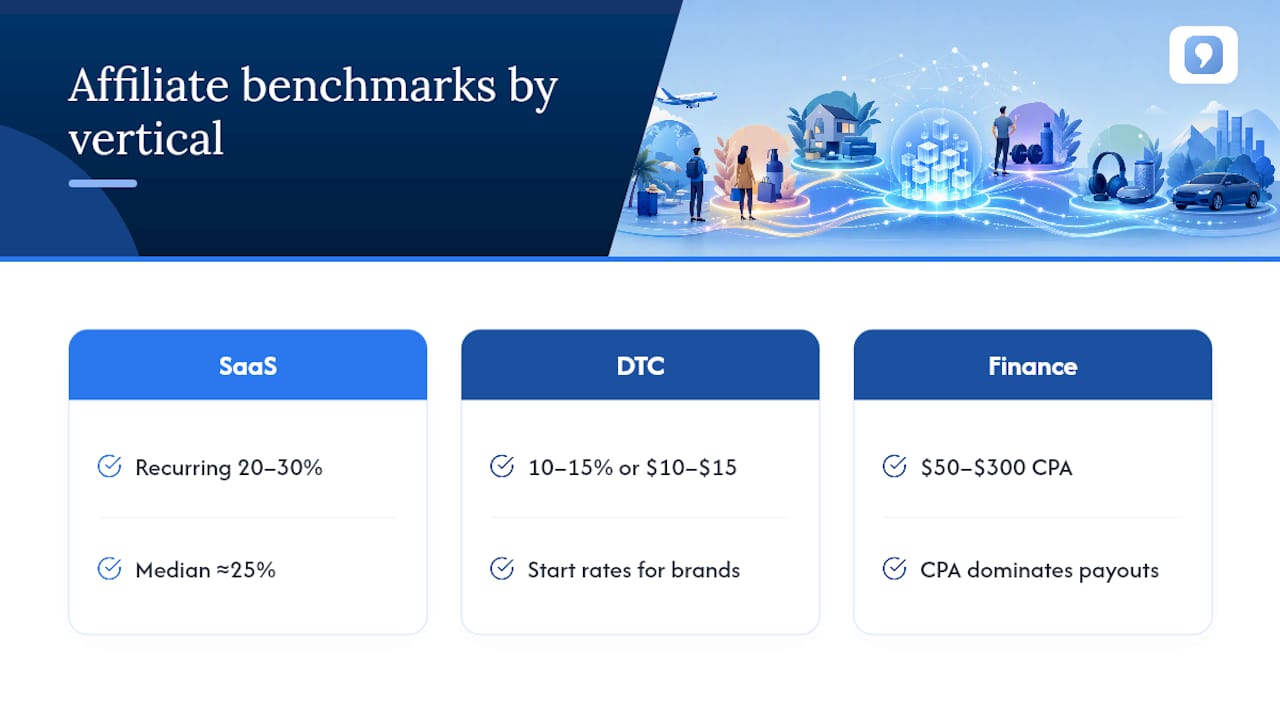
Most programs should anchor to vertical norms, not gut feeling: SaaS commonly runs 20 to 30% recurring. E-commerce sits at 5 to 15% per sale, and finance or hosting often pays flat CPA bounties of $50 to $300. The number that actually matters isn't the percentage on your landing page. It's the dollar amount per conversion and whether that payout survives contact with your margins over the next 12 months.
TL;DR:
- Recurring commissions are standard in SaaS and often outperform one-time payouts over time, especially for high-retention customers.
- Industry benchmarks show SaaS paying around 20 to 30% recurring, while finance and iGaming programs offer $50 to $400 CPA or 25 to 45% revenue share.
- Calculating an affordable commission depends on gross margin or projected lifetime value, with practical caps typically 12 to 24 months for recurring models.
- Tiered structures, bonuses, and caps should be carefully designed and tested through pilots to optimize affiliate motivation without risking margins.
- Cookie windows vary by industry, with short-term durations in e-commerce and longer in SaaS, impacting attributions and affiliate payouts.
Table of Contents
- What Are Typical Affiliate Commission Rates, and Which Model Fits Your Business?
- Affiliate Commission Rate Benchmarks by Industry
- How Do You Calculate an Affordable Affiliate Commission Rate?
- How Should You Structure Tiers, Bonuses, and Caps?
- How Do Cookie Windows and Fraud Checks Affect Real Payout Value?
- How Commas Supports Recurring Commissions and Clean Attribution
- Common Pitfalls When Setting Commission Rates
- A Program Manager's Perspective on Getting This Right
- Get Your Affiliate Program Running on One Platform
- Sources
- FAQ
What Are Typical Affiliate Commission Rates, and Which Model Fits Your Business?
Every commission structure boils down to five basic shapes, and picking the wrong one is how programs quietly bleed margin for years without anyone noticing.
Flat percentage of sale. The affiliate gets a fixed cut of whatever the customer pays, once, per transaction. This works well for products with a stable, predictable margin, where you can afford to give away a slice without recalculating every quarter. A skincare brand paying 15% on every order is a clean example: simple to explain, simple to audit.
Cost per action (CPA). A fixed dollar payout per qualifying action, regardless of order size. CPA thrives in verticals with high customer value but murky per-sale economics, like finance, insurance, or online gambling, where a "sale" might mean a funded account rather than a purchase. Finance CPA often lands within a broad typical range per lead depending on the product's underwriting value.
Revenue share (revshare). The affiliate earns a percentage of revenue the customer generates over time, not just at first purchase. iGaming built its entire affiliate economy on this model because player lifetime value can stretch for years, and a one-time bounty would badly undervalue a loyal player.
Hybrid (CPA plus revshare). A guaranteed upfront payment plus an ongoing cut. This gives affiliates cash flow while still rewarding them for quality traffic that sticks around, and it's increasingly common in regulated verticals where affiliate costs need to be predictable for budgeting purposes.
Recurring commission. Common in SaaS, this pays the affiliate a percentage of the customer's subscription for as long as that customer stays active, sometimes capped at 12 or 24 months, sometimes uncapped. It rewards affiliates who bring in customers who don't churn, which is exactly the incentive most subscription businesses want to create.
A few operational details change the real value of any model:
- Refund windows can claw back a commission after it's already paid, so payout timing usually lags 30 to 60 days behind the sale.
- Qualification rules (minimum order value, new customer only) determine whether a sale counts at all.
- Payout schedules (net 30, net 60) affect affiliate cash flow and, indirectly, how hard they promote you.
Affiliate Commission Rate Benchmarks by Industry
Rates vary enormously by vertical, and the spread exists for a reason: margin structure, customer lifetime value, and regulatory overhead differ so much between a SaaS tool and an online casino that comparing their percentages directly is close to meaningless.
SaaS and software. Recurring commissions of 20 to 30% are standard, with a median around 25%, according to Track360's 2026 benchmark analysis of cross-program data. Because software margins are high and churn is the real cost driver, most SaaS programs would rather pay a generous ongoing percentage than a large one-time bounty.
Shopify's own affiliate commission guide recommends direct-to-consumer brands start around 10 to 15%, or a flat $10 to $15 per new customer order, then reserve higher tiers for top performers.
Finance and lending. CPA dominates here, typically $50 to $300 per funded lead or account, reflecting the high value of a single approved customer and the compliance overhead of regulated financial products.
iGaming and crypto. This is where numbers get large. Track360 reports Tier 1 iGaming CPA ranging from $150 to $400 per depositing player, with revenue share running 25 to 45% of net gaming revenue. Crypto affiliate programs often mirror this structure, paying either a significant CPA per funded trading account or a lasting revshare on trading fees.
Marketplaces. Amazon Associates sits at the low end deliberately. Its published commission schedule fixes rates by category, often in the 1 to 10% range, because marketplace margins are thin and volume is the entire strategy.
Statistic Callout: Across sampled programs, SaaSGoodies reports a median commission rate near 20%, but it stresses that headline percentage matters far less than whether the payout is recurring. A 15% recurring commission on a $50 monthly subscription can out earn a 40% one-time bounty within five months, if the customer stays.
Variance across these ranges comes down to three drivers: how competitive the affiliate market is for that vertical, how much margin the product actually carries, and how much regulatory or compliance cost sits behind each conversion. Hybrid setups, like a $75 CPA plus 10% ongoing revshare, are becoming more common precisely because they let a brand balance affiliate cash flow against long-term customer value instead of betting everything on one number.
How Do You Calculate an Affordable Affiliate Commission Rate?
Start with margin, not with what competitors advertise. The core formula is:
Maximum Affordable Commission = Target Margin Share × Gross Margin
Or, for subscription businesses, calculate it against projected lifetime value instead of a single transaction:
Maximum Affordable Commission = (Projected LTV × Acceptable CAC Ratio) − Other Acquisition Costs
Shopify's guidance frames this as a margin-first exercise: figure out how much of your gross margin you can allocate to acquisition while still hitting your CAC targets, then convert that budget into a percentage or flat rate.
Two worked examples make this concrete:
- Physical product, low margin. A $60 order with 35% gross margin generates $21 in margin dollars. If you're willing to spend 40% of that margin on acquisition, your affordable commission tops out around $8.40, or 14% of the sale, roughly matching the e-commerce norm.
- SaaS subscription. A $50 monthly plan with 80% gross margin and an average customer lifespan of 18 months generates roughly $720 in lifetime gross margin. Allocating 25% of that to acquisition allows a recurring commission near $10 a month for the customer's active life, which lands close to a 20% recurring rate.
| Scenario | Order/Plan Value | Gross Margin | Affordable Commission Share | Resulting Rate |
|---|---|---|---|---|
| Physical product | $60 one time | 35% | 40% of margin | ~14% per sale |
| SaaS subscription | $50 monthly | 80% | 25% of margin | ~20% recurring |
Two variables can quietly wreck this math. And churn does the same thing to SaaS: if customers only stay 8 months instead of 18, the lifetime margin pool shrinks by more than half, which is why smart programs often cap recurring commissions at 12 or 24 months rather than paying forever.
How Should You Structure Tiers, Bonuses, and Caps?
A flat rate for every affiliate treats your best partner the same as someone who sends one unqualified click a month, which is a fast way to demotivate the people actually driving revenue.
This rewards volume without requiring you to renegotiate every contract individually.
New customer bias. Most brands pay a higher rate, or an exclusive bonus, for first-time customers versus returning ones. Shopify's data shows this is deliberate: returning-customer purchases often happen with or without the affiliate's influence, so paying full commission on repeat orders overpays for demand that already existed.
Bonus mechanics. Milestone bonuses ($200 for the first 50 sales in a month) and seasonal boosters (a temporary rate bump during a launch window) push affiliates to concentrate effort when it matters most to you.
Caps and clawbacks. Caps limit total payout exposure on a single mega-affiliate; clawback rules pull commission back if a sale later gets refunded or charged back.
- Set tier thresholds around your actual affiliate distribution, not round numbers that sound good in a deck.
- Document new-customer definitions precisely (same email, same payment method, lookback window) to avoid disputes.
- Cap uncapped recurring commissions at a defined term unless lifetime value data justifies paying indefinitely.
Pro Tip: Run new tier structures as a pilot with your top 10 affiliates before rolling them out program-wide. You'll catch pricing mistakes before they cost you across a thousand partners instead of ten.
How Do Cookie Windows and Fraud Checks Affect Real Payout Value?
The cookie window, the length of time a click stays credited to an affiliate, often changes program economics more than a few points of commission ever will. Track360's benchmark data shows SaaS programs commonly running 30 to 90 day windows, while e-commerce leans shorter, often 7 to 30 days, matching typical purchase decision speed.
Longer windows favor affiliates and can inflate your attributed conversions beyond what the affiliate actually influenced. Shorter windows protect margin but can frustrate partners driving upper-funnel awareness rather than instant clicks. Privacy frameworks are tightening this further: consent requirements under frameworks like the Transparency and Consent standard tracked by Microsoft Clarity can limit how long tracking cookies legally persist, which is pushing more programs toward server-side or first-party attribution instead of long browser cookie windows.
Qualification rules matter just as much as window length:
- Minimum order value thresholds prevent commissions on trivial purchases that don't cover the payout cost.
- New-customer-only verification stops affiliates from "recycling" existing customers through tracking links.
- Refund and chargeback policies should be written down and shared with affiliates before launch, not discovered mid-dispute.
Report payouts on a predictable cadence, monthly is standard, and treat contractor classification seriously. U.S. wage-and-hour guidance from the Department of Labor is worth a look if your affiliates are structured closer to employees than independent partners, since misclassification risk is real even in a purely commission-based relationship.
How Commas Supports Recurring Commissions and Clean Attribution
Running the model and benchmarks above by hand, spreadsheets for tiers, a separate tool for tracking, another for payouts, is how most programs accumulate operational debt within the first year.
Commas' Affiliate Center is built to handle tiered rates, recurring commission tracking, and payout rules inside one dashboard, so the affordability math from the earlier section translates directly into a working program rather than a static policy document. A few features map directly onto the needs covered above:
- Native tracking and attribution remove the guesswork around cookie windows and qualification rules discussed earlier.
- Built-in payout infrastructure through Commas Payments handles multi-currency payouts, which matters once affiliates are recruited globally.
- Funnel tools inside Vibe Funnels let you see which affiliate traffic actually converts, so tier thresholds can be based on real LTV data rather than raw click counts.
- One unified account means commission rules, product delivery, and payment processing don't live in three disconnected systems that drift out of sync over time.
For programs scaling past a handful of partners, that consolidation is less a convenience and more a defense against the reporting errors that show up when tracking, payments, and product delivery run on separate platforms.
Common Pitfalls When Setting Commission Rates
The single most common mistake is anchoring on a competitor's advertised rate instead of your own margin.
The second is ignoring refund and churn risk when the rate is set. A rate that looks sustainable on paper falls apart once real-world refund rates or subscription churn eat into the margin pool it was calculated against.
Third, many programs launch with a single flat rate and never revisit it. Affiliate markets shift, competitors adjust, and a rate that was competitive eighteen months ago can quietly become uncompetitive or, worse, unaffordable as your own margins change.
Fourth, unclear new-customer definitions create disputes that damage affiliate trust faster than almost anything else. If "new customer" isn't documented precisely, expect arguments over every disputed sale.
Finally, overly aggressive caps or clawback policies, applied without warning, can push your best affiliates toward competitors. Rate structure is a negotiation with your most valuable partners, not a policy you impose and forget.
A Program Manager's Perspective on Getting This Right
The instinct to lead with a big headline percentage is understandable and almost always wrong. The programs that last are the ones that treat commission rate as a margin decision first and a marketing decision second.
If there's one thing worth prioritizing above everything else in this article, it's running a limited pilot before locking in a permanent rate. Test two or three rate structures with a small affiliate cohort, watch earnings per click and, critically, watch churn among the customers those affiliates bring in. A rate that produces great short-term signups but terrible retention isn't a win, it's a delayed loss.
Attribution clarity matters nearly as much as the rate itself. A generous commission on a broken tracking setup pays out for sales you didn't actually earn.
— FanBasis
Get Your Affiliate Program Running on One Platform
Commas gives you recurring commission tracking, tiered payouts, and multi-currency payment processing in the same dashboard where you already manage funnels and product delivery, so the affordability math from this article turns into a running program instead of a spreadsheet you have to maintain by hand.

The Affiliate Center handles tier structures, new-customer rules, and recurring payout schedules without a separate tracking tool bolted on, while Commas Payments settles affiliate earnings across currencies without a second vendor in the loop. If you're recruiting affiliates for the first time, pairing this with tools like BabyLoveGrowth's affiliate growth resources can help you find partners worth structuring a program around in the first place. Set up your commission tiers and start tracking your first affiliate cohort inside Commas today.
Sources
The vertical ranges and medians in this article draw primarily from Track360's 2026 affiliate benchmark report, SaaSGoodies' commission rate statistics, Shopify's affiliate commission guide, and Amazon's published commission income schedule. Cross-reference these directly if you need category-level detail beyond what's covered here.
- Affiliate Commission Rates Benchmark 2026: All Verticals
- Affiliate Commission Guide: Structures + Industry Benchmarks (2026) - Shopify
FAQ
What Is a Good Affiliate Commission Rate to Start With?
It depends entirely on your vertical and margin, but SaaS programs commonly start around 20% recurring while e-commerce brands often begin near 10 to 15% per sale, per Shopify's guidance. Calculate your affordable ceiling using gross margin first, then compare that number against vertical benchmarks rather than picking a rate off a competitor's page.
Is a Recurring Commission Better Than a One-Time Bounty?
Recurring commissions tend to earn affiliates more over time when customer retention is strong, since the payout compounds with every renewal instead of ending at the first sale. SaaSGoodies' data notes that dollar value and durability matter more to serious affiliates than the headline percentage.
How Long Should My Affiliate Cookie Window Be?
Cookie windows commonly range from 7 to 30 days in e-commerce and 30 to 90 days in SaaS, based on typical purchase decision timelines noted in Track360's benchmark data. Shorter windows protect margin, while longer ones favor affiliates driving early-funnel awareness.
Should New Customers and Returning Customers Get the Same Commission?
Most programs pay a higher rate or a bonus for new customer sales, since returning purchases often happen with or without affiliate influence. This structure, recommended in Shopify's affiliate guide, keeps commission spend focused on incremental revenue rather than repeat demand you'd have captured anyway.
Can Commas Manage Tiered and Recurring Commission Structures?
Yes. The Commas Affiliate Center handles tiered rates, recurring commission tracking, and payout scheduling in the same account used for funnels and payment processing. Pricing details are available on the Commas site.